More Than A Clean Room
The phrase hospital-acquired infection, or HAI, describes an infection that develops during or soon after a person receives care. Some…
The phrase hospital-acquired infection, or HAI, describes an infection that develops during or soon after a person receives care. Some…
When you walk into a hospital, you see the doctors and nurses. You notice the monitors, the uniforms, the bright…
When hospital leaders see Hospital-Acquired Infections climb, the response is predictable. Leadership calls a meeting, clinical educators refresh hand hygiene…
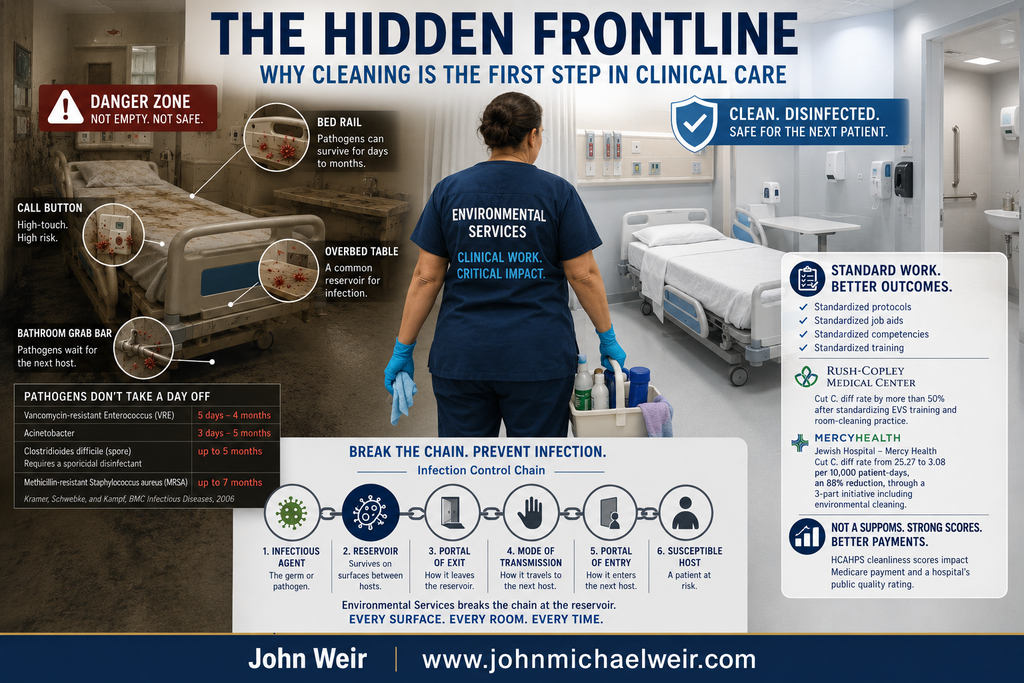
The Hidden Frontline: Why Cleaning is the First Step in Clinical Care Intervention: an action taken to prevent, treat, or…
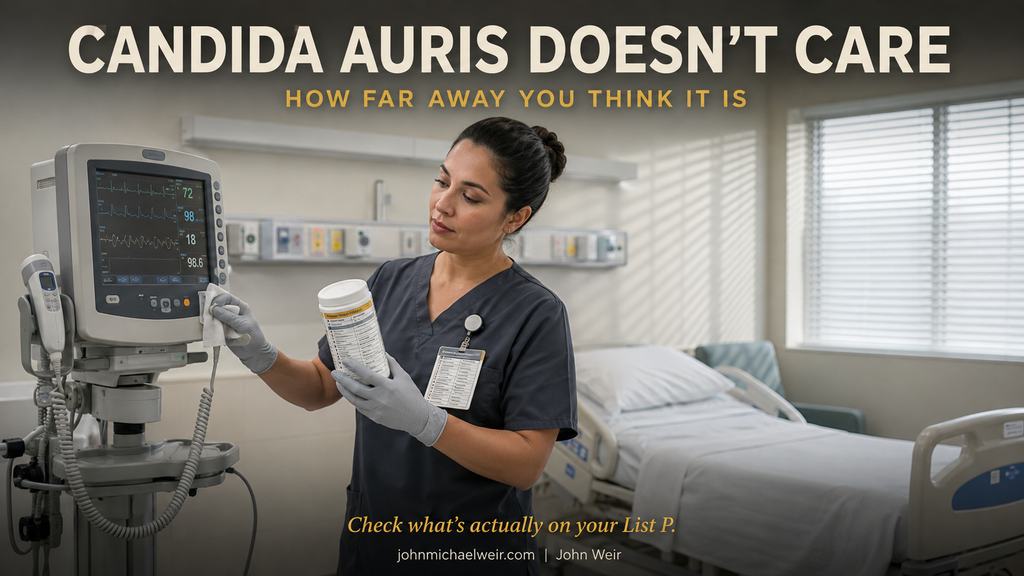
King County Washington. In January 2024, Washington State confirmed its first locally acquired cases of Candida auris there, traced to…
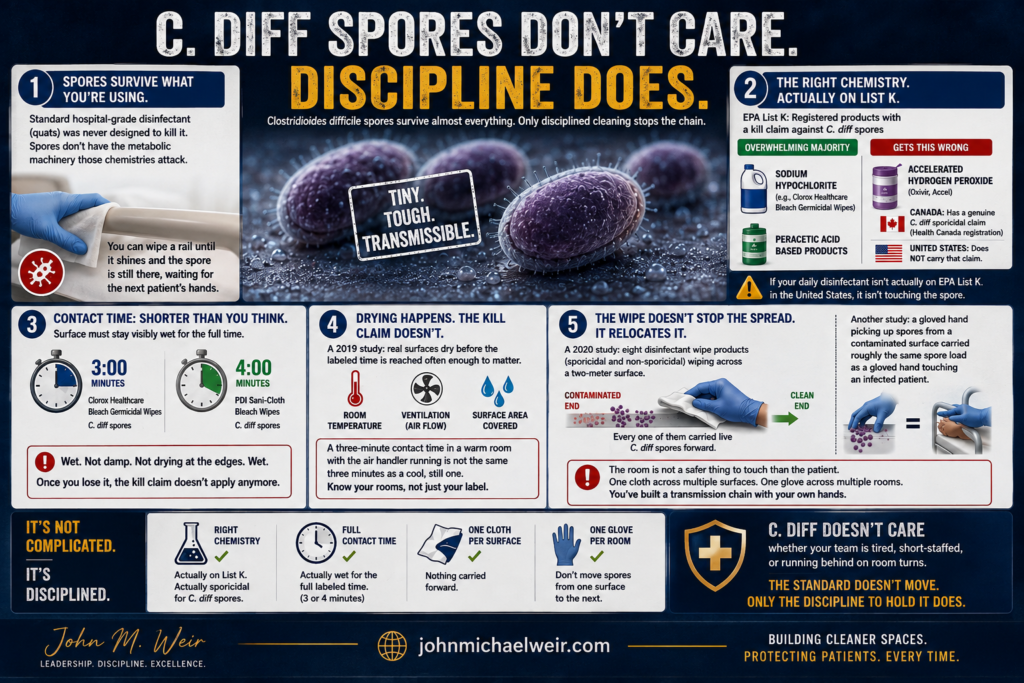
Clostridioides difficile forms a spore that survives almost everything you’re using to disinfect a room. Standard hospital-grade disinfectant, the quaternary ammonium product most departments use every day, was never designed to kill it. Spores don’t have the metabolic machinery those chemistries attack. You can wipe a rail until it shines and the spore is still there, waiting for the next patient’s hands.
Sodium hypochlorite (Clorox Healthcare Bleach Germicidal Wipes) and peracetic acid-based products make up the overwhelming majority of EPA List K, the actual registered list of products with a kill claim against C. diff spores. Here’s the detail some training materials get wrong: the accelerated hydrogen peroxide products a lot of departments already stock for daily disinfection, the Oxivir and Accel lines, do carry a genuine C. diff sporicidal claim in Canada under Health Canada registration. They do not carry that claim here. If your daily disinfectant isn’t actually on EPA List K in the United States, it isn’t touching the spore, no matter how hospital-grade the label says it is.
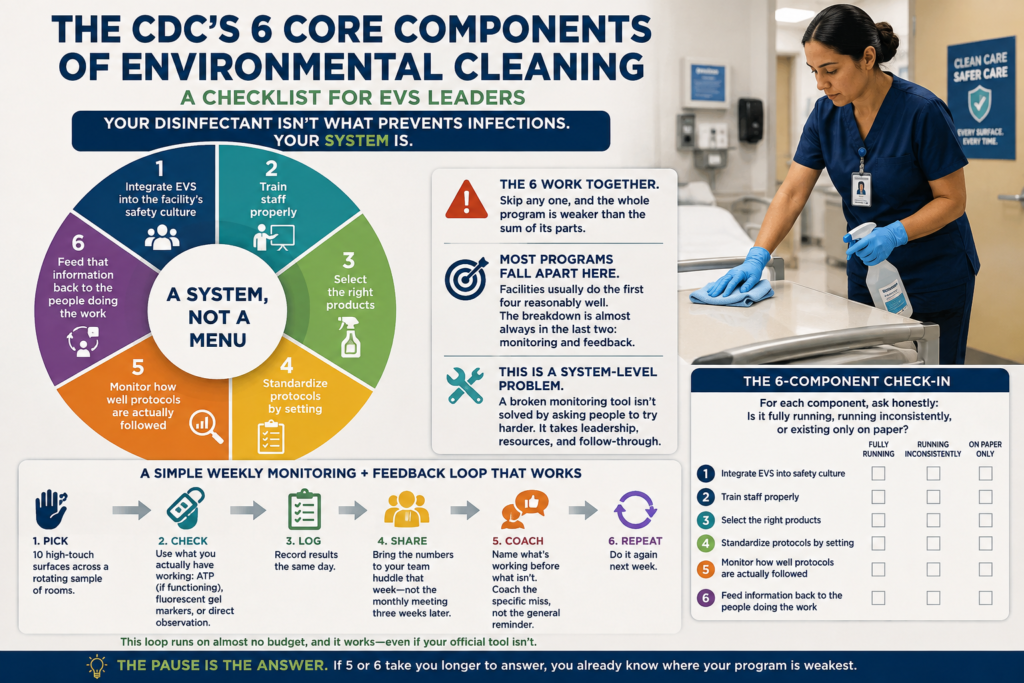
If you work in EVS leadership and have not looked into the CHESP, the CMIP, or the T-CNACC, start. Not for the credential. For what the learning does to how you see your own work.
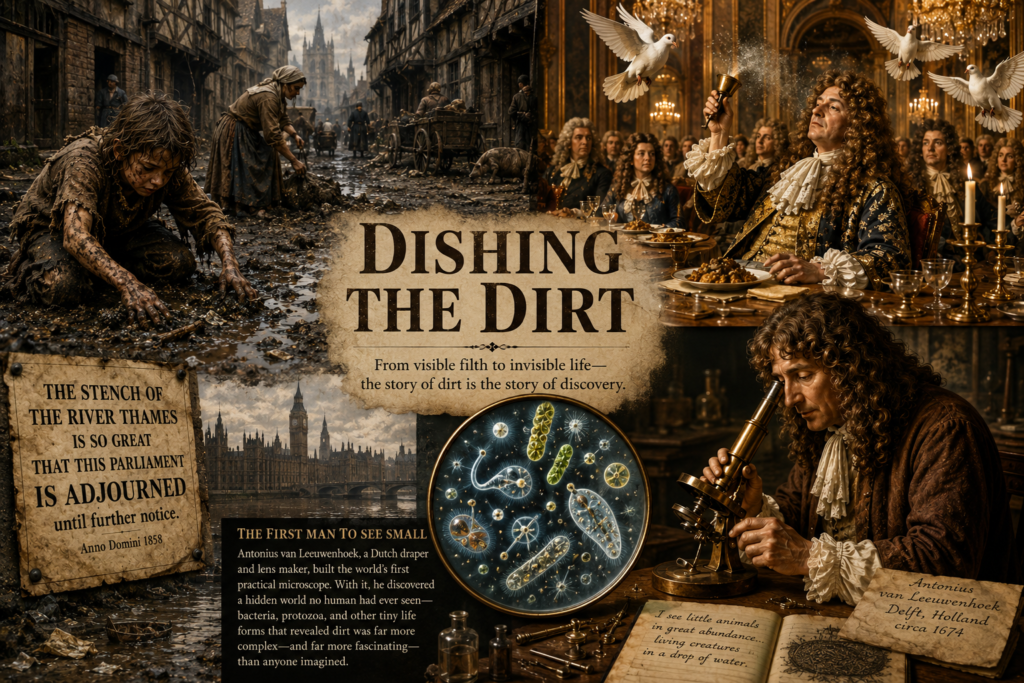
Tom Brokaw didn’t mention it. It wasn’t on Time magazine’s list of the most significant events of the twentieth century. But at least once every millennium, there ought to be a serious discussion about dirt. It has always been around, and as society has progressed, so has the nature of the dirt that surrounds us.
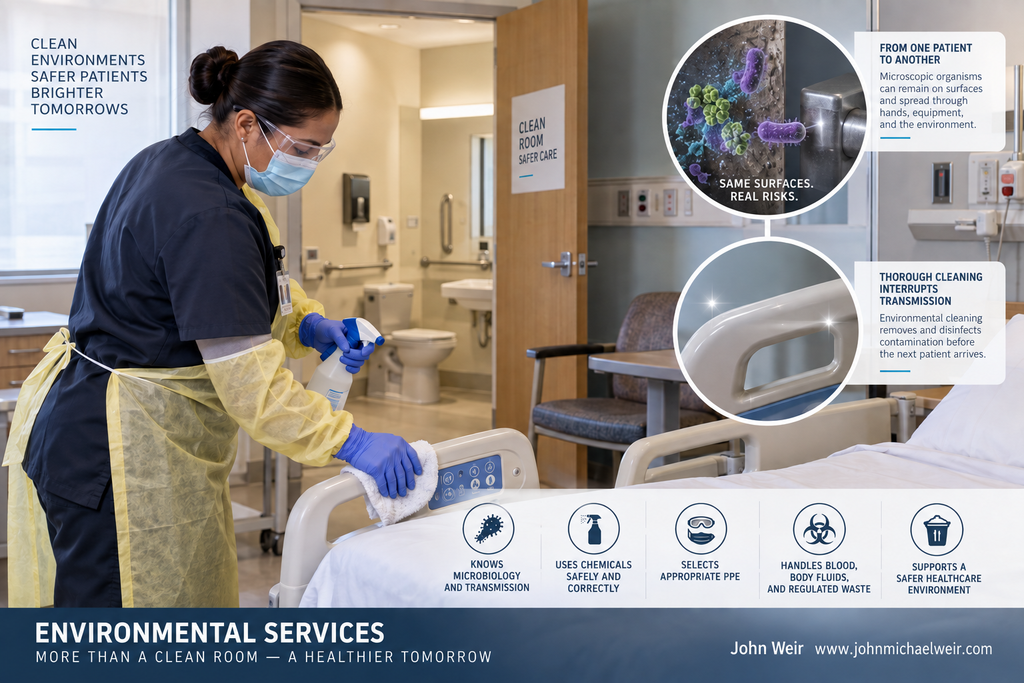
When you think of the word “clean,” you might picture a sparkling kitchen counter. But in a hospital operating room, “clean” is a term of microscopic precision, where the stakes are infinitely higher. For the highly trained Environmental Services (EVS) technicians responsible for this environment, cleaning is not about tidiness—it is a critical, non-negotiable component of patient safety.
Analogy for Understanding: Think of Candida auris like a “microscopic ghost.” Long after a patient has been discharged, the fungus remains haunting the surfaces of the room. Using standard cleaners is like dusting the furniture while the ghost remains; only periodic interventions like this will truly clear the space for the next patient.
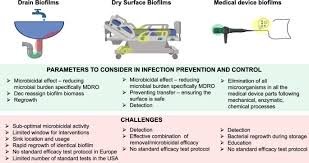
Biofilm is a common but often overlooked challenge in healthcare settings, where it can increase the risk of infections. Understanding what biofilm is, how to recognize it, and how to remove it effectively is essential for healthcare environmental services staff.