
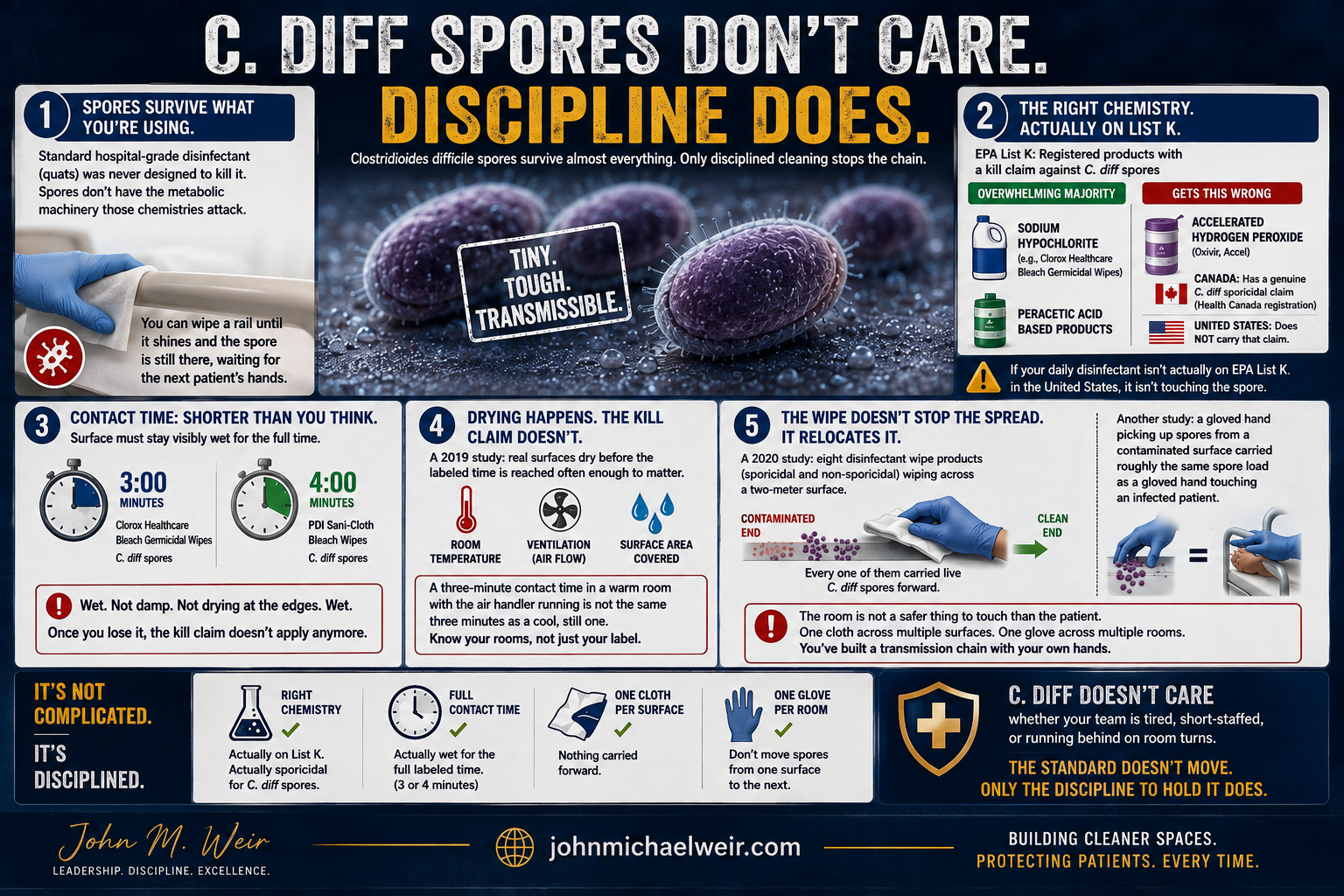
Clostridioides difficile forms a spore that survives almost everything you’re using to disinfect a room. Standard hospital-grade disinfectant, the quaternary ammonium product most departments use every day, was never designed to kill it. Spores don’t have the metabolic machinery those chemistries attack. You can wipe a rail until it shines and the spore is still there, waiting for the next patient’s hands.
Sodium hypochlorite (Clorox Healthcare Bleach Germicidal Wipes) and peracetic acid-based products make up the overwhelming majority of EPA List K, the actual registered list of products with a kill claim against C. diff spores. Here’s the detail some training materials get wrong: the accelerated hydrogen peroxide products a lot of departments already stock for daily disinfection, the Oxivir and Accel lines, do carry a genuine C. diff sporicidal claim in Canada under Health Canada registration. They do not carry that claim here. If your daily disinfectant isn’t actually on EPA List K in the United States, it isn’t touching the spore, no matter how hospital-grade the label says it is.
Contact time is where this falls apart in practice, and the real labeled numbers are shorter than most people assume, not longer. Clorox Healthcare Bleach Germicidal Wipes carry a three-minute labeled contact time for C. diff spores. PDI Sani-Cloth Bleach Wipes carry four minutes. Three or four minutes of a surface staying visibly wet, not damp, not drying at the edges, wet, is the actual threshold you need to reach. That isn’t a long time to hold. It’s also not a hard time to lose, and once you lose it, the kill claim doesn’t apply anymore.
Losing it isn’t usually a training failure either. A 2019 study on wet contact time found that real surfaces dry before the labeled time is reached often enough to matter on its own, driven by room temperature, ventilation, and how much surface area one application actually covers, not just staff moving too fast. A three-minute contact time in a warm room with the air handler running is not the same three minutes as a cool, still one. Know your rooms, not just your label.
The other failure point is the cloth in your hand. A 2020 study tested eight disinfectant wipe products, sporicidal and non-sporicidal alike, wiping across a two-meter surface. Every one of them carried live C. diff spores forward from the contaminated end to the clean end. The wipe doesn’t stop the spread. It relocates it. A separate study found that a gloved hand touching a contaminated surface picked up roughly the same spore load as a gloved hand touching an infected patient directly. The room is not a safer thing to touch than the patient. One cloth working across multiple surfaces, one glove working across multiple rooms, and you’ve built a transmission chain with your own hands.
None of this is complicated. It’s disciplined. The right chemistry, actually on List K, actually wet for the full labeled time, one cloth per surface with nothing carried forward. C. diff doesn’t care whether your team is tired, short-staffed, or running behind on room turns. The standard doesn’t move. Only the discipline to hold it does.
#Cdiff #EVS #EVSLeadership #Education
References:
Nkemngong CA, Chaggar GK, Li X, Teska PJ, Oliver HF. (2020). Disinfectant wipes transfer Clostridioides difficile spores from contaminated surfaces to uncontaminated surfaces during the disinfection process. Antimicrobial Resistance & Infection Control, 9, 176. https://doi.org/10.1186/s13756-020-00844-0
Guerrero DM, Nerandzic MM, Jury LA, Jinno S, Chang S, Donskey CJ. (2012). Acquisition of spores on gloved hands after contact with the skin of patients with Clostridium difficile infection and with environmental surfaces in their rooms. American Journal of Infection Control, 40(6), 556-558.
Teska PJ, Li X, Gauthier J. (2019). Wet contact time directly impacts antimicrobial efficacy of Environmental Protection Agency-registered disinfectants. American Journal of Infection Control, 47(4), 474.
U.S. Environmental Protection Agency. List K: EPA’s Registered Antimicrobial Products Effective Against Clostridioides difficile Spores. epa.gov/pesticide-registration
Clorox Healthcare Bleach Germicidal Wipes, EPA Registration No. 67619-12. Three-minute labeled contact time for Clostridium difficile spores.
PDI Sani-Cloth Bleach Wipes, EPA Registration No. 9480-8. Four-minute labeled contact time for Clostridium difficile spores.
