
Originally written in 2009. Updated for 2026.
Tom Brokaw didn’t mention it. It wasn’t on Time magazine’s list of the most significant events of the twentieth century. But at least once every millennium, there ought to be a serious discussion about dirt. It has always been around, and as society has progressed, so has the nature of the dirt that surrounds us.
For early humans, dirt, scum, and sludge were a big part of daily life. People lived in hovels. Beds were often nothing more than rubbish heaps or piles of leaves and straw. Clothing typically consisted of vermin-infested rags. Worms were everywhere, in food, in beds, in clothing, and even inside the human body.
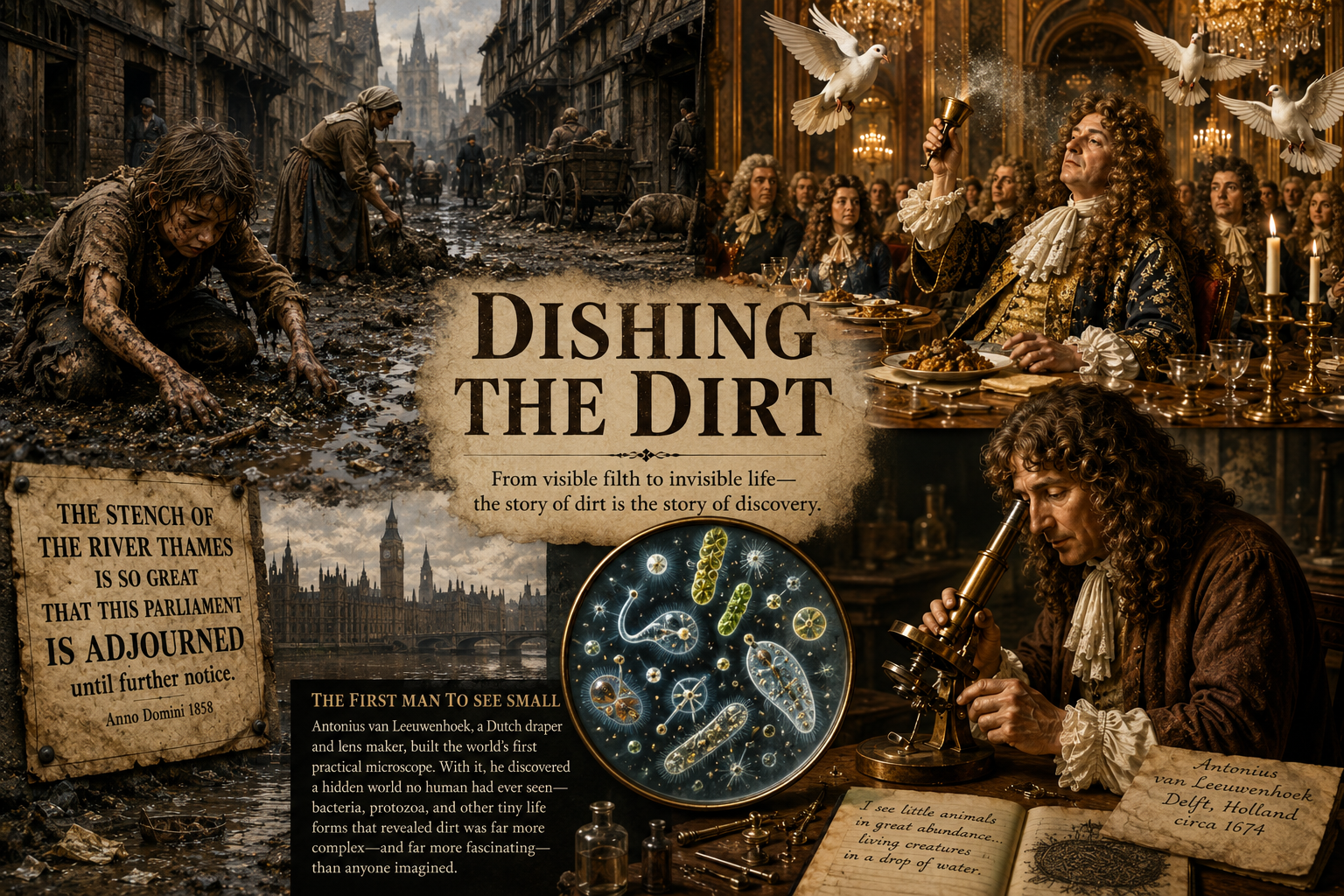
Royalty wasn’t much better off than the commoners. In the court of Louis XIV, people smelled so bad that doves were drenched in perfume and released to fly throughout the hall during dinner parties. The flapping wings served as a crude form of air freshener. In London during the 1600s, the stench of the polluted River Thames even forced Parliament to adjourn. Dirt in the Middle Ages was large, easy to see, easy to step in, easy to throw out
The First Man to See Small
During this period, a Dutchman discovered there was much more to dirt than what the naked eye could see. Antonius van Leeuwenhoek was a draper by trade, a cloth merchant in Delft who had a side obsession: polishing lenses. His workshop technique for grinding glass was so refined that he eventually produced a magnifying instrument capable of enlarging objects up to 270 times. By modern standards it was crude. By any standard of his era, it was miraculous. He had built the world’s first practical microscope.
With it, van Leeuwenhoek saw something no human had ever seen: a universe of microorganisms invisible to the naked eye. Bacteria. Protozoa. The living, teeming world hiding in a drop of pond water or scraped from a human tooth. Dirt, it turned out, was much, much smaller than anyone had imagined.
The War on What We Can’t See
As science advanced, humanity connected these smaller organisms to illness and death. People began cleaning up their personal environments. Sterilization, antiseptic procedures, and proper hand hygiene transformed public health. Later, inventions like the washing machine, the upright vacuum, and the safety razor improved personal cleanliness. Life expectancy climbed. Cities stopped killing their own residents.
Yet while the domestic environment improved, the Industrial Revolution introduced dirt of its own. Coal mining, large-scale manufacturing, grinding, purifying, and chemical processes added new contaminants to air and water. By the 1970s, the U.S. government had formally declared war on environmental pollution, debating and regulating everything from auto emissions to factory smokestacks.
Acronyms like EPA (Environmental Protection Agency) and IAQ (Indoor Air Quality) signal that society has reached a point of understanding: what we cannot see, smell, or taste can, in fact, hurt us. Worms and sludge are no longer the focal points of our cleaning efforts. Now we measure particle counts, colony-forming units, and bacterial loads. Dirt keeps getting smaller.
Two Kinds of Dust
The more we learn about the physical world, the more we understand that the universe is essentially made of dust. On Earth, dust comes from everywhere: minerals, seeds, insects, pollen, skin cells, bacteria. But most of what we deal with in the built environment breaks down into two categories: dust we remove, and dust we apply.
The dust we apply includes air fresheners, disinfectants, floor finishes, and furniture polish. We apply chemistry to floors to make them resilient. We apply chemistry to surfaces to eliminate pathogens. Ideally, the dust we apply is safer and healthier than the dust we are trying to eliminate.
The dust we remove is increasingly the dangerous kind.
The Invisible Threat Becomes Undeniable
In 2009, when I first wrote this piece, the prime example of a dangerous invisible pathogen was HIV, a virus that changed behavior, policy, and public health forever. Tuberculosis, once thought nearly eradicated, had also made a frightening comeback with drug-resistant strains.
Then came 2020.
COVID-19 did something no public health campaign had ever managed to do: it made the entire world acutely aware that invisible particles, respiratory droplets, aerosols, surface contamination, could shut down economies, collapse healthcare systems, and kill millions. Overnight, the question was no longer whether Environmental Services professionals mattered. The question became how fast can we get more of them?
Hospitals discovered what EVS professionals had always known: a clean room is not an aesthetic achievement. It is a clinical one. Surface disinfection protocols, terminal cleans, and contact time compliance are not housekeeping details. They are infection prevention interventions.
The pandemic accelerated what was already happening. The role of the cleaning professional is not what it was in your grandmother’s era. It never should have been treated as if it were.
The Tools Caught Up
When I wrote the original version of this article, I made a few predictions. Some have come true.
Portable ATP (adenosine triphosphate) meters, devices that measure biological contamination on surfaces in seconds, are now standard equipment in healthcare environmental services departments. They replaced the white-glove test, just as I suggested they would. Laser particle counters are in use in cleanroom and pharmaceutical environments. Nanotechnology has found its way into surface coatings, antimicrobial textiles, and filter media. Microfiber, which I mentioned as an emerging technology in 2009, is now the baseline standard for cleaning textiles in most healthcare settings.
The tools kept shrinking. The science kept sharpening. The standards kept rising.
What our grandmothers did with washboards and powdered abrasives, we now do with enzymatic chemistry, electrostatic disinfectant sprayers, microfiber flat mops, and evidence-based cleaning protocols tied to infection data. The janitor’s closet has become a supply chain of sophisticated chemistry and precision tools.
Why It Matters
We are documenting our cleaning in ways we never did before, because we now understand that what we do, and how well we do it, affects patient outcomes, staff health, regulatory compliance, and public trust. A terminal clean is a clinical handoff. A properly disinfected procedure room is a patient safety measure. An EVS technician who understands contact time, product selection, and high-touch surface protocols is not just a housekeeper. They are a member of the infection prevention team.
The arc from van Leeuwenhoek’s polished lenses to today’s ATP meters is really a single story: the progressive discovery of what dirt is, where it hides, and what it costs us when we ignore it. Each generation has had to reckon with a new kind of invisible threat. Each time, the answer has been the same, better knowledge, better tools, and better-trained people to use them.
Environmental Services professionals are those people. The world is finally starting to understand that.
John Weir is Director of Environmental Services at MultiCare Auburn and Covington Medical Centers and MHS Behavioral Health Network. He holds credentials as a Certified Healthcare Environmental Services Professional (CHESP) and Certificate of Mastery in Infection Prevention (CMIP).
