
Ask an Environmental Services (EVS) program how it knows a room is clean, and you’ll get one of three answers: someone looked at it, someone marked it, or someone tested it. Only one of those three is actually capable of seeing what matters. The human eye can only ever catch visible soil. It has no way to see pathogen load, because pathogen load isn’t visible. Whatever a person can see with their own eyes was never going to be the whole picture, and the research bears that out again and again.
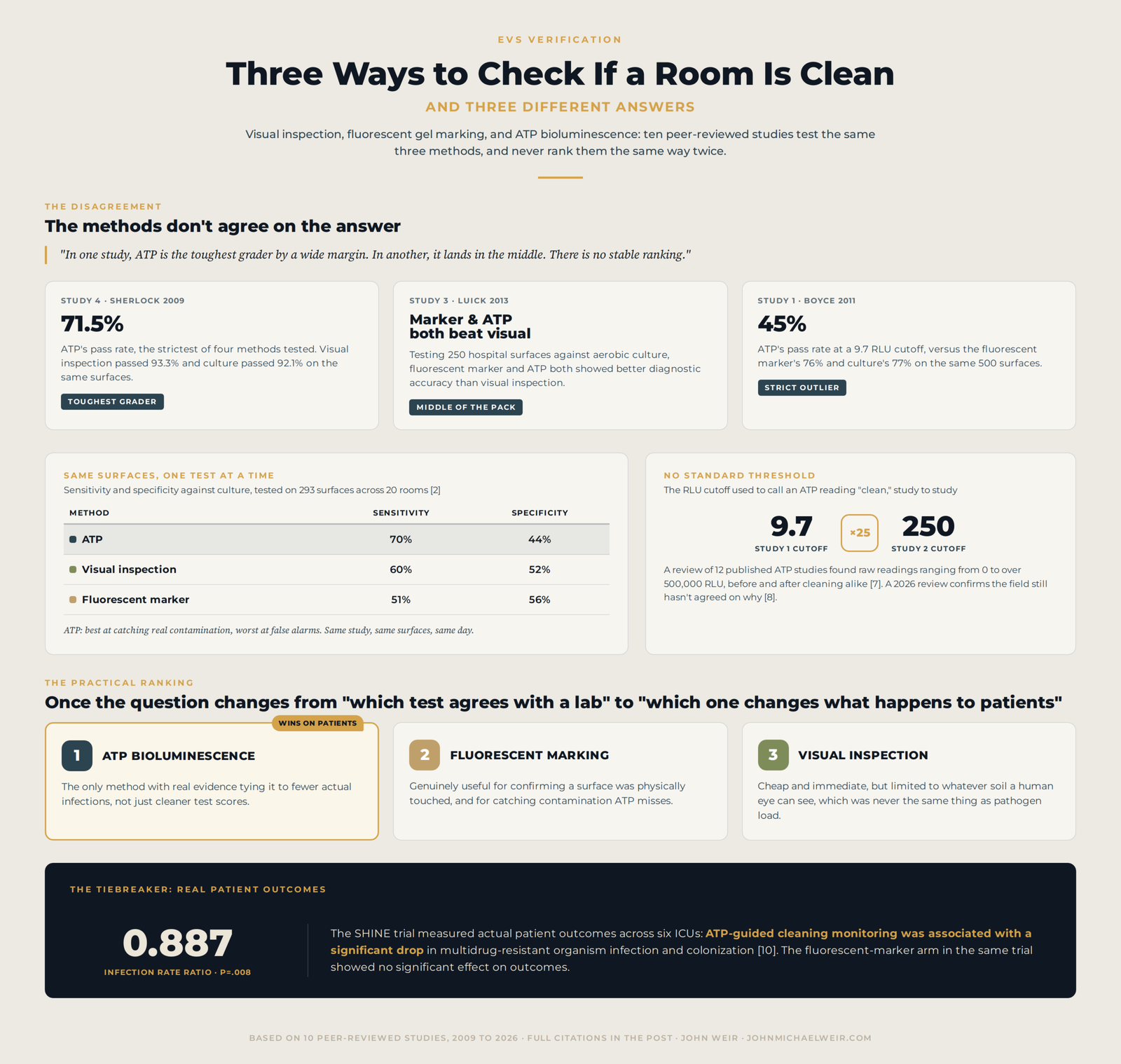
Start with the clearest single-study example. Researchers marked five high-touch surfaces (bedrails, overbed tables, TV remotes, bathroom grab bars, toilet seats) across 100 hospital rooms with an invisible fluorescent marker before terminal cleaning, then checked the same 500 surfaces three ways after cleaning: whether the marker was removed, an adenosine triphosphate (ATP) bioluminescence reading, and an actual aerobic culture [1]. At the aggregate level the numbers look almost reassuring: the marker passed 76 percent of surfaces, the culture test passed a nearly identical 77 percent. Read only that far, it looks like a physical wipe tracks a real biological result closely.
It doesn’t. The study’s actual finding is sharper than the aggregate numbers suggest: surfaces classified as clean by the fluorescent marker were significantly less likely to also be classified as clean by the culture and ATP tests. Two methods can land on nearly the same overall pass rate and still be disagreeing, surface by surface, about which specific rooms actually passed. ATP, tested against a threshold of under 9.7 relative light units per square centimeter, passed only 45 percent of the same 500 surfaces, the clear outlier of the three. The degree of wiping mattered in a measurable way, too: surfaces where the marker was fully removed were significantly more likely to pass the ATP check than surfaces only partially wiped (P = .003), a real dose-response relationship between physical thoroughness and biological result.
A more direct comparison tested all four methods on the same surfaces at once: visual inspection, fluorescent marker, ATP, and aerobic culture, across 293 surfaces in 20 rooms [2]. Against the culture gold standard, ATP had the best sensitivity of the three field methods at 70 percent, meaning it caught the most real contamination. But it also had the worst specificity, 44 percent, meaning it flagged the most false alarms. Visual inspection actually held up better than expected here: 60 percent sensitivity and 52 percent specificity, a more balanced result than the fluorescent marker’s 51 percent sensitivity and 56 percent specificity. In this particular study, the cheapest method wasn’t clearly the worst one.
The disagreement isn’t even consistent about which method is strictest. Testing 250 hospital surfaces against aerobic culture, both fluorescent marker and ATP showed better diagnostic accuracy than visual inspection [3]. But another four-method study, this one adding a test specific to methicillin-resistant Staphylococcus aureus (MRSA) alongside visual, ATP, and culture, found the opposite shape entirely: visual inspection passed 93.3 percent of surfaces, culture passed 92.1 percent, the MRSA-specific test passed 95.0 percent, and ATP was the clear outlier at only 71.5 percent, by far the strictest method in that particular hospital [4]. In one study ATP is the toughest grader by a wide margin. In another, it lands in the middle. There is no stable ranking here. The methods don’t just disagree with each other, they disagree about which one disagrees the most.
Fluorescent marking has its own specific blind spot, and it isn’t simply “less accurate than ATP” in one consistent direction. Another study found the fluorescent marker’s clean rate came in significantly lower than both the microbiological method and ATP, the reverse of what the first study in this piece found [5]. The likely reason: the marker itself doesn’t reliably indicate actual bioburden, in either direction. Sometimes marker removal overstates cleanliness, sometimes it understates it. A 2025 study across two National Health Service (NHS) hospitals used a portable UV torch and found fluorescent contamination on every single surface checked, with ATP readings significantly higher in the fluorescent areas than in control areas [6]. But the fluorescence also caught something ATP missed entirely: what appeared to be cleaning fluid and drug residue, both of which carry their own fluorescent signature that ATP’s biological-residue detection isn’t built to flag. Marker and ATP aren’t a strict hierarchy. They’re catching partly different things, and the overlap isn’t complete in either direction.
ATP’s most consistent real weakness across the research isn’t sensitivity, it’s standardization. Study [2] used a 250 RLU cutoff. Study [1] used 9.7. A review of 12 separate ATP studies found raw readings before cleaning ranging from 0 to over 500,000 RLU, and after cleaning from 3 to 500,000 RLU, across the published literature [7]. A 2026 review of the same field confirmed the problem hasn’t gone away: thresholds still vary widely across facilities and studies with no real agreement on why, and ATP detects organic matter in general, not specific pathogens [8].
There’s also an underasked question hiding in all of this: does knowing you’re being measured change how the cleaning actually gets done? One study ran cleaning verification in two phases, a baseline period followed by a second phase that added staff education and advance notice that ATP testing was coming [9]. That’s a different question from “which method is most accurate.” It’s asking whether the act of measuring, and telling people you’re about to measure, changes the underlying behavior before any test result is even read. A verification program is never just a passive instrument. It’s also feedback, whether that’s the intent or not.
All of that disagreement raises the obvious question: is there still a practical answer, or is “it depends” the only honest one? There is an answer, once the question changes from which method most often agrees with a lab culture to which method actually changes what happens to patients.
That answer doesn’t come from a surface-classification study at all. It comes from an intensive care unit (ICU) trial that measured real patient outcomes: ATP-guided cleaning monitoring across six ICUs was associated with a significant reduction in multidrug-resistant organism infection and colonization (infection rate ratio 0.887, P = .008), while a fluorescent-marker-guided arm in the same research program showed no significant effect on outcomes [10]. That’s the one place in this research where the question wasn’t “did the surface pass a test,” it was “did fewer patients get infected.” That’s the tiebreaker.
Here is the practical ranking. ATP first: it’s the only method with real evidence tying it to fewer actual infections, not just cleaner test results. Fluorescent marking second: genuinely useful for confirming a surface was physically touched, and for catching some contamination ATP misses, even without proof it moves patient outcomes on its own. Visual inspection third: cheap and immediate, but structurally limited to whatever soil a human eye can see, which was never going to be the same thing as pathogen load.
That ranking doesn’t mean drop the other two. It means know what each one is actually for: visual inspection for a fast daily read, fluorescent marking for confirming staff made physical contact with a surface, ATP as the method worth trusting when the real goal is fewer infections, not just a better-looking audit score.
#ATP #BlackLight #PatientsSafety #InfectionPrevention #EnvironmentalServices #Leadership
References
- Boyce JM, Havill NL, Havill HL, Mangione E, Dumigan DG, Moore BA. Comparison of fluorescent marker systems with 2 quantitative methods of assessing terminal cleaning practices. Infect Control Hosp Epidemiol. 2011;32(12):1187-1193. doi:10.1086/662626
- Snyder GM, Holyoak AD, Leary KE, Sullivan BF, Davis RB, Wright SB. Effectiveness of visual inspection compared with non-microbiologic methods to determine the thoroughness of post-discharge cleaning. Antimicrob Resist Infect Control. 2013;2:26. PMID: 24088298
- Luick L, Thompson P, Loock M, et al. Diagnostic assessment of different environmental cleaning monitoring methods. Am J Infect Control. 2013;41(8):751-752. doi:10.1016/j.ajic.2012.09.019
- Sherlock O, O’Connell N, Creamer E, Humphreys H. Is it really clean? An evaluation of the efficacy of four methods for determining hospital cleanliness. J Hosp Infect. 2009;72(2):140-146. doi:10.1016/j.jhin.2009.02.013. PMID: 19321226
- Hung IC, Chang HY, Cheng A, et al. Application of a fluorescent marker with quantitative bioburden methods to assess cleanliness. Infect Control Hosp Epidemiol. 2018;39(11):1296-1300. doi:10.1017/ice.2018.222. PMID: 30221609
- Fieldhouse S, Bastaki BB, Ledgerton A, Clarke P, Lewis T. Assessing the effectiveness of hospital cleaning using fluorescence: a proof-of-concept study and comparison with ATP testing. J Hosp Infect. 2025;166:38-45. doi:10.1016/j.jhin.2025.08.008. PMID: 40935115
- Amodio E, Dino C. Use of ATP bioluminescence for assessing the cleanliness of hospital surfaces: a review of the published literature (1990-2012). J Infect Public Health. 2014;7(2):92-98. doi:10.1016/j.jiph.2013.09.005. PMID: 24231159
- Kotsiou OS, Gouta E, Natsaridis N, Papageorgiou G, Daniil Z, Gourgoulianis KI. The role of ATP bioluminescence in monitoring surface hygiene in hospital settings: a comprehensive review. Antimicrob Resist Infect Control. 2026;15:44. doi:10.1186/s13756-026-01698-8
- Boyce JM, Havill NL, Dumigan DG, Golebiewski M, Balogun O, Rizvani R. Monitoring the effectiveness of hospital cleaning practices by use of an adenosine triphosphate bioluminescence assay. Infect Control Hosp Epidemiol. 2009;30(7):678-684. doi:10.1086/598243. PMID: 19489715
- Ziegler MJ, Babcock H, Welbel SF, et al. Stopping Hospital Infections With Environmental Services (SHINE): a cluster-randomized trial of intensive monitoring methods for terminal room cleaning on rates of multidrug-resistant organisms in the intensive care unit. Clin Infect Dis. 2022;75(7):1217-1223. doi:10.1093/cid/ciac070

1 Comment