
The Overlooked Heroes in Healthcare:
Why the Housekeeping Team Saves More Lives Than Anyone Realizes
A surgeon gets applause. An EVS tech gets a pay stub. One of them prevents more infections than the other, and it’s not who you think.
Environmental Services staff earn a national median of $39,310 a year, well below the $100,210 median for registered nurses in the same hospitals (U.S. Bureau of Labor Statistics, 2025). They are among the lowest paid people in the building, and easy to overlook, and they sit directly on the front line of infection prevention. Not adjacent to it. Not supporting it from a distance. On it. Every surface a patient touches, every high-risk room turned over between cases, every terminal clean that stands between one patient and the next one, runs through their hands first.
The work is invisible because the work is supposed to be invisible. A room that never causes a problem looks like nothing happened in it. That’s the problem.
Here’s what gets missed in most conversations about infection control: recognition isn’t a morale nicety you add on top of a good program. It’s part of the program. The Centers for Disease Control and Prevention’s own framework for environmental cleaning names integrating EVS into the facility’s safety culture as the first of six required components, not an afterthought bolted onto training and product selection. A department that isn’t seen as part of the safety culture isn’t fully running that component, no matter how good its cleaning technique is.
This isn’t a theory. Stamford Hospital, a 305-bed community hospital in Connecticut, ran a 10-year program built on exactly this idea: fold EVS into infection prevention instead of keeping it separate (Parry et al., 2022). Liaison nurses ran monthly cleaning-validation checks with EVS staff, built a real feedback loop, and treated the results as shared ownership rather than a scorecard handed down from above. Tracked over 2011 to 2021: cleaning performance rose from 74.7 percent to a sustained above 90 percent. C. difficile rates dropped 75 percent. Surgical-site infections dropped 55 percent. Overall hospital-acquired infection rates dropped 75 percent.
That’s not an isolated anecdote. That’s a decade of real data.
Stamford isn’t the only example. Gillette Children’s Specialty Healthcare, a nonprofit health system in Saint Paul, Minnesota, ran a similar quality-improvement push between 2016 and 2018: high-touch cleaning reliability rose from 37 percent to 90 percent, hospital-acquired infections dropped 65 percent, and the program avoided roughly $500,000 in associated costs (Craig et al., 2020). Two different hospital systems, two different time periods, the same underlying move: stop treating EVS as a service outside the clinical conversation and bring it inside.
Stop treating cleaning as a task and start treating it as a treatment. That’s the transformation both programs made, in practice rather than in a mission statement.
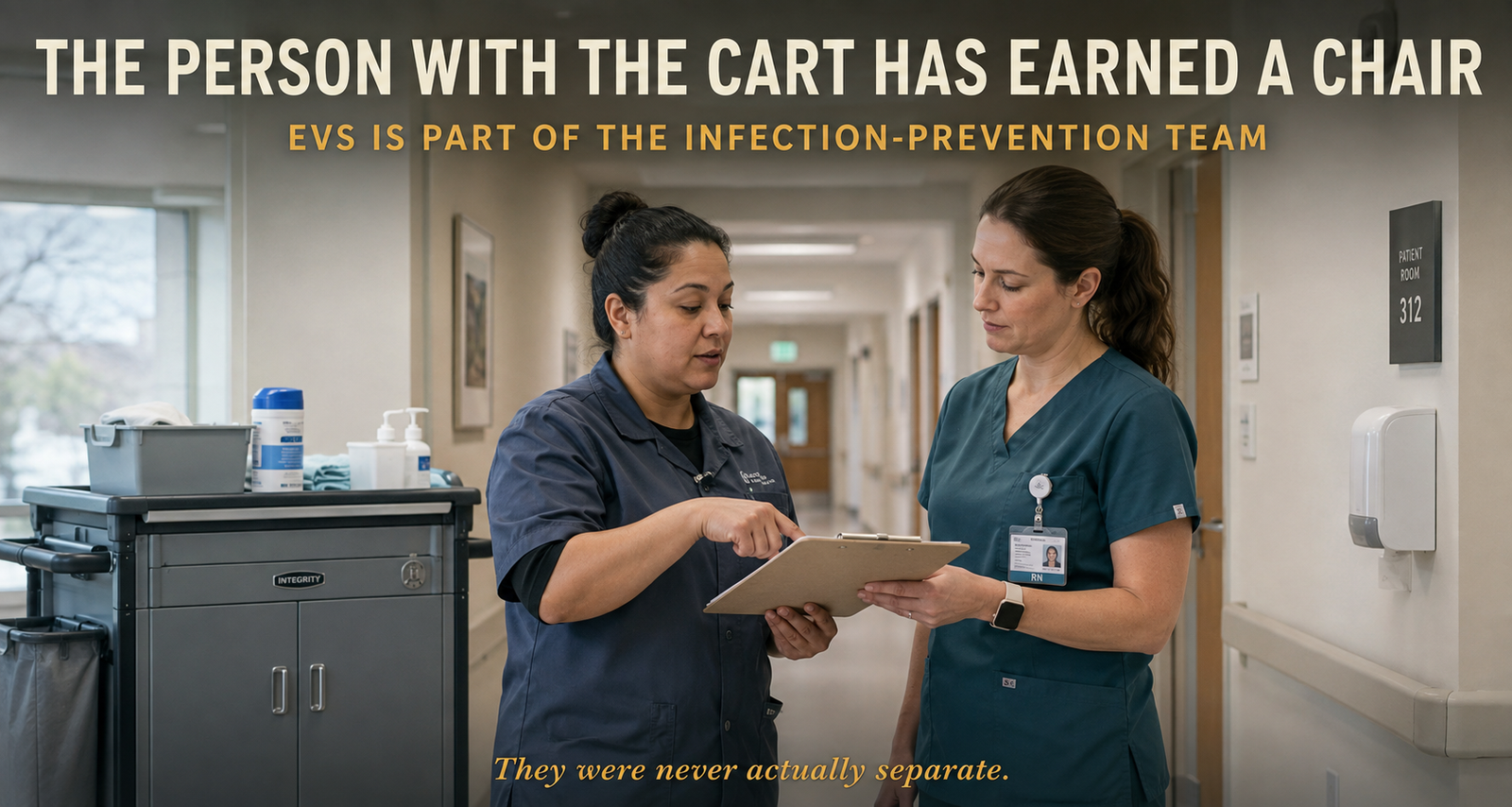
What does that look like day to day, short of a multi-year research program? Bring the EVS supervisor to the infection control committee instead of handing them the minutes afterward. Let a housekeeper’s observation about a recurring contamination spot carry the same weight in a safety huddle as a nurse’s. Back up a title change from Housekeeping to Environmental Services with an actual seat at the table, instead of leaving it as a name nobody acts on.
None of that requires a bigger budget. It requires deciding that the person with the cart has earned a chair, not just a supply closet.
The math from both programs makes the case better than any morale argument could. Two hospitals that treated their EVS teams as clinical partners didn’t just end up with happier housekeepers. They ended up with measurably fewer infections. Those are the same outcome, arrived at from two different directions, and the honest version of this story is that they were never actually separate.
References:
Craig, S. L., Lang, M. D. M., & Schlottman, K. J. (2020). Environmental services quality improvement drives healthcare-acquired infection reduction. Pediatric Quality & Safety, 5(Suppl 2), e280. https://doi.org/10.1097/pq9.0000000000000280
U.S. Bureau of Labor Statistics. (2025). Occupational Employment and Wage Statistics, May 2025: General Medical and Surgical Hospitals (NAICS 622100) [Data set]. U.S. Department of Labor. https://www.bls.gov/oes/
Parry, M. F., Sestovic, M., Renz, C., Pangan, A., Grant, B., & Shah, A. K. (2022). Environmental cleaning and disinfection: Sustaining changed practice and improving quality in the community hospital. Antimicrobial Stewardship & Healthcare Epidemiology, 2(1), e113. https://doi.org/10.1017/ash.2022.257
#EVS #HEALTHCARE #HOUSEKEEPING #INFECTIONPREVENTION #LEADERSHIP #CONTINUOUSIMPROVEMENT #ENVIRONMENTALSERVICES
