
The First Impression: What Patients Notice When They Enter the Room
Two days ago I wrote about three ways to check if a room is clean: visual inspection, fluorescent marker, and ATP testing. All three exist because none of them fully agree with each other, and none of them is the one your patient is actually using.
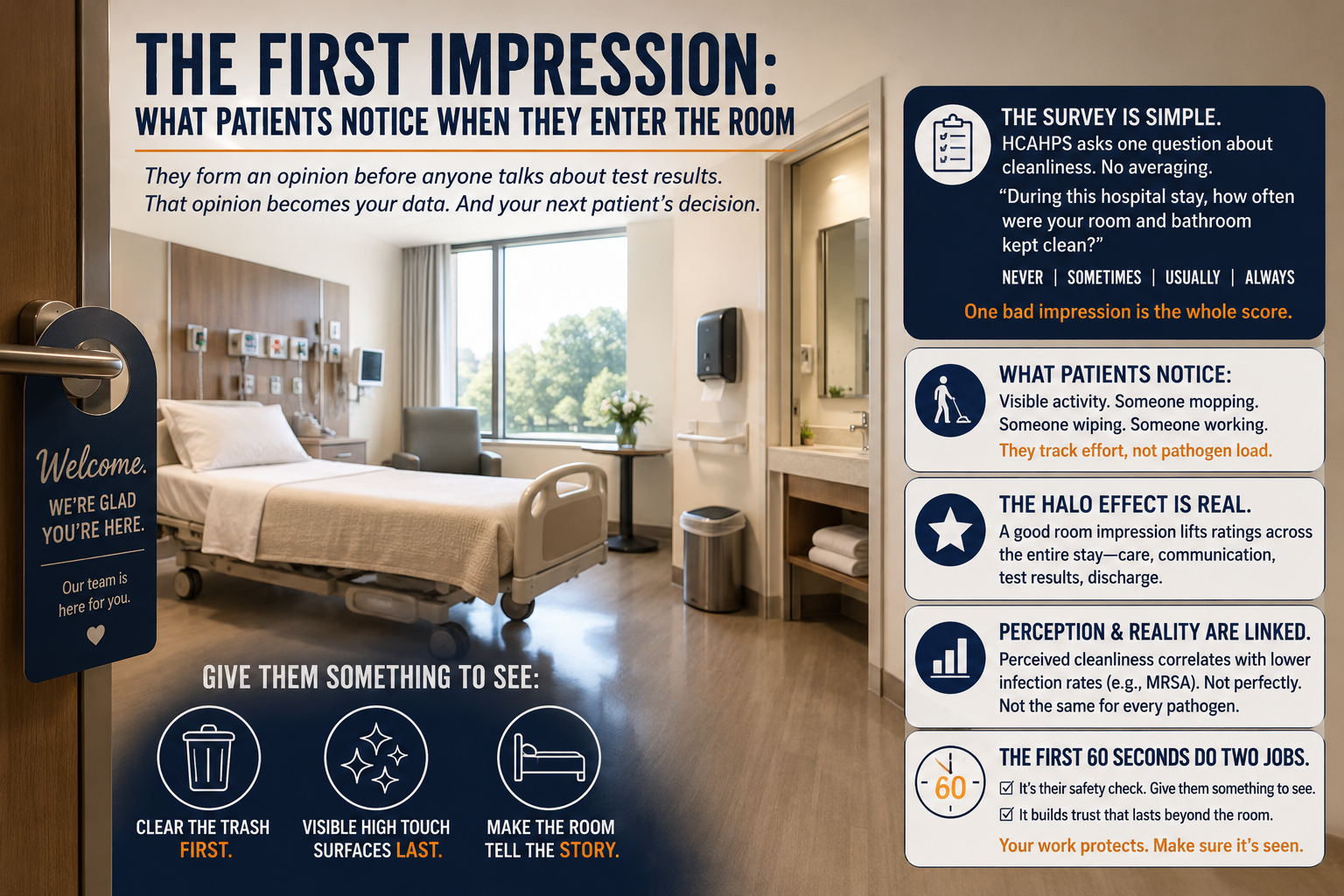
A patient forms an opinion about your hospital before anyone tells them the room passed any of those three tests. They form it by looking around: no dust on the windowsill, no wrapper in the trash, how the floor looks, a bed made square. That opinion becomes data. It shows up on a federal survey, and that is how the next patient hears about your hospital before they walk through the door.
Here’s the survey question, word for word, from HCAHPS (the Hospital Consumer Assessment of Healthcare Providers and Systems, the patient-experience survey every Medicare-participating hospital runs): “During this hospital stay, how often were your room and bathroom kept clean?” Never, Sometimes, Usually, or Always. That’s it. One question, about the whole room, answered from memory after the patient has already gone home. Compare that to “Communication with Nurses,” which averages three separate questions. Cleanliness gets no averaging. One bad impression is the whole score.
So what actually shapes that impression? A small study of hospitalized veterans found patients don’t judge cleanliness by what your infection prevention team measures. They judge it by watching the activity: someone mopping, someone wiping the bed rail, someone visibly working the bathroom. One veteran put it plainly: “It’s got to be something you take seriously, especially during this pandemic.” Patients aren’t tracking pathogen load. They’re tracking whether they saw effort.
That first impression does more than answer one survey question. A 2025 Stanford study found something researchers call the halo effect. Patients in private rooms didn’t just rate the room higher. They rated test results, care coordination, and discharge information higher too, categories that had nothing to do with the room itself. A good room impression colors a patient’s trust in the entire stay, in departments that never touched the room.
That’s the tension EVS leaders live inside every day. The work that actually keeps a patient safe is invisible: the disinfectant’s full contact time, the sequence from cleanest to dirtiest surface, the difference between a wipe that looked thorough and one that was. None of that shows up to a patient standing in the doorway. What shows up is whether the room looks good.
Two large studies, using CMS data across thousands of facilities, found patient-perceived cleanliness does correlate with real infection rates. The MRSA correlation held across two separate years of data: hospitals patients called “always clean” had lower infection scores, hospitals patients called “never clean” had higher ones, both times. The C. diff correlation was there one year and gone the next. Perception and reality are connected. Just not perfectly, and not the same way for every pathogen.
The first sixty seconds a patient spends in a room is doing two jobs. It’s the only clinical safety check they’re capable of running themselves, so give them something to see: finish the visible high touch surfaces last if you can, clear the trash before you clear anything else. It’s also building trust that will outlast the room, affecting how that patient hears about the nurse, the doctor, the whole stay. Your team already does the invisible work that actually protects the next patient. The sixty seconds after you leave the room is where that work either gets seen or it doesn’t. Both jobs matter. Don’t let anyone tell you only one of them does.
#HCAHPS #CMS #PatientSatisfaction #Education #MRSA
References:
Baubie K, McKinley L, Keating J, Bartel R. (2021). Engaging Veterans in Identifying Key Elements of Environmental Cleaning: The Patient Perspective. Antimicrobial Stewardship & Healthcare Epidemiology, 1(Suppl 1), s62. https://doi.org/10.1017/ash.2021.120
Atsavapranee E, Heidenreich PA, Smith-Bentley M, Vyas A, Shieh L. (2025). “Halo effect”: room impacts patient perception of overall hospital experience. BMJ Open Quality, 14(2), e003196. PMID 40294958.
Stowe C. (2022). Does Perception of Cleanliness Matter? A Correlational Study Exploring Patient Perception of Cleanliness and HAC Score Performance. Open Forum Infectious Diseases, 9(Suppl 2). https://doi.org/10.1093/ofid/ofac492.1038
Crews-Stowe C. (2024). Does Patient Perception of Cleanliness Still Matter? The Relationship between HCAHPS and HAC During the COVID-19 Pandemic. Antimicrobial Stewardship & Healthcare Epidemiology, 4(Suppl 1), s133-s134. https://doi.org/10.1017/ash.2024.301
