- Share on LinkedIn (Opens in new window) LinkedIn
- Share on X (Opens in new window) X
- Share on Facebook (Opens in new window) Facebook
- Share on Pinterest (Opens in new window) Pinterest
- Share on Reddit (Opens in new window) Reddit
- Print (Opens in new window) Print
- Email a link to a friend (Opens in new window) Email
The Centers for Disease Control and Prevention, the CDC, lays out six core components for an environmental cleaning program:
Integrate Environmental Services, EVS, into the facility’s safety culture
Train staff properly
Select the right products
Standardize protocols by setting
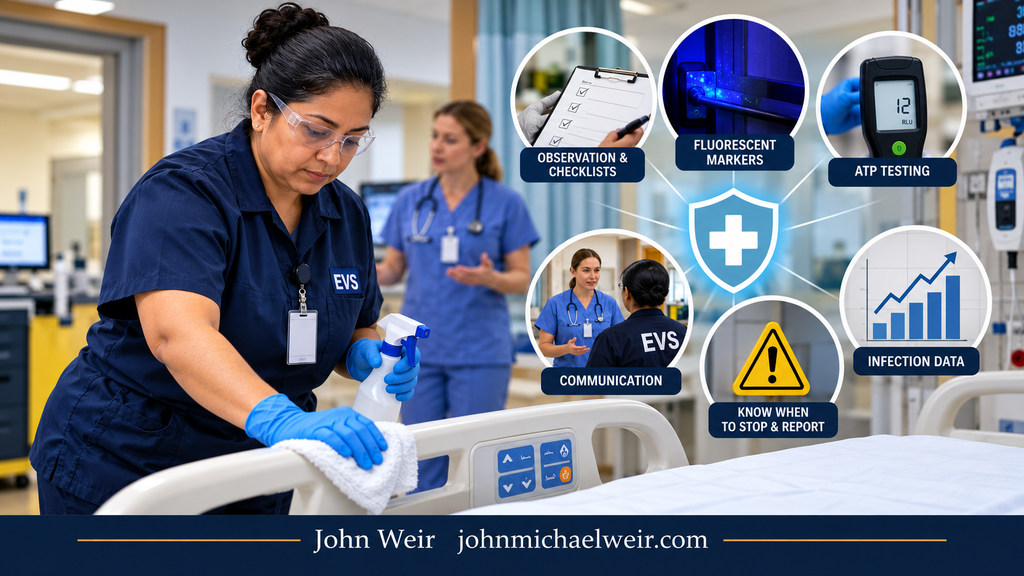
Monitor how well those protocols are actually followed
Feed that information back to the people doing the work
CDC is explicit about one thing that gets lost in the summary version: these six work as a system, not a menu. You don’t get to run four of them well and skip the other two. Skip any one, and the whole program is weaker than the sum of its parts.
Administration Continuous Improvement Infection Prevention Leadership Patient Safety Patient Satisfaction Quality Assurance
Is Your EVS Program Ready?
For years, infection prevention conversations treated Environmental Services as a support function. A separate department. A cost center. The people who clean after everyone else goes home. That era is ending. The 2026 guidance is explicit: if your EVS team is not staffed, trained, and monitored, that is a leadership failure, not a staff failure.
The guidance documents do not use the word blame. They use the word accountability. The expectation has moved from “did the room look clean” to “can you prove it is clean, and can you show who is responsible when it is not.”
My thoughts on promoting from within. #EnvironmentalServices #Leadership #Mentoring #Recognition #Joy
Why Low Budget Doesn’t Mean Low Standard You don’t need a multi-million dollar capital equipment budget to lower your Hospital-Acquired
Looks Clean Is Not Clean A room can look spotless and still fail. I wrote yesterday about why a fixed
Stop Asking ATP What Clean Is Most Environmental Services (EVS) departments that adopt an ATP (adenosine triphosphate) luminometer program start
Years ago, as a Supervisor, at a different medical center, I walked in and found nine callouts. Vacations already approved and sick calls reduced half of my team that same day. On paper it looked impossible.
I didn’t try to fix it myself. I pulled the team together, explained exactly what we were facing, and we worked through it as a group. We agreed on what had to get done that shift, the basics that could not wait, and what could safely hold until the next one, based on who was actually going to be there. It worked. We got through the day, and it still amazes me to this day.
Washington hospital break enforcement remains an active leadership exposureClassification: Mandatory Washington requirement; not newly issued this week. Washington L&I’s hospital
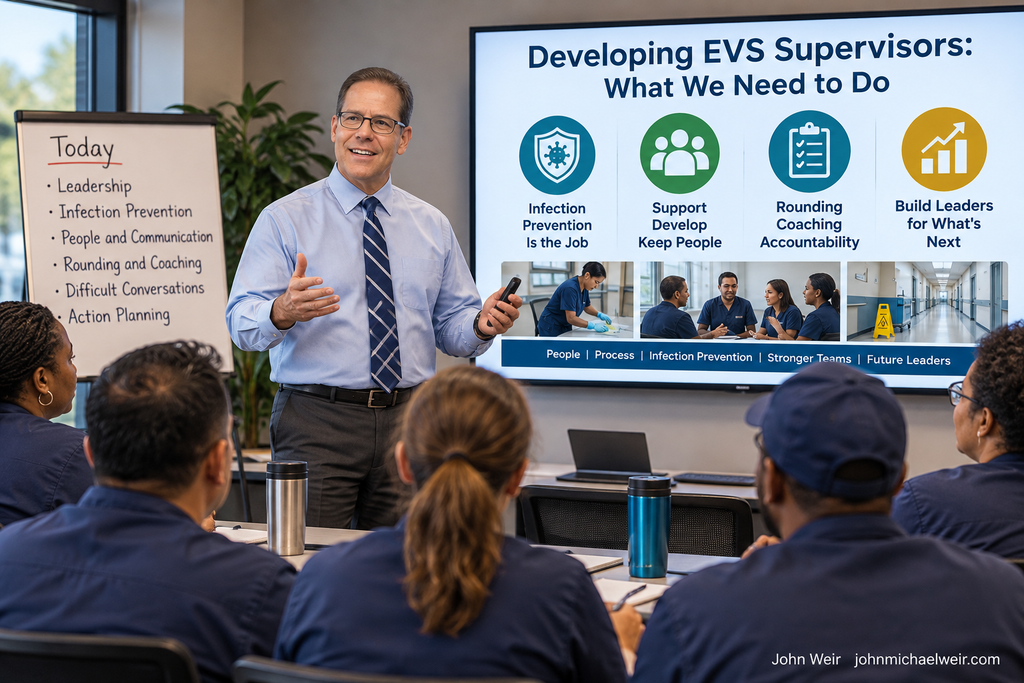
It’s not always a staffing shortage. We have a leadership development vacuum. If a paycheck is your only retention strategy, you are losing your best people to whoever offers a slightly bigger one.
I’ve hired people straight off the floor who had more leadership in them than some managers I’ve worked with. The instinct in a lot of departments is to look outside for that: post the supervisor job, bring in someone with a title already attached. Meanwhile the person who already knows the building, the staff, and the standard is standing right there, wiping down a room.
What people see in a patient room is a clean environment. No visible soil. Everything in place. A perfect picture.
Learn more about my book: Stoic Self Confidence, on sale now.