
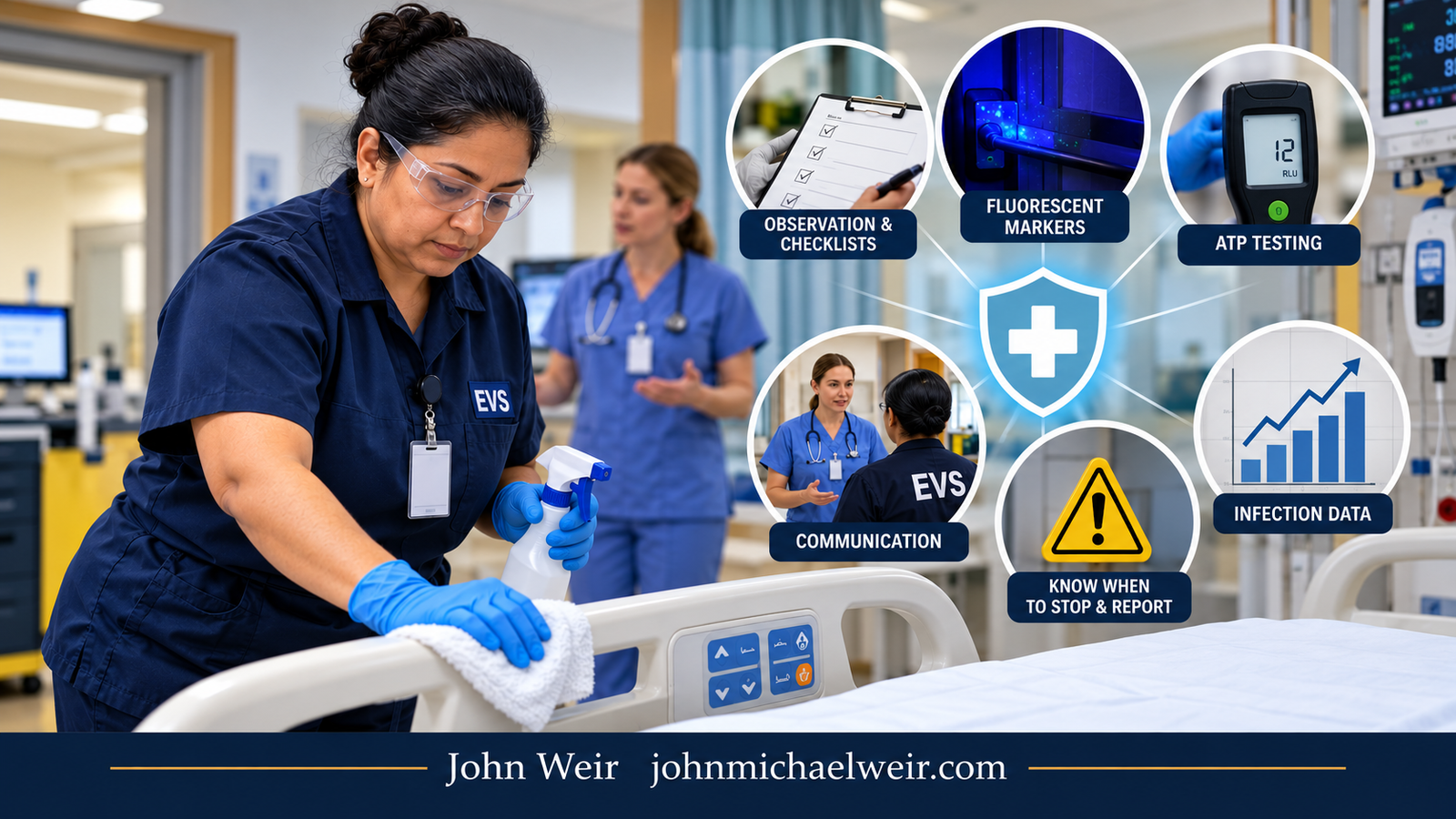
Environmental Services (EVS) work ties directly to patient safety and to the way patients experience the hospital. Careful cleaning reduces the chances of contamination, and a poor process adds risk. Strong programs give technicians practical tools, quality checks, realistic workloads, and respect for the professional role they fill.
Quality assurance turns effort into evidence
A hospital needs to know whether its cleaning works. Supervisors have several ways to check: direct observation, checklists, fluorescent markers, adenosine triphosphate (ATP) testing, patient feedback, and infection data. Each one answers a different question. A fluorescent marker shows whether a high-touch surface was wiped. ATP testing shows how much organic material is left on it. Infection data shows patterns over time, but it does not always point to a single cause.
Strong programs use several of these together. When a gap shows up, look at supplies, staffing, workflow, and training before blaming the person. Quality assurance works when it teaches, when staff report honestly, and when the people doing the cleaning help fix the process. That is how careful work becomes evidence that patients are protected.
Communication supports safe patient care
EVS works in every part of the hospital, so communication is part of infection prevention. Before entering an isolation room, a technician needs to know the precautions, the required PPE, the waste procedures, and any timing restrictions. When a patient is in treatment, using equipment, or getting ready for a procedure, the technician checks with the nurse first. A short conversation prevents interruptions, exposures, and missed cleaning steps.
Communication also means knowing when to stop. An unfamiliar spill, a damaged device, a strong or unusual odor, an unclear room status, suspected hazardous material: none of these get handled by guesswork. The technician secures the area when it is safe to do so and calls the supervisor or the department that owns the problem. Stopping to report is not a failure to do the job. It is a professional decision that protects patients, coworkers, and the technician.
Can your department show that its cleaning works, or only that it was done?
#HealthcareLeadership #EnvironmentalServices #PatientSafety #InfectionPrevention #EnvironmentalCleaning #QualityImprovement #HospitalOperations #FrontlineLeadership
