
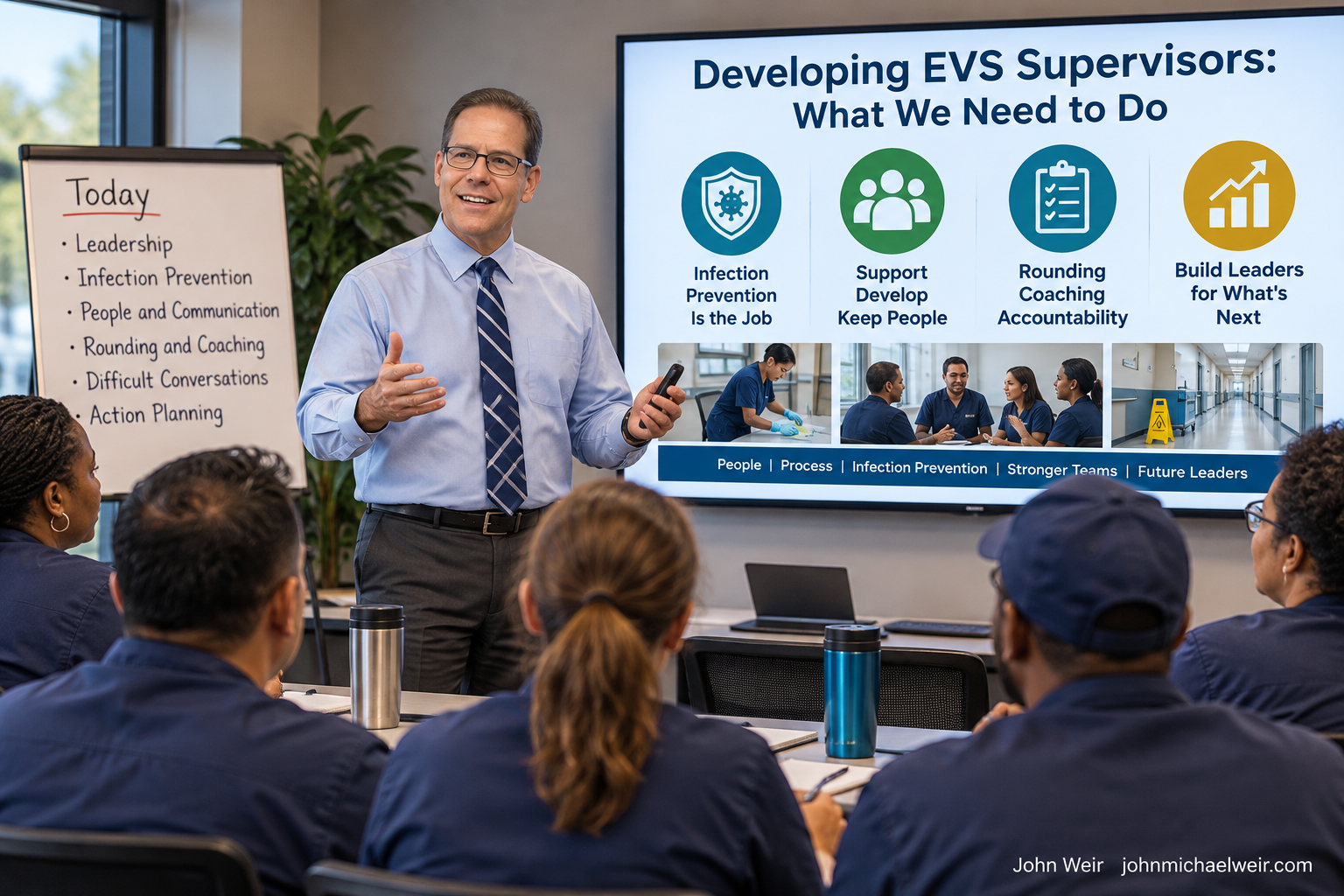
Our supervisors decide whether a room actually gets cleaned to standard, whether a short-staffed shift holds together, and whether a good employee stays or leaves. Many of them got the job because they were good at the work on the floor, and then nobody really trained them to supervise. That is what this program has to fix.
The point is to move up
The purpose of this training is to develop supervisors into great leaders who are ready to move up and take over. It is not to keep them where they are, and I want that said plainly in the first session, so nobody is confused about why they are in the room. If a supervisor tells me they just want to be a supervisor, they don’t want to be a manager, they don’t want to move up, and they are not close to retirement or planning a move or something significant like that, that is not who I want on the team. I am building this for people who want to grow, the same way we look for the next leads among our frontline staff.
Infection prevention is the job
Infection prevention cannot be one topic on the list; it is the reason the rest of the list exists. Our primary job is to break the chain of infection. Patient interaction, turnaround times, the checklists, all of that depends on it. Our staff need that explained to them on a regular basis, not once at orientation, and the person explaining it is the supervisor.
Supervisors have to understand the science well enough to teach it, dwell time, cleaning order, why C. diff and C. auris get handled the way they do, what a spill response is actually protecting against. This is where teaching the why first comes in. A supervisor who only knows the steps can’t teach the why, and staff who only know the steps will cut them when the shift gets hard. Every session should tie back to this and give supervisors something short they can take back to their staff that week.
People stay because of their supervisor
Many employees will tell you they work and stay at a location because of their supervisor, primarily. When they feel supported, that’s a big plus. So being supportive, kind, and caring is something we train, not something we hope a supervisor already has. That means knowing their people, backing them up, and giving feedback in a way that never embarrasses anyone in front of their peers.
Nothing is one and done
Nothing in our business is a one and done. Staff forget, they drift from established practices to what works easier for them, especially when callouts mean they have to make their own judgments on what to prioritize. Training by itself will never stop that. What will is a supervisor who is out on the floor watching the work and giving feedback regularly.
I want supervisors trained to round the way I think about the 15-minute leadership round, as diagnosis, not policing. Observe a room clean, give the feedback in private, follow up. After a rough stretch of callouts, sit down with the team and reset priorities instead of assuming everyone came back to standard on their own. Fluorescent marker and ATP results should be coaching tools, not report cards.
The skills every supervisor needs
Talking to patients. Staff need to be comfortable knocking, introducing themselves, explaining what they are there to do, and thanking the patient on the way out. Some patients worry they are in the way when we clean, and how we come into the room changes how they see it. Supervisors have to model this and practice it with their staff, including what to do when a patient is upset.
Poor communication shows up inside our own department and between us and the clinical teams, and the supervisor is the link in both directions.
Difficult conversations. With staff who aren’t meeting the standard, with patients, and with nursing, which is often the harder one. Supervisors need to hold turnaround expectations, escalate when they need to, and say no to requests that aren’t ours without burning the relationship.
How we run it this time
These must be working sessions, not lectures. Every session ends with homework applied on their own unit, run two rounds and bring back what you found, teach one why to a shift and tell us how it landed, and the next session opens with those results.
The first assignment should be a needs survey. Before we settle on the curriculum, we ask supervisors what they need. That puts them in the active role from day one, and how seriously each person takes it tells us who wants to learn.
I also want us to agree up front on two or three measures we already collect, HCAHPS cleanliness, retention, cleaning audit scores, discharge turnaround, so we know whether this is working instead of guessing.
If we do this right, the supervisors who come through it will understand that their job is breaking the chain of infection, they will know how to keep their people and keep them at standard, and they will be ready for the next role when it opens. That is the standard I am holding this program to. We are building the people who take over after us.
#EVS #Leadership #Development #StaffRetention #HCAHPS #Cleanliness #PatientSafety
