
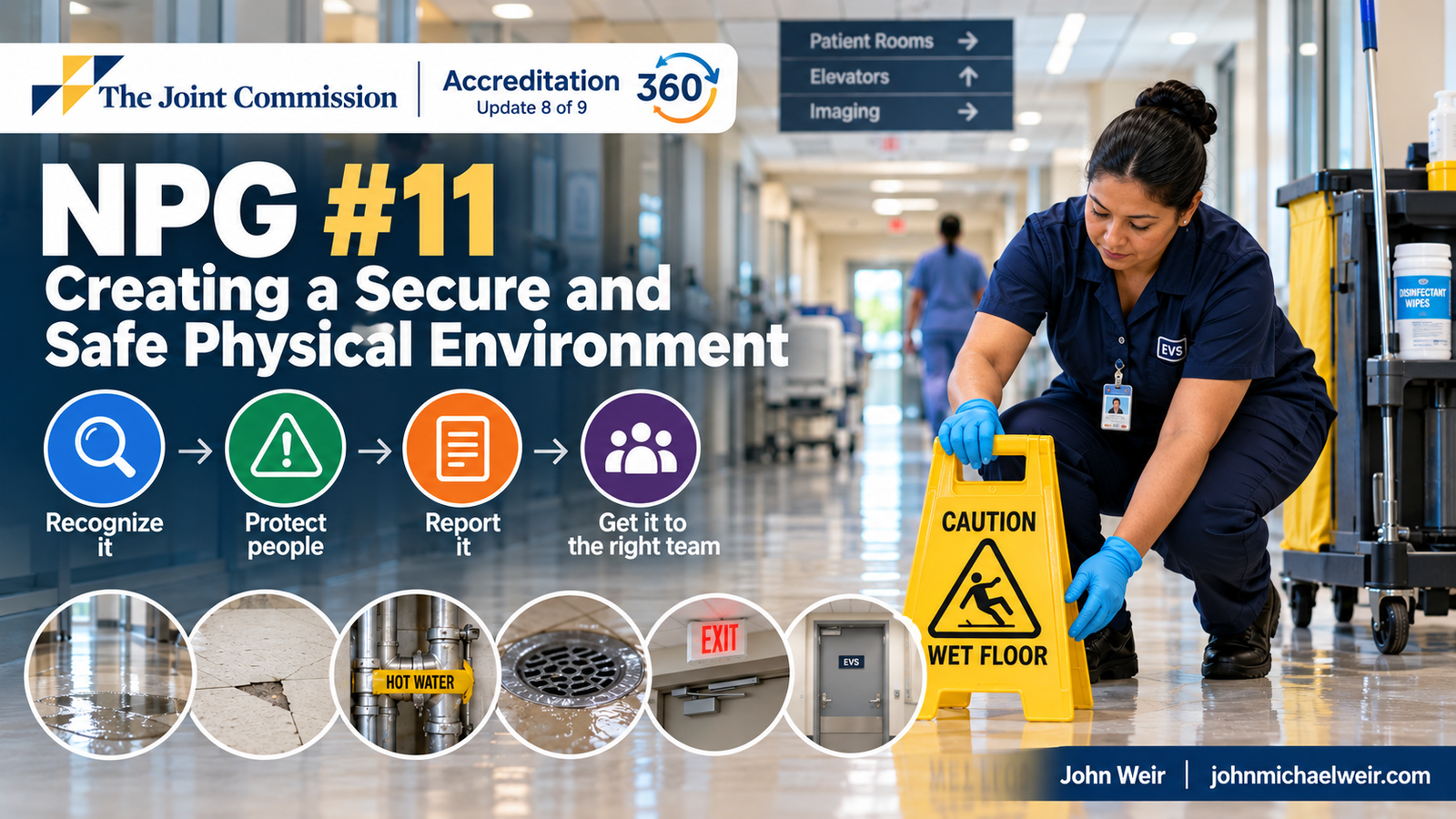
NPG #11: Creating a Secure and Safe Physical Environment
A safe hospital is built out of small actions. A spill gets picked up before someone slips. A corridor stays clear. A chemical gets used the way the label says. A damaged surface gets reported before it becomes a hazard. That is everyday Environmental Services work, and it ties directly to The Joint Commission’s National Performance Goal #11, Creating a Secure and Safe Physical Environment.
The National Performance Goals arrived with Accreditation 360 in 2026. The Joint Commission describes them as measurable, actionable priorities built from existing requirements, not new ones. Security risks and certain utility-related safety requirements moved out of the old Environment of Care structure and into NPG #11. That rules out building a parallel program for it. In this article I try to tie together NPG#11 and EVS.
EVS gets measured on cleanliness, response time and satisfaction scores. Those are useful numbers, but they leave something out. The space also has to be safe to move through, free of avoidable hazards and orderly enough that care happens without interruption. Safety is part of the cleaning task itself, not an extra step.
Seeing a hazard is only the start. A technician needs a dependable way to deal with it, and it comes down to four steps:
Recognize it. A spill, damaged flooring, supplies left unsecured, a floor scrubber that isn’t working right.
Protect people from it. Put a wet floor sign out, block off the area, and never leave a hazard unmarked while going for help.
Report it. Use the hospital’s reporting process, and get it to the department that owns it when the fix isn’t EVS’s.
EVS does not have to repair the problem to report the problem. A technician doesn’t need to know fire code. They need to say, “That does not look right. I am reporting it,” and they need to know who to call.
Utilities work the same way. They are a Facilities responsibility, but they become an EVS problem fast: no hot water, drains that back up, flooding, condensation, sewer odors, an isolation-room door behaving strangely. A tech may notice and then they should call facilities or infection prevention to report it.
Patients and visitors experience the hospital as one building, even though we have many different departments. A hazard can turn up while cleaning, in a public hallway or on a unit. Every technician should know which conditions EVS fixes on the spot, and which get escalated, how to secure an area, how to report a maintenance or security concern, and what to do when the normal reporting route isn’t available. Teach it with real examples from your own building, in orientation, in regular refreshers and on supervisor rounds, so it isn’t a once-a-year topic.
One report is a hazard. The same report over and over is often a process problem, not a people problem. Those patterns belong in front of the departments that can act on them: Facilities, Infection Prevention, Security and clinical operations. The purpose is to find the pattern, understand who owns it and check whether the fix is holding. Nobody gets blamed for reporting a hazard. Those aren’t Joint Commission measures. They show whether your process works.
Accreditation 360 moves surveyors away from policy binders and toward watching the work. Training records, rounding records, hazard reports, work orders and corrective actions should reflect what staff already do, not paperwork assembled for a survey. A good record shows what was seen, where it went and whether it got fixed. Staff should be able to explain the process in their own words and show it in their own area.
Do not prepare your department to answer survey questions. Prepare the department so that what the surveyor sees is already the normal way you work.
References:
The Joint Commission, “Accreditation 360: The New Standard FAQs,” https://www.jointcommission.org/en-us/accreditation/accreditation-360/faqs (accessed September 26, 2026). States that Accreditation 360 “dramatically streamlines and simplifies processes, provides better support, and more efficiently and collaboratively shares best practices across the healthcare ecosystem.”
The Joint Commission, “National Performance Goals (NPGs),” https://www.jointcommission.org/en-us/standards/national-performance-goals (accessed September 26, 2026). Describes NPGs as “14 high-priority topics that are measurable, actionable, and organized to make it easier for hospitals to track progress and improve outcomes on key areas of patient safety and quality care,” and states that they “incorporate existing Joint Commission requirements” and that “there are no new requirements added.”
The Joint Commission, “Accreditation 360 – Updated Accreditation Manual: National Performance Goals – On Demand Webinar Transcript,” August 12, 2025, https://digitalassets.jointcommission.org/api/public/content/9e9679b0d2244bf6a1ae34ce1a0d0014?v=aada9682. States that “Goal 11 Focuses on creating a safe physical environment for both patients and workers.” Consult the current accreditation manual for authoritative requirements.
#HealthcareLeadership #EnvironmentalServices #HospitalOperations #PatientSafety #FrontlineLeadership #QualityImprovement #JointCommission #Compliance
