
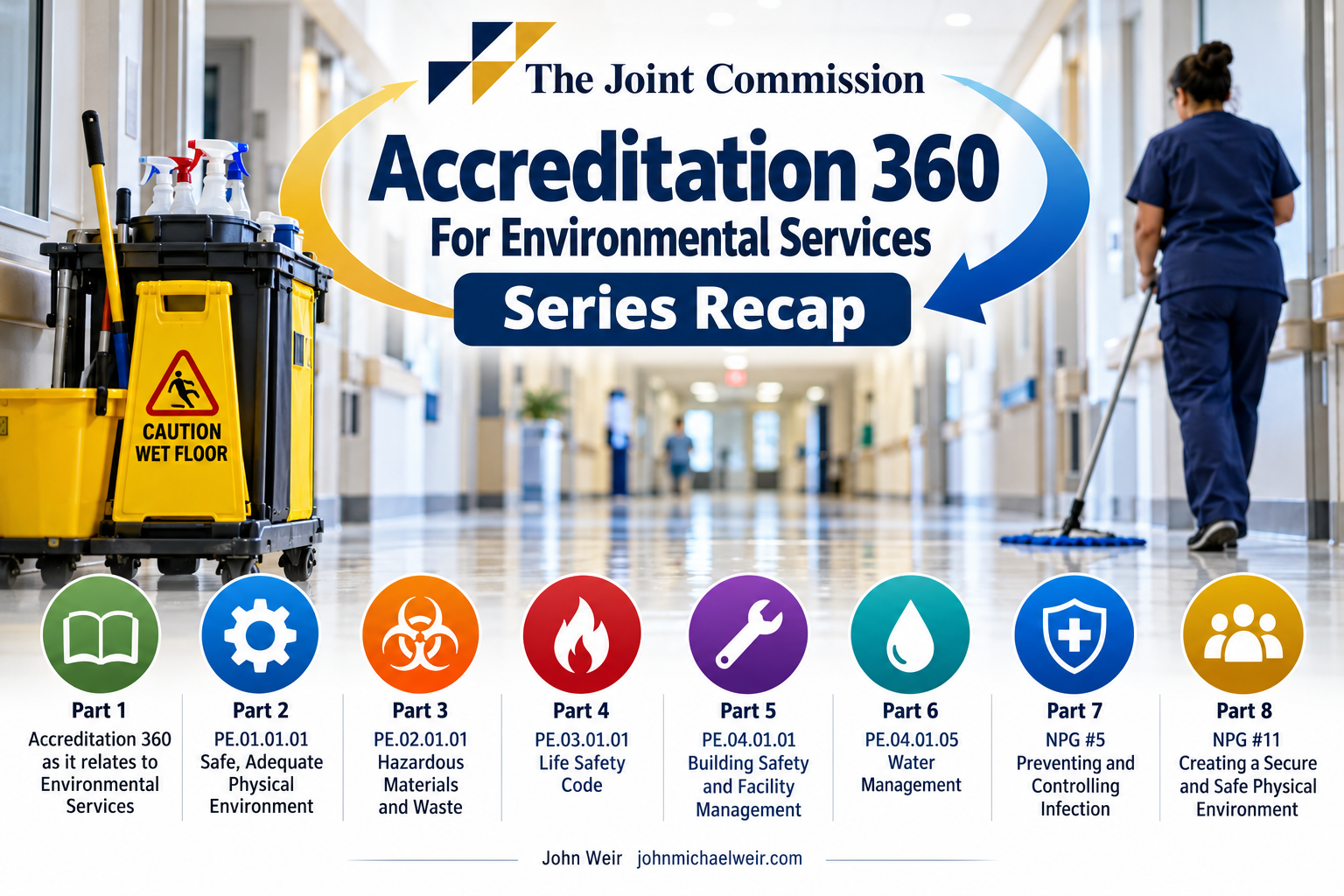
On January 1, 2026, Joint Commission’s Accreditation 360 replaced the Environment of Care (EC) and Life Safety (LS) chapters with a new Physical Environment (PE) chapter and a set of National Performance Goals (NPGs). The first eight parts of this series went through what that means for Environmental Services (EVS), one standard at a time. This final part goes back through all eight with a summary of what each one covered.
Part 1: Accreditation 360 as it relates to Environmental Services
The standard itself did not change. A facility compliant under EC and LS should still be compliant under PE and the NPGs. What changed is how a surveyor checks: less time reading a policy binder, more time walking a unit and watching what staff actually do. A technician needs to be able to explain why a container is labeled the way it is, not recite a policy back. That is why our teams must run year-round readiness instead of survey-season readiness.
If a surveyor stopped one of your technicians today, could that person explain their own process in their own words?
Part 2: PE.01.01.01: Safe, Adequate Physical Environment
This standard comes down to cleanable versus clean. A surface can be spotless and still fail if it is too damaged to hold up to disinfection. A torn operating room (OR) mattress is the clearest example: fluid gets into the tear, and cleaning harder does not fix it. Chipped laminate, a wall dented by beds and a temporary patch nobody remembers was temporary all fall under the same standard. Repairing or replacing the surface is not EVS work. Seeing the damage and reporting it is.
When a technician finds a torn mattress, are you sure it is reported that shift?
Part 3: PE.02.01.01: Hazardous Materials and Waste
For EVS, this standard lives in the central accumulation area (CAA) and its weekly inspection. The requirement is measured in days elapsed, not day-of-week habit. A Wednesday inspection that slips to Friday and then returns to Wednesday leaves a gap longer than seven days, even though the calendar looks covered. Every container needs the correct label and an accumulation start date, and anything another department leaves in the room still has to be accounted for. The inspection only works if the person doing it understands what each line is asking.
Count the days between your last two inspections. Is the number seven or fewer?
Part 4: PE.03.01.01: Life Safety Code
EVS does not own the Life Safety Code program, but it can create a finding under it and is often the first department to see one. A corridor has to hold eight feet of clear width. A cart in use can project into it as long as five feet stays clear. The same cart parked and unattended is storage, and storage gets no allowance. Supplies stacked above the red line in a storeroom keep a sprinkler from working as designed. A dusty sprinkler head or a stained ceiling tile gets noticed when someone looks up, and it gets reported to Facilities, not touched. EVS does not have to own the repair to own the observation.
During floor care on your busiest unit, is eight feet of corridor still clear?
Part 5: PE.04.01.01: Building Safety and Facility Management
This standard requires essential equipment to be kept in safe operating condition and requires documented testing of fire detection, alarm and suppression systems. EVS does none of that testing, and the building’s equipment belongs to Facilities. EVS’s own equipment is a different matter. Floor machines, vacuums, extractors, carts and extension cords sit under the same expectation as everything else in the building. A frayed cord on a burnisher or a machine that trips a breaker every time it starts is EVS’s to find, and taking it out of service is the department’s own decision.
Who in your department checks the cords on your own floor machines?
Part 6: PE.04.01.05: Water Management
The water management program belongs to an individual or team that maps every water source and end-use point in the building. EVS does not own that program. EVS stands at the end-use points. All sinks and showers get run twice a week, two minutes each, at a flow about the width of a pencil. Shower wands hang straight down so the hose drains. Carpet extractors get emptied, rinsed and left dry, never parked overnight with a full tank. None of it counts unless it is written down, which is why my annual report to Facility Engineering goes out as an email with a date on it.
Which sink in your facility has not been turned on this week?
Part 7: NPG #5: Preventing and Controlling Infection
A room can look clean and still carry risk. Every technician should be able to answer three questions. What disinfectant am I using? What is its contact time? What personal protective equipment do I need? The sequence is inspect, clean, disinfect, verify, and verification is where looking falls short, because pathogens cannot be seen. Adenosine triphosphate (ATP) testing is the best verification. Black light or ultraviolet light is mediocre. Vision alone cannot do it.
Can every technician on your team answer all three?
Part 8: NPG #11: Creating a Secure and Safe Physical Environment
A safe hospital is built out of small actions, and safety is part of the cleaning task itself. When a technician finds a hazard, the process is to recognize it, protect people from it and report it. EVS does not have to repair the problem to report the problem. Utilities are a Facilities responsibility, but no hot water, a backed-up drain, sewer odor or an isolation-room door behaving strangely is often noticed by EVS first, and it goes to Facilities or Infection Prevention. The same report over and over is a process problem, not a people problem.
Does every technician on your team know who to call?
What EVS owns and what it reports
EVS owns some of this outright: its own machines, the flushing, the weekly CAA inspection and what its technicians know. The building’s systems belong to Facilities, and the program behind many of these standards belongs to someone else. There, what EVS owns is the observation and the report. Accreditation 360 checks both the same way, by walking the floor and asking the people doing the work. None of these questions are for survey season. They are for a random Tuesday.
References:
The Joint Commission. Accreditation 360 program overview, effective January 1, 2026. jointcommission.org
The Joint Commission. Physical Environment (PE) chapter, effective January 1, 2026. jointcommission.org (standards portal, login required)
The Joint Commission. National Performance Goals (NPGs), effective January 1, 2026. jointcommission.org/en-us/standards/national-performance-goals
#HealthcareLeadership #EnvironmentalServices #HospitalOperations #PatientSafety #QualityImprovement #InfectionPrevention #JointCommission #Compliance #Accreditation360 #MultiCare #HealthIsCalling #EVS #StrategicExecution #ExecutiveLeadership
