
Most EVS departments collect data the same way. Productivity reports go to administration. Attendance records go to HR. Patient scores get reviewed every month. Supply costs get flagged when they go over budget.
And then everyone goes back to work and does the same thing next month.
That is not data strategy. That is data storage. There is a significant difference, and most EVS leaders have never been shown what the difference looks like in practice.
Here are seven things you can do with the data your department already generates — things almost nobody in EVS is actually doing.
1. Make better staffing decisions instead of educated guesses
Most staffing decisions in EVS are based on seniority, availability, and whoever the supervisor trusts on a given unit. That is not entirely wrong, but it leaves performance data sitting unused on a spreadsheet.
When you track room clean times by employee over several months, patterns emerge. Some staff are significantly faster on discharge cleans. Others are more thorough on isolation terminal cleans. Some perform better on busy units. Others thrive in the quieter early morning hours.
That data should be driving assignments, not just archiving history. Matching staff to the work they do best is not favoritism. It is optimization. Your highest-acuity units deserve your most capable people, and the data can tell you who that is.
2. Turn your compliance documentation into a competitive advantage
Privacy curtain change logs. UV treatment records. Terminal clean checklists. Most departments file these and forget them. A few departments use them when a surveyor asks.
The best departments use them proactively.
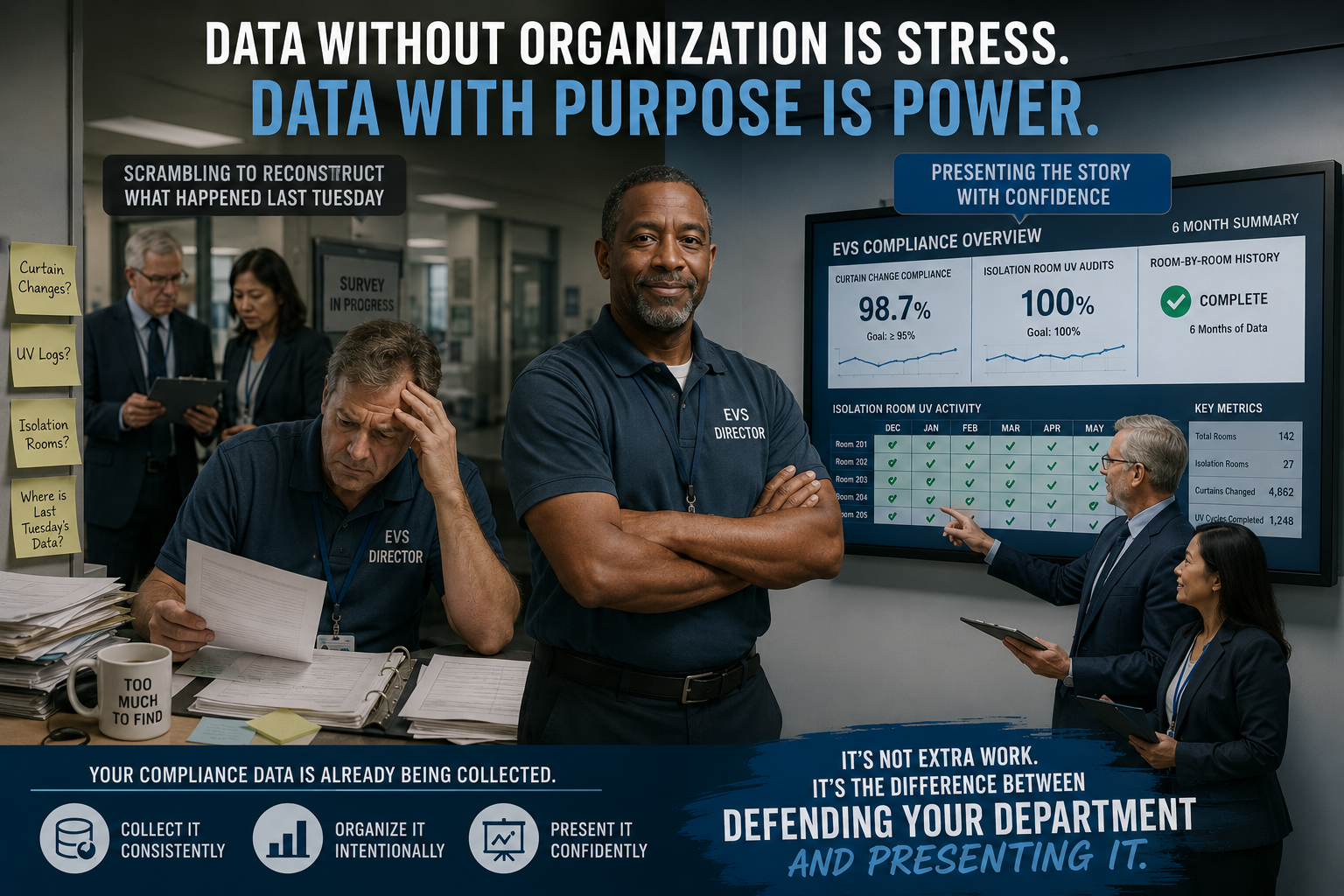
When Joint Commission or DOH walks in, the EVS director who can pull up six months of room-by-room curtain change history, cross-referenced with isolation room UV records, is having a completely different conversation than the one who is scrambling to reconstruct what happened last Tuesday.
Your compliance data is already being collected. Organizing it so it tells a story on demand is not extra work. It is the difference between defending your department and presenting it.
3. Give infection control something they cannot get anywhere else
Infection Control tracks HAI rates by unit. They know when an event occurred and what organism was involved. What they often do not know is what happened in that room in the 48 to 72 hours before the positive culture.
You know. Your terminal clean logs know. Your room assignment records know.
When EVS and Infection Control start sharing data across those timelines, patterns surface that neither team can see independently. Which rooms had accelerated turn times that week. Whether a specific cleaning product was in use. Whether staffing changed on that unit. That is not just useful. That is the kind of partnership that changes how administration views EVS.
4. Use attendance data to have the right conversation at the right time
Most managers look at attendance after it becomes a problem. An employee hits a threshold, a disciplinary conversation follows, and everyone is on the defensive.
There is a better way, and it starts the moment someone returns from a sick day.
Every time an employee comes back from an absence, I have what I call a post-absence conversation. It is a welcome back, not an interrogation. I ask how they are doing. I acknowledge that they were missed. And I touch briefly on their attendance — with praise if it is good, and with a straightforward, non-punitive note if it is not.
That conversation, done consistently, does several things. It tells the employee that their attendance is visible and that it matters. It communicates care rather than suspicion. And it creates a natural rhythm of accountability that makes formal discipline far less necessary.
The side benefit is real: when staff know that coming back means a personal conversation with their director, they think twice before calling out for something minor. Not because they are afraid, but because the relationship makes them want to show up. Attendance data makes those conversations informed. The pattern over time tells you who needs support and who needs a different kind of conversation.
5. Build the business case for resources before you are desperate for them
Every EVS director has asked for something and been told no. More staff. Better equipment. A new cart. A software upgrade.
The directors who get yes more often are the ones who bring data to the request.
Supply cost per patient day trending upward over six months is a different conversation than “we are running out of supplies.” Discharge response times documented over a quarter make a staffing request concrete rather than anecdotal. Labor cost trends compared against productivity standards tell administration exactly what the math looks like before they have to ask.
You cannot wait until the problem is obvious to start collecting the evidence. Build the documentation now, when things are manageable, so the case is already made when you need it.
6. Create a feedback loop that actually reaches the frontline
Data in EVS almost always flows upward. Productivity numbers go to administration. Scores go to leadership. Compliance reports go to infection control.
Almost nothing flows back down to the people doing the work.
That is a missed opportunity. When a tech knows that their discharge response time on Tuesday was the fastest on the floor, that means something. When a team sees that their unit had the lowest complaint rate in the building for the month, that means something. When a supervisor can show their staff a trend line moving in the right direction, that means something.
Data is not just a management tool. It is a motivation tool. The departments that share their numbers with the people generating them get better numbers back.
7. Position EVS as a source of intelligence, not just a service
This one is the least obvious and the most powerful.
Your department moves through every floor of that hospital every single day. You see things that nursing does not see. You notice things that facilities misses. You have eyes on equipment, on patient rooms, on supply rooms, on public spaces, in a way that no other department does.
That is not just operational. That is intelligence.
When EVS leaders start thinking of their department not just as a cleaning operation but as an information source, the value proposition to hospital administration changes entirely. You are not the people who clean the rooms. You are the people who know what is happening in this building and can prove it with documentation.
That shift in framing does not require new technology or a bigger budget. It requires a different relationship with the data you are already sitting on.
Most of these are not complicated. None of them require a data science degree or a six-figure software platform. They require the discipline to collect the right information, the habit of reviewing it regularly, and the confidence to use it in conversations that matter.
The data is already there. The question is what you decide to do with it.
#Leadership #Environmental Services #Intelligence
