
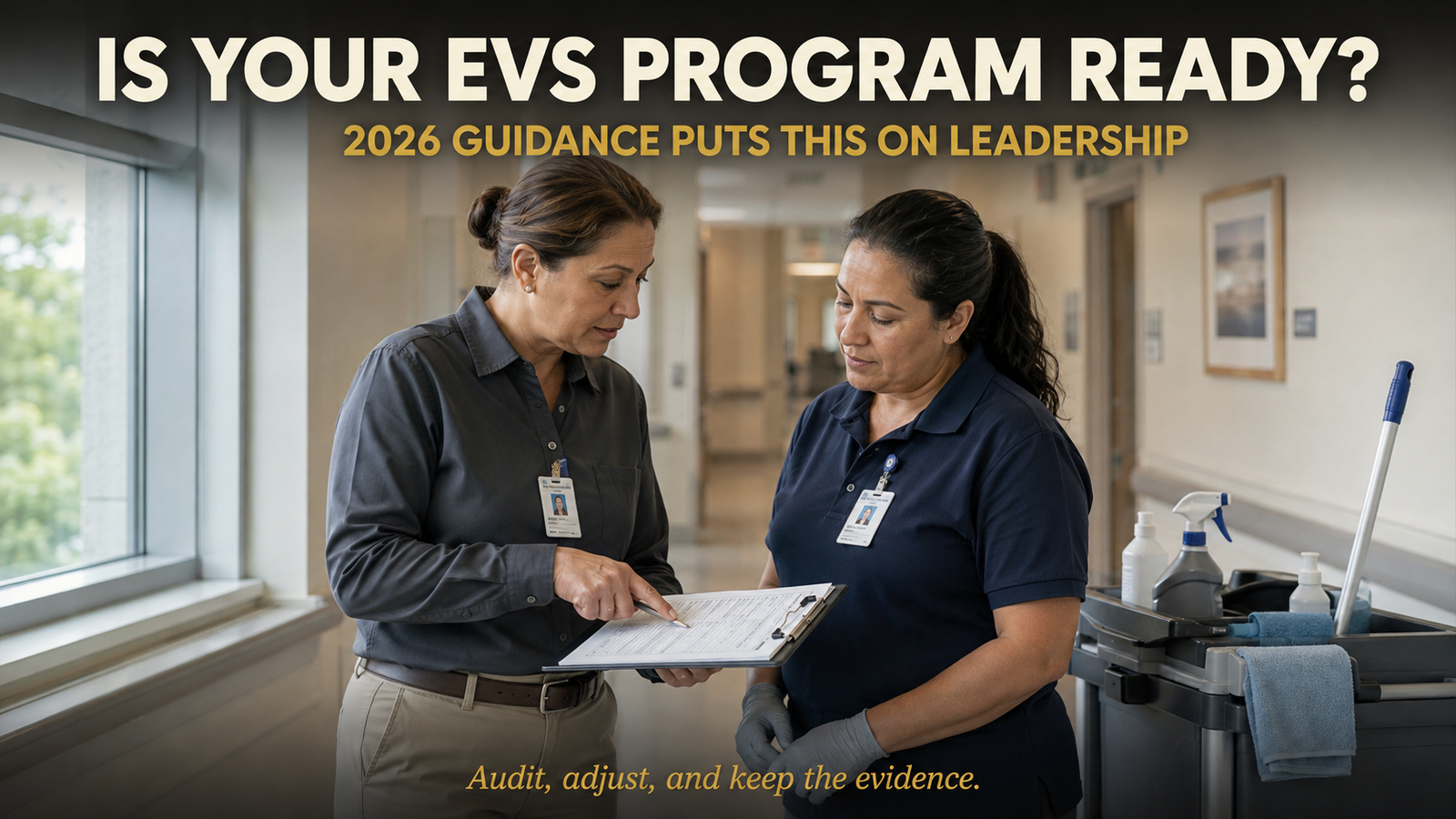
2026 Guidance Puts Infection Prevention on Leadership. Is Your Environmental Services (EVS) Program Ready?
For years, infection prevention conversations treated Environmental Services as a support function. A separate department. A cost center. The people who clean after everyone else goes home. That era is ending. The 2026 guidance is explicit: if your EVS team is not staffed, trained, and monitored, that is a leadership failure, not a staff failure.
The guidance documents do not use the word blame. They use the word accountability. The expectation has moved from “did the room look clean” to “can you prove it is clean, and can you show who is responsible when it is not.”
EVS Is Now Part of the Facility Safety Culture
Historically, EVS operated downstream of clinical decisions. Infection prevention set the policies, nursing reported the gaps, and EVS was called in after something went wrong. That has reversed. The Centers for Disease Control and Prevention (CDC) framework for environmental cleaning embeds EVS inside the facility safety culture. That means a clear reporting structure, a seat at the table for the EVS leader, and monitoring data shared back to the people doing the cleaning instead of being filed in an office.
This changes how a program is led. You are leading a function that carries real clinical risk, and it needs to be run that way.
The New Baseline Is Objective Monitoring
Visual inspection alone is no longer considered sufficient evidence. The eye cannot detect soil, biofilm, or organic residue that remains after a wipe. Three methods dominate now: fluorescent gel, Adenosine Triphosphate (ATP) testing, and direct observation.
Fluorescent gel means marking high-touch surfaces, letting them dry, having cleaning staff remove them, then checking under Ultraviolet (UV) light. The result is a simple pass or fail per surface that is easy to show a team. ATP testing measures organic residue in relative light units on a swab and gives you a number immediately, one you can trend over time. Direct observation is a trained observer watching cleaning practice in real time and scoring technique against a standard, which gives you behavior-level feedback a swab cannot.
The SHINE trial, published in Clinical Infectious Diseases in 2022, made the stakes concrete. In that study, Intensive Care Units (ICUs) using ATP monitoring with feedback saw a statistically significant drop in infections and colonizations from antibiotic-resistant organisms compared with standard cleaning. Fluorescent gel monitoring in the same trial did not show that same significant benefit. That does not mean fluorescent gel is worthless, it still catches gaps a swab won’t. ATP is simply the method with a trial behind it right now.
Cleaning Time Is a Design Standard, Not a Suggestion
A common mistake in EVS scheduling is the assumption that more rooms per hour equals better performance. The new standards treat time as a minimum, not a target. The Association of periOperative Registered Nurses (AORN) 2026 Guideline for Environmental Hygiene sets terminal cleaning expectations for the perioperative environment at 45 to 60 minutes for a standard Operating Room (OR) using approved disinfection products, and longer for higher-risk case cleaning. If the schedule does not allow the compliant cleaning time, the schedule is the non-compliance finding. Not the EVS team.
The real question is whether the staffing model is built around what the standard actually requires. Many are still built around a productivity number from a different decade.
Annual Training and Competency Verification Are Non-Negotiable
The new emphasis is not just on initial orientation. It is on annual refreshers and task-based competency verification. A worker can demonstrate the correct surface sequence once and still drift within six months. The expectations:
- Annual refresher training on infection prevention basics and departmental standards
- Task-based competency checks where a leader observes actual practice, not a quiz answer
- Retraining with documentation if a monitoring result shows a gap
- Job aids at the point of use so the standard is visible, not memorized
The monitoring and training work is exactly why you need frontline leaders who can own a section, review their own data, and coach their peers. I have seen it work best when a program already has someone being developed for that role, not scrambling to find one after the fact. I have always found at least one team member who will gladly help.
The Leadership Self-Audit Checklist
Before your next survey, leadership review, or infection prevention committee meeting, run this audit. Save it. Print it. Use it.
- Structure: does the EVS leader report into a structure where infection prevention outcomes are a shared responsibility, not something that lands on staff alone?
- Resourcing: is staffing modeled to meet documented cleaning time standards for routine and terminal cleaning per room type?
- Monitoring: which objective method is in place, fluorescent gel, ATP, direct observation, or a combination? Are results shared with the team?
- Feedback: is monitoring data reviewed monthly with frontline staff? Are wins celebrated in public and gaps coached in private?
- Training: are annual refreshers scheduled and completed? Is competency verified by observation of tasks, not just attendance?
- Job aids: are the current task aids visible at the point of use and updated to match the latest products and protocols?
- Time standards: does the schedule allow the documented time for terminal cleaning on every shift, including high-risk rooms?
- Escalation: is there a clear path for an EVS team member to flag a cleaning gap without fear, and does leadership act on it?
- Supply readiness: are products in stock, in date, and matched to the organisms listed in the facility risk assessment?
- Next leader: who on the team is being developed right now to own this program in the next five years?
The 2026 guidance does not make EVS the problem. It makes leadership the answer. The expectation is integrated, monitored, trained, and accountable. That is a high bar, but it is also a clear one. You do not need to guess anymore. You need to audit, adjust, and keep the evidence.
What is your monitoring method today? Save the checklist for your next leadership review.
Key sources: CDC framework for environmental cleaning in healthcare facilities; SHINE trial, Clinical Infectious Diseases, 2022; AORN 2026 Guidelines for Perioperative Practice, Guideline for Environmental Hygiene.
#EVS #Healthcare #Leadership #InfectionPrevention #EnvironmentalServices #PatientSafety #HealthcareLeadership #Compliance #ATPTesting #HospitalCleaning #Accountability #QualityImprovement
