
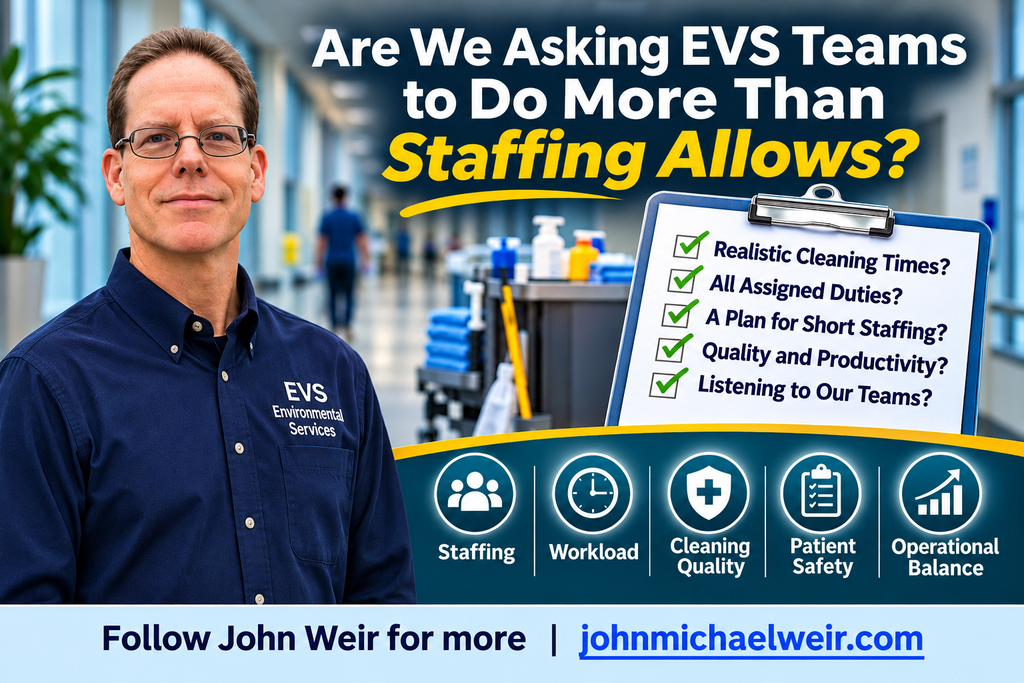
Healthcare Environmental Services departments are under constant pressure to do more with the resources available; clean patient rooms quickly, turn over operating rooms efficiently, maintain public areas, all while managing labor costs, staffing shortages, employee absences, and increasing expectations for cleaning quality.
But are we giving EVS employees enough time to perform their work correctly?
Productivity vs. Cleaning Quality
Productivity standards are important. EVS managers must use labor resources responsibly, and hospitals need efficient operations. However, productivity should never be the only measure of success.
Consider two technicians assigned the same number of patient rooms. One finishes ahead of schedule, while the other takes longer because several rooms required additional cleaning, isolation precautions, or interruptions from clinical staff.
A productivity report may suggest the faster employee performed better. But did both employees complete every required cleaning step? Were high-touch surfaces properly disinfected? Were appropriate disinfectant contact times followed?
Speed is easy to measure. Cleaning effectiveness requires additional evidence.
The CDC recommends establishing minimum cleaning times for major patient-care room types and aligning those times with staffing plans. Those times should reflect actual cleaning procedures, not simply how quickly someone can finish an assignment.
Are We Accounting for All the Work?
EVS technicians do much more than clean patient rooms. They prepare carts, replenish supplies, transport waste, respond to spills, attend required training, communicate with clinical departments, and take legally required meal and rest breaks.
A staffing model that assumes every paid minute is available for direct cleaning will overestimate the department’s actual capacity.
When staffing falls below the plan, the remaining employees are often expected to absorb the additional workload. Occasionally, that may be unavoidable. When it becomes routine, however, cleaning quality, employee safety, and morale can suffer.
A staffing shortage should trigger a deliberate operational response, not an expectation that employees simply work faster.
Five Questions EVS Leaders Should Ask
Are our cleaning times realistic? Have we observed actual cleaning procedures, including isolation rooms and discharge cleaning, to determine how much time is needed?
Are we accounting for all assigned duties? Do our staffing calculations include supply preparation, waste handling, travel time, training, and other necessary activities?
What happens when we are short-staffed? Do we have clear priorities and a plan for adjusting assignments without compromising essential cleaning?
Are we measuring quality alongside productivity? Are we using cleaning observations, fluorescent markers, ATP monitoring where appropriate, competency assessments, and employee feedback?
Are we listening to our employees? Frontline EVS technicians often recognize inefficient workflows and unrealistic expectations before management reports reveal a problem.
These questions can help managers determine whether staffing challenges result from insufficient labor, inefficient processes, or a combination of both.
Making the Case for Adequate Staffing
EVS leaders should be prepared to demonstrate staffing needs using actual workload information. Rather than simply stating that the department needs more employees, show hospital leadership the number of cleaning assignments, the time required to complete them correctly, the available productive labor hours, and the department’s quality results.
Data builds the case, but it’s stronger when paired with evidence that the department has already pursued efficiency. Better supply locations, improved equipment, more effective scheduling, and clearer cleaning responsibilities can recover valuable productive time.
But efficiency improvements have limits. There comes a point when additional work cannot be absorbed without affecting service quality or employee well-being.
Finding the Right Balance
The goal is not to eliminate productivity standards or suggest that every staffing challenge requires additional employees. The goal is to establish realistic expectations that balance operational efficiency, infection prevention, cleaning quality, and employee safety.
A successful EVS department is not necessarily the one that cleans the most rooms with the fewest employees. It is the department that consistently delivers the required level of environmental hygiene while using its resources responsibly.
The question is not simply whether our employees are working hard enough. It is whether we have designed a system that allows them to do their jobs correctly.
#EnvironmentalServices #HealthcareEVS #InfectionPrevention #HospitalCleaning #PatientSafety #HealthcareLeadership #HealthcareManagement
References
- Centers for Disease Control and Prevention. (2024). Considerations for Reducing Risk: Surfaces in Healthcare Facilities. https://www.cdc.gov/healthcare-associated-infections/hcp/infection-control/index.html
- Association for the Health Care Environment. Workloading in Environmental Services. https://www.ahe.org/workloading-environmental-services
- Centers for Disease Control and Prevention. Environmental Cleaning Programs: Monitoring and Feedback. https://www.cdc.gov/healthcare-associated-infections/hcp/cleaning-global/programs.html
- Cross, J. (November 3, 2026). Products, Practice and Proof: A Formula for Healthcare Cleaning. ISSA. https://www.issa.com/articles/products-practice-and-proof-a-formula-for-healthcare-cleaning/
Discover more from John Michael Weir CHESP CMIP T-CNACC
Subscribe to get the latest posts sent to your email.
