
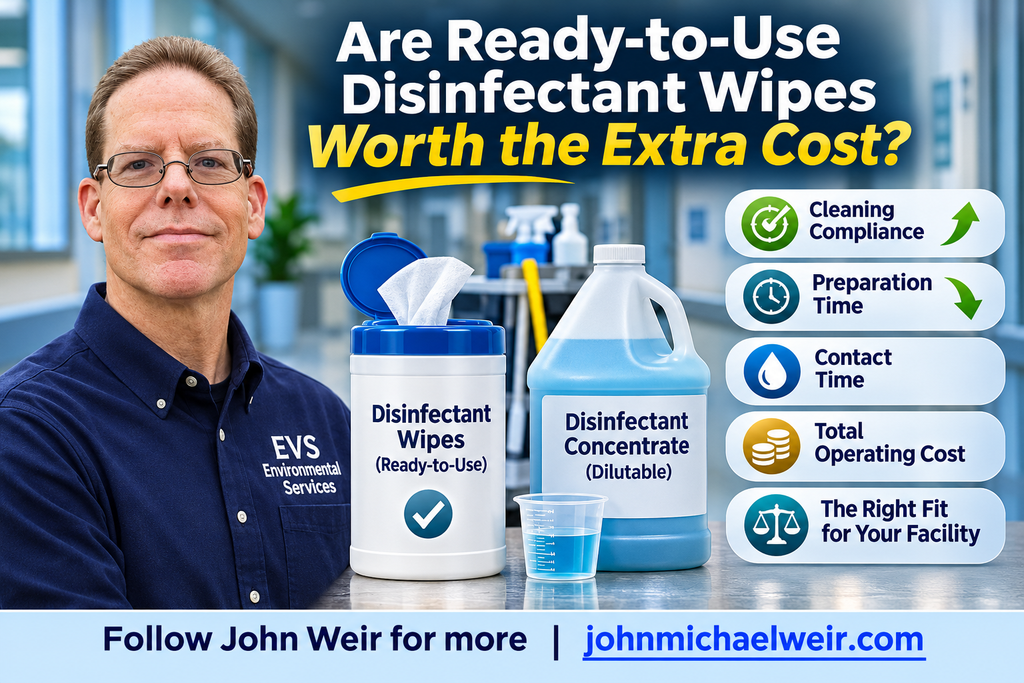
Healthcare Environmental Services departments are constantly looking for ways to improve cleaning effectiveness while controlling operating expenses. One question that frequently arises is whether ready-to-use disinfectant wipes are worth their higher purchase price compared with traditional disinfectants diluted and applied using reusable cleaning cloths.
At first glance, the answer might seem obvious. Concentrated disinfectants are generally less expensive per gallon of usable solution, while disposable wipes create an ongoing supply expense. But the cost of a disinfectant is not necessarily the same as the cost of using it.
Convenience and Consistency Matter
Ready-to-use disinfectant wipes offer several operational advantages. They eliminate the need for employees to prepare cleaning solutions, reduce opportunities for dilution errors, and provide a convenient method for applying disinfectant to high-touch surfaces. For busy EVS technicians moving between patient rooms, having the correct disinfectant readily available can simplify the cleaning process.
A 2026 study published in the American Journal of Infection Control examined a transition from a dilutable quaternary ammonium disinfectant to ready-to-use wipes. Researchers reported improved cleaning compliance following the change, although the observed reduction in overall cleaning time was not statistically significant. The study found that average cleaning compliance scores increased from 11.5 to 17.7, while average supply preparation time decreased from 13.2 minutes to 3.8 minutes.
That distinction matters. Wipes may improve consistency and simplify preparation, but we should not automatically assume they will produce measurable overall labor savings.
The Importance of Contact Time
One of the most important considerations when selecting any disinfectant is the manufacturer’s required contact time. A surface must remain wet for the time specified on the product’s EPA-approved label to achieve the applicable disinfection claim.
Some ready-to-use wipes offer relatively short contact times, which can make them easier to incorporate into routine cleaning procedures. However, contact times vary considerably by product and microorganism. A disinfectant effective against common vegetative bacteria may not have the same contact time or efficacy claims for organisms such as Clostridioides difficile spores.
EVS leaders must evaluate products based on the organisms of concern, approved uses, surface compatibility, and required procedures rather than convenience alone.
Looking Beyond the Purchase Price
When comparing disinfectant systems, managers should consider more than the cost of the chemical or wipes. Traditional systems may involve dilution equipment, reusable cloths, laundering, chemical storage, and additional handling. Ready-to-use wipes eliminate some of those activities but introduce recurring costs for disposable materials and waste disposal. The evaluation should also consider employee training, product availability, cleaning compliance, and the potential for wasted supplies.
The least expensive product to purchase is not always the most economical system to operate. A lower-cost disinfectant that is frequently mixed incorrectly, applied inconsistently, or used without achieving the required contact time may not deliver the intended results. Likewise, an expensive wipe does not guarantee effective disinfection if employees fail to use it correctly.
Is One System Better Than the Other?
Both systems can be effective when properly selected, implemented, and monitored. Ready-to-use wipes may be particularly useful for high-touch surfaces, isolation cleaning, and areas where consistent product preparation is a concern. Dilutable disinfectants may remain practical and economical for larger surfaces or cleaning applications where the facility has reliable dilution controls, appropriate equipment, and established procedures. Some hospitals may find that a combination of both approaches provides the best balance of cost and performance.
Making the Right Decision
Before switching disinfectant systems, EVS leaders should consider conducting a small operational evaluation. Compare the total cost of supplies, preparation and handling requirements, cleaning time, employee feedback, and cleaning verification results. Include Infection Prevention and frontline EVS employees in the evaluation. Most importantly, confirm that the products meet the facility’s infection prevention requirements and that employees can consistently follow the manufacturer’s instructions.
The goal is to select a system that supports reliable cleaning and disinfection while making responsible use of hospital resources. Ready-to-use wipes may cost more per unit, but their value should be measured by the complete cleaning process, not simply the price on the supply invoice.
References
Cadnum, J. L., Milner, A. L., Memic, S., & Donskey, C. J. (2026). Time and motion evaluation of cleaning and disinfection practices before and after a switch from a dilutable quaternary ammonium disinfectant to a ready-to-use wipe product. American Journal of Infection Control, 54(9), 959–963. https://doi.org/10.1016/j.ajic.2026.04.020
U.S. Environmental Protection Agency. Selected EPA-Registered Disinfectants. https://www.epa.gov/pesticide-registration/selected-epa-registered-disinfectants
Centers for Disease Control and Prevention. (2024). When and How to Clean and Disinfect a Facility. https://www.cdc.gov/hygiene/about/when-and-how-to-clean-and-disinfect-a-facility.html
#EnvironmentalServices #HealthcareEVS #HospitalCleaning #InfectionPrevention #HealthcareCleaning #Disinfection #PatientSafety #EVSLeadership #HealthcareQuality #CleaningCompliance
Discover more from John Michael Weir CHESP CMIP T-CNACC
Subscribe to get the latest posts sent to your email.
