
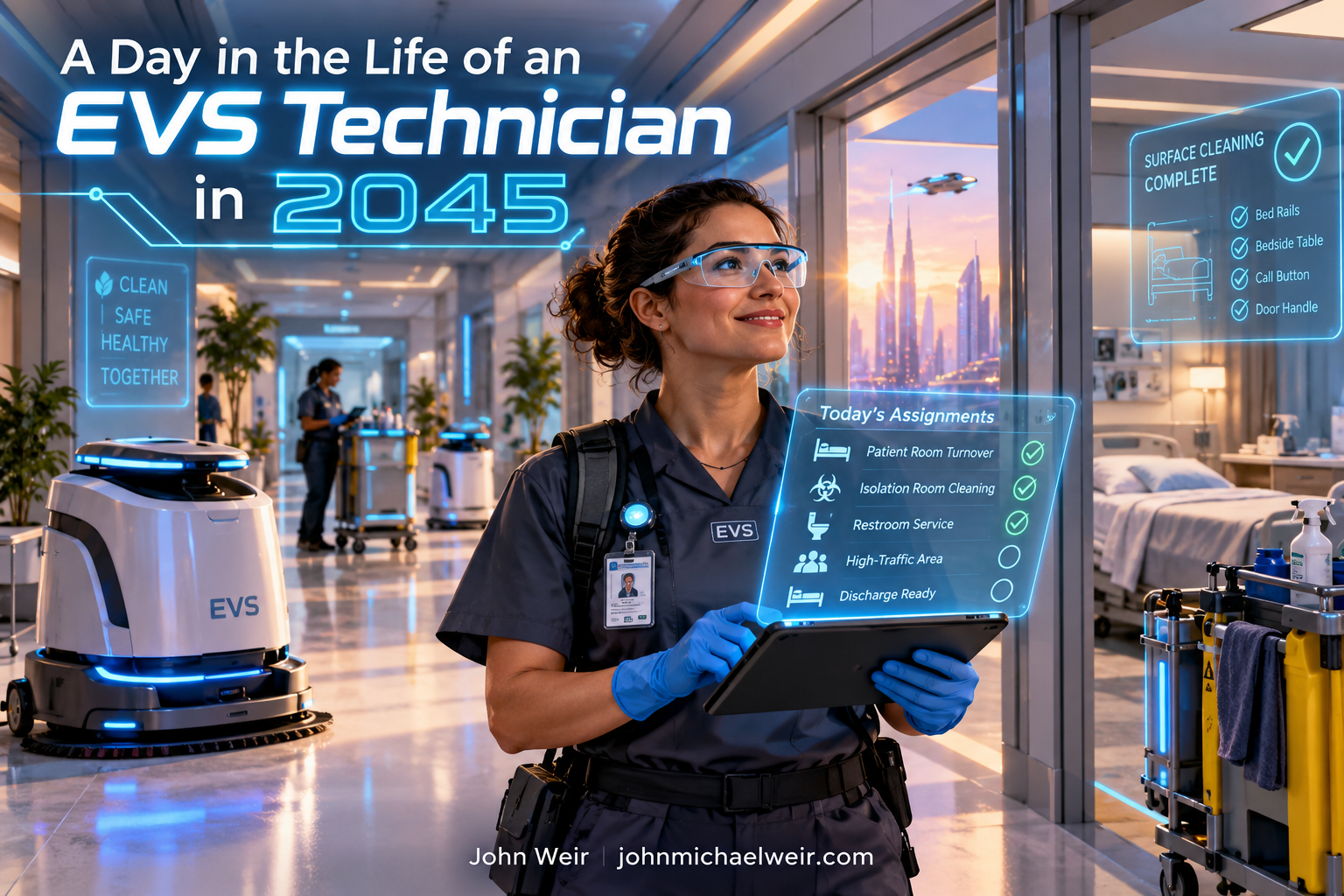
In my last post I walked through fifty years of Environmental Services, from cotton string mops and shared buckets to microfiber, color-coding, and the autoscrubbers many of us run today. That piece looked back. This one looks twenty years forward, and it is imagination, not a forecast, but it is imagination built from things already showing up in hospitals in some early form. So, I want to walk through one shift as I picture it, from the moment a technician clocks in to the end of her day.
Dana arrives for the 6am shift and there is no printed assignment sheet waiting for her in the EVS office. She checks a digital dashboard instead, and by the time she looks at it the system has already pulled together discharge activity, room occupancy, who is on shift, and the infection prevention requirements for each space. It can see that three rooms on her units are approaching discharge, that an isolation room will need specialized cleaning when it turns over, that the emergency department is running unusually high turnover, and that a night-shift technician is close to the end of her shift with work still open, and it recommends assignments around all of that so nobody walks the length of the building for a room that was next door to where they already were. The biggest improvement is not faster cleaning; it is that so much of the time wasted between assignments is gone.
The night already took care of a lot of the floor work. Autonomous floor machines ran the scheduled corridor cleaning while the building was quiet and are back on their docks, so the main hallway is dry before the first visitors come off the elevator. The public restrooms have touchless faucets, soap dispensers, flush valves, and doors, and overnight each one closed, ran its automated cleaning cycle, verified the programmed steps, and reopened on its own. Two of them still need a person. In one, a smart waste container signaled EVS directly that it needed attention instead of waiting to be found on a scheduled round, and in the other the occupancy sensors show heavy use from the emergency department waiting room, which triggered an additional cleaning. Those two go to the top of her list, because somebody still has to remove the trash, replenish the supplies, address any visible contamination the cycle did not handle, and verify that the equipment did what it says it did.
By 7am she is at her first patient room, and it is occupied. Before she knocks, a digital assistant on her device shows the precautions for that room and the cleaning sequence, so she is not working from memory or from a sign she glanced at in the hallway. She works the room the way good technicians always have, and the system records each task as she completes it, so the documentation is finished when the cleaning is finished instead of being something she pieces together at the end of the shift.
The room is also paying attention to what she touches. An AI-supported monitoring system tracks which surfaces have been wiped, and it can tell she has done the bed rails, the bedside table, and the call button but has not touched the door handle, which is one of the surfaces people touch all day. She gets a notification before she leaves, not on an audit report weeks later, and she wipes the handle on her way out. This part is not entirely science fiction. A 2025 study evaluated an AI platform using thermal and optical cameras to monitor cleaning coverage and contact time on selected surfaces, and the preliminary findings were promising, although broader validation was still needed, so I treat it as an early signal and not a finished product.
A few rooms later an older man starts apologizing before she is through the door, because his breakfast tray went over and the floor around the bed is a mess. The system knows the room has a spill. It does not know he is embarrassed about it, so she tells him this is exactly what she is there for and talks with him while she cleans it up, and when he mentions he has been waiting a while for help getting to the bathroom, she tells his nurse on her way out instead of assuming someone already knows. None of that shows up on her dashboard as a task, but it has always been part of the work, and the time the automation gave back is what lets her slow down for it.
Mid-morning a patient two doors down is discharged. The bed-management system notifies EVS the moment the discharge goes in, and the assignment goes straight to the nearest technician, which today is Dana, without anyone waiting on a phone call or a radio message that may or may not be heard over the noise of the unit. Before she goes in, the room’s display shows her what the previous patient had. That patient was being treated for C. diff, so the display tells her what PPE to put on and flags the room for sporicidal disinfection, which means bleach. The broad-spectrum disinfectant she uses every day already covers nearly everything she will see, which is why one disinfectant does the job in so many rooms, but it does not kill C. diff spores. So, she switches to bleach for this room. None of that is new knowledge, good technicians have always needed to know it, the difference is that she is not depending on an isolation sign that may have come down at discharge or a nurse she has to track down to ask.
The room itself is built differently from the rooms we clean now. The surfaces are seamless, with fewer joints and crevices and fewer hard-to-reach places where soil builds up. The bed, cabinets, and equipment are designed for access beneath and around them, several of them wall-mounted, so she is not dragging furniture away from the wall to clean behind it, and the medical equipment has smooth surfaces, fewer exposed seams, and materials compatible with hospital disinfectants. Some surfaces are antimicrobial materials, selected because they may reduce microbial survival under specified conditions, and none of that changes her job, because those materials do not replace routine cleaning and disinfection. Sensors watch for water leaks and unusual moisture, and one of them has already flagged moisture under the sink, so a work order went to Facilities before she got there. She completes the terminal clean, an approved supplemental disinfection system runs its cycle and records the result, and the room is released for the next patient only after every required check is satisfied.
When she finishes, she does not push a heavy waste container across the hospital. She places the secured container at an approved collection point, and an autonomous transport system retrieves it and delivers it where it needs to go. While she was in the room, a supply robot delivered clean materials to the storage areas on the unit, and the same kind of system is moving clean linen and restocking supply locations between departments. Hospitals move enormous quantities of waste, soiled linen, clean linen, and supplies every day, and that work takes significant employee time and a lot of lifting, pushing, pulling, and repetitive movement. This is where I think automation could make a substantial difference for the people doing the work.
On her way back down the hall she passes a vacant room where a mobile cleaning robot is working. It uses cameras, sensors, and a robotic arm to clean the countertops and tables, wipe certain bed-frame surfaces, clean the compatible door handles and fixtures, and disinfect the designated high-touch surfaces, then it mops the floor and documents what it treated. Vacant rooms, administrative areas, and some public spaces are where a machine like this does its best work, because those spaces stay predictable. An occupied patient room does not, furniture moves, equipment changes position, and the robot has to tell what it is allowed to clean from what needs special handling, so the occupied rooms on her list stay hers, and so does a discharge like the C. diff room she just finished.
Dana’s supervisor has had a different morning too. Instead of spending much of it locating supplies, answering routine assignment calls, and compiling reports by hand, the supervisor started at the department’s performance dashboard, and the time that used to go to chasing things goes to coaching, inspections, training, and supporting employees on the units. That supervisor also needs stronger technical and analytical skills than the job asks for today, because reading the data and knowing what it means is now part of leading the shift. The director’s week shifts in the same direction, with more of it going to evaluating equipment investments, coordinating with Information Technology, analyzing operational performance, and integrating environmental cleaning systems into hospital-wide operations. The floor machines, sensors, and dashboards only work if they connect to bed management, Facilities, and supply chain, and somebody in EVS has to own that.
When people hear about robots cleaning hospitals, they often assume Environmental Services positions will eventually disappear. I see a different possibility. I believe EVS jobs become more specialized and more technically demanding over the next twenty years, with new responsibilities around robotic equipment, automated cleaning systems, environmental monitoring, and digital quality assurance. Technicians will need training in operating automated equipment, troubleshooting systems, interpreting cleaning data, and understanding infection prevention technologies that keep getting more sophisticated. The physical demands of some jobs could come down as machines take over repetitive floor cleaning, heavy transport, and other physically demanding tasks, and the technology creates its own maintenance responsibilities and different staffing models. Hospitals may eventually need fewer labor hours for certain routine tasks, and they will still need skilled employees for patient-room cleaning, complex contamination events, specialized environments, and quality assurance.
Every decade in my last post changed the tools and left the core of the work where it was, and I expect 2045 to do the same. The technology in Dana’s day has not eliminated Environmental Services, it has eliminated many of the unnecessary obstacles that keep Environmental Services from doing its best work. By the end of her shift a machine has run the corridor, a camera has caught the door handle, and a robot has wiped down a vacant room, but someone still had to clean the room correctly, understand why the sequence matters, notice the man who was embarrassed about his tray, and know what to do when the system gets it wrong. That person is still an EVS technician, and the job will ask more of them, not less.
#EnvironmentalServices #HealthcareLeadership #HospitalOperations #InfectionPrevention #HealthcareTechnology #SupportServices #WorkforceManagement #PatientSafety
