
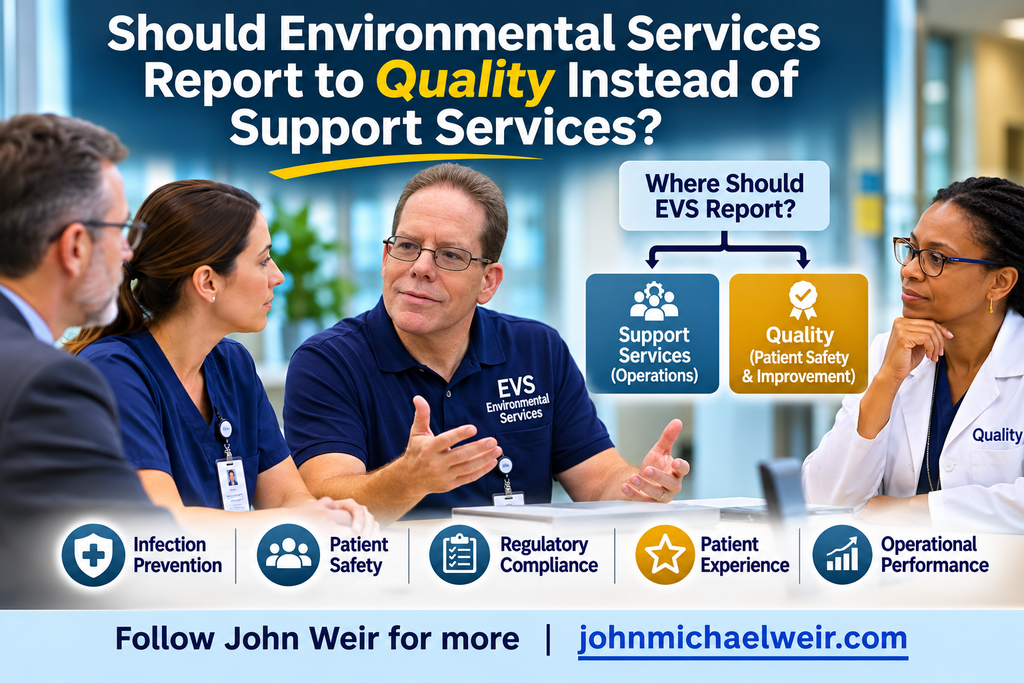
For decades, hospital Environmental Services departments have traditionally reported through Support Services, Facilities, or Operations. That structure makes sense from an operational standpoint — EVS manages staffing, budgets, equipment, supplies, and the daily cleaning of the healthcare environment. But perhaps it is time to reconsider where EVS belongs in the hospital’s organizational structure. What if Environmental Services reported directly to Quality?
Think about what EVS professionals do every day. We help reduce environmental infection risks. We clean and disinfect patient rooms, operating rooms, emergency departments, and other clinical areas. We support isolation precautions, respond to contamination events, and help maintain an environment that is safe for patients, visitors, and staff. Our work directly supports infection prevention, patient safety, regulatory compliance, and the patient experience. Those are all central responsibilities of a hospital’s Quality department.
Yet EVS performance is frequently evaluated through operational measurements such as labor productivity, cleaning costs, staffing levels, and discharge room turnaround times. Those measurements are important — hospitals must operate efficiently, and EVS leaders must be accountable for their resources. But efficiency alone does not tell us whether we are delivering a safe, clean healthcare environment.
Imagine an EVS department where performance discussions routinely include cleaning verification results, infection prevention collaboration, employee competency, patient safety concerns, and corrective actions alongside traditional productivity measures. Imagine EVS leadership participating more directly in Quality initiatives, patient safety discussions, and organizational improvement efforts. Would reporting through Quality strengthen that relationship?
There are legitimate arguments for maintaining EVS within Support Services. Operational oversight, resource management, and coordination with other support departments remain essential. Changing a reporting relationship does not automatically improve cleaning quality or patient outcomes. And a department does not necessarily need to report to Quality to be fully integrated into the hospital’s quality and safety programs.
Perhaps the real question is not simply where EVS reports, but whether Environmental Services has the organizational visibility, authority, resources, and accountability appropriate to its role in patient safety. Still, I believe the reporting relationship is a conversation worth having. Environmental Services has evolved considerably over the past several decades. Our organizational structures should be evaluated to ensure they reflect that evolution.
I’d like to hear from other healthcare leaders: Should Environmental Services report directly to Quality, remain within Support Services, or operate under a different structure? More importantly, what reporting structure have you seen work best, and why?
#EnvironmentalServices #HealthcareEVS #HealthcareQuality #PatientSafety #InfectionPrevention #HospitalLeadership #HealthcareManagement
Discover more from John Michael Weir CHESP CMIP T-CNACC
Subscribe to get the latest posts sent to your email.
