
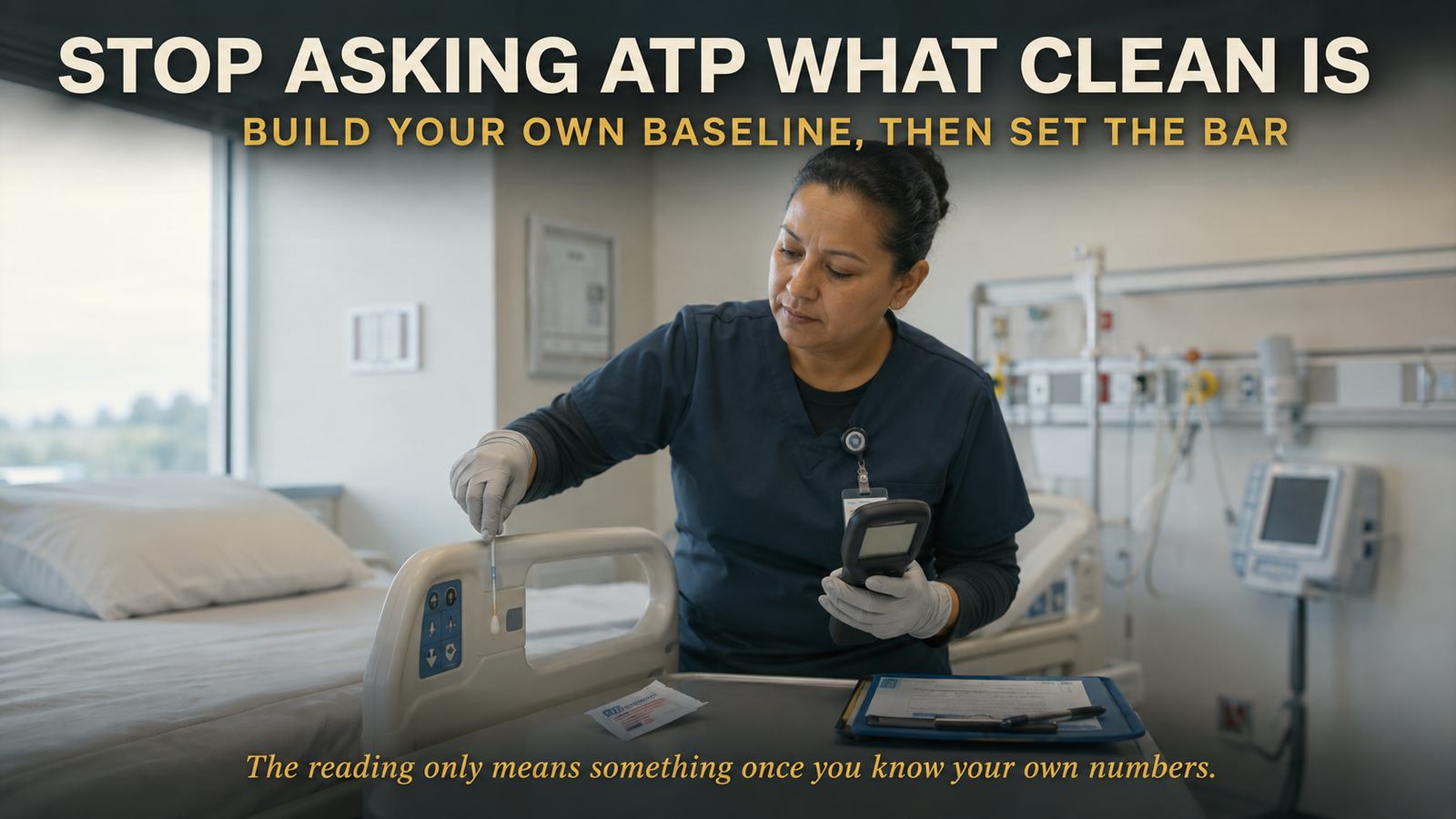
Stop Asking ATP What Clean Is
Most Environmental Services (EVS) departments that adopt an ATP (adenosine triphosphate) luminometer program start with the same question: what should our pass/fail number be. That is the wrong question. The right one is what does clean look like on our surfaces, with our chemistry, with our staff, measured by our device. You cannot answer the first question honestly until you have answered the second.
I have used Hygiena for many years. At my facilities, we are working to get set up with Neogen, which bought out the 3M Clean-Trace program. Every time a facility moves between systems like this, the same lesson repeats: the number on the screen means nothing until you know what your own surfaces read.
What ATP Measures
ATP testing measures organic residue, not sterility. A low reading tells you a surface is free of biological material at a level the device can detect. It does not tell you the surface is free of pathogens, and it was never designed to.
That distinction matters because a lot of departments treat the Relative Light Unit (RLU) number like a lab result with a fixed normal range, the way you would read a blood test. It is not that. A 2017 systematic review by Nante and colleagues, published in the Journal of Preventive Medicine and Hygiene, looked at the cutoffs used across published studies and found benchmark values ranging from 45 RLU to 1,000 RLU, with 250 and 500 as the two most common cutoffs, and some studies using different thresholds for different surface types within the same building. There is no universal number in the research because there is no universal surface, device, or cleaning process.
Even the manufacturers admit this. Hygiena’s own website states plainly that no ATP systems measure on the same scale, and they publish a conversion calculator just to translate readings between their system and competitors like Neogen, Charm, and 3M. If the companies selling these devices cannot agree on a shared scale, no EVS leader should be borrowing someone else’s cutoff and calling it a standard.
Why a Borrowed Number Fails
Readings vary by luminometer brand and surface material. They vary by cleaning chemistry, soil load, and sampling technique. They vary by your own facility’s cleaning workflow. A bed rail in a med-surg room is not the same surface as an OR boom or a bathroom grab bar. If you apply one cutoff to all of them, you will end up punishing a hardworking team for a surface that is inherently harder to get clean, and letting a team coast on a surface that was always going to read low.
Set the threshold too tight before you know your own baseline, and you get a program where almost everything fails. That is not process improvement. That is discouraging, and a discouraged team stops trusting the tool.
Build Your Own Baseline First
Here is the approach that works, and it is not complicated.
Pick your high-priority, high-touch surfaces. Test them repeatedly, after your normal cleaning process, for at least two weeks. Do not test once and call it a baseline. You are looking for a real pattern, not a single data point.
Say that pattern comes back showing your team is consistently landing around 200 RLU across those surfaces after a normal clean. Setting your pass threshold at 50 in that situation is a mistake. Nearly everything will fail, not because your team is doing a bad job, but because the number was never grounded in what your facility actually produces.
Instead, build tiers around your own data. Something like this: 0 to 150 passes clean. 151 to 200 passes, but flags that the surface could be cleaner. 201 and above fails and gets re-cleaned on the spot. That range is not arbitrary. It came from watching your own surfaces long enough to know what normal looks like before you set a bar.
From there, the bar is supposed to move. As training improves and technique gets more consistent, you tighten the range. The 150 ceiling becomes 120. The 200 fail line becomes 175. You are not managing to a fixed number forever. You are using the data to drive a trend, one training cycle at a time.
What This Buys You
Used this way, ATP stops being a pass/fail hammer and becomes a coaching tool. It tells you where to focus training, which surfaces need a process change, and whether your team is actually improving over time, not just whether they cleared an arbitrary bar someone else set.
Stop asking ATP what clean is. It cannot answer that question, and neither can a number borrowed from a study done in a different building with a different device. Start asking what clean looks like in your own facility, build the baseline that answers it, and let the threshold move as your team gets better.
#HealthCare #EVSLeadership #ATPTesting #Quality #CleaningStandards #InfectionPrevention #StarLeadership
