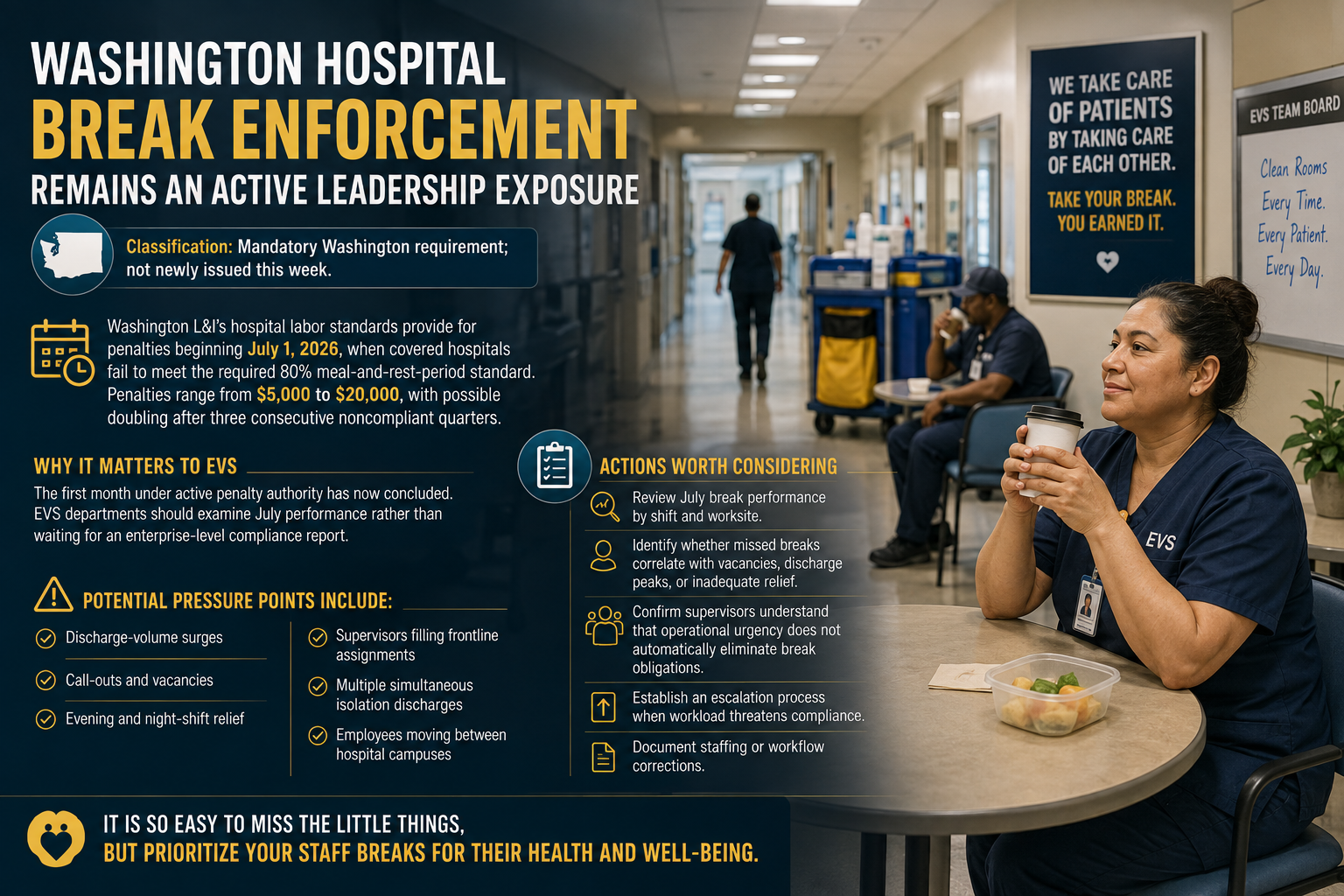
Washington hospital break enforcement remains an active leadership exposure

Washington hospital break enforcement remains an active leadership exposure
Classification: Mandatory Washington requirement; not newly issued this week.

Washington L&I’s hospital labor standards provide for penalties beginning July 1, 2026, when covered hospitals fail to meet the required 80% meal-and-rest-period standard. Penalties range from $5,000 to $20,000, with possible doubling after three consecutive noncompliant quarters.

Why it matters to EVS
The first month under active penalty authority has now concluded. EVS departments should examine July performance rather than waiting for an enterprise-level compliance report.

Potential pressure points include:
Discharge-volume surges
Call-outs and vacancies
Evening and night-shift relief
Supervisors filling frontline assignments
Multiple simultaneous isolation discharges
Employees moving between hospital campuses

Actions worth considering
Review July break performance by shift and worksite.

Identify whether missed breaks correlate with vacancies, discharge peaks, or inadequate relief.

Confirm supervisors understand that operational urgency does not automatically eliminate break obligations.

Establish an escalation process when workload threatens compliance.

Document staffing or workflow corrections.

It is so easy to miss the little things, but prioritize your staff breaks for their health and well-being.

With over 27 years in Healthcare Environmental Services (ES), I lead with a belief that attitude drives outcomes. As a Regional Director at MultiCare Health System, I oversee multi-site ES operations with a focus on people-first leadership, infection control, and operational excellence. I champion a Positive Mental Attitude (PMA) not as a slogan, but as a leadership principle. I believe positivity is contagious, and as a leader, I set the tone. Through consistent, uplifting communication, I create environments where ES teams feel empowered to be helpful, proactive, and proud of their impact. For me, development is a choice, and I invest in training, huddles, and coaching that energize teams, helping them thrive in their current roles and grow toward what’s next. My approach to high standards isn't theoretical, it's practical. Just like we notice when a hotel room is clean and fresh, patients and families immediately sense a space that’s been cared for. Through standardized protocols, team accountability, and a shared mission, I help create clean, safe, and healing environments that directly enhance patient experience and staff well-being. It's a privilege to lead teams that play such a vital role in the patient journey, and to help elevate the perception and performance of ES professionals across our system.

What do you think?