
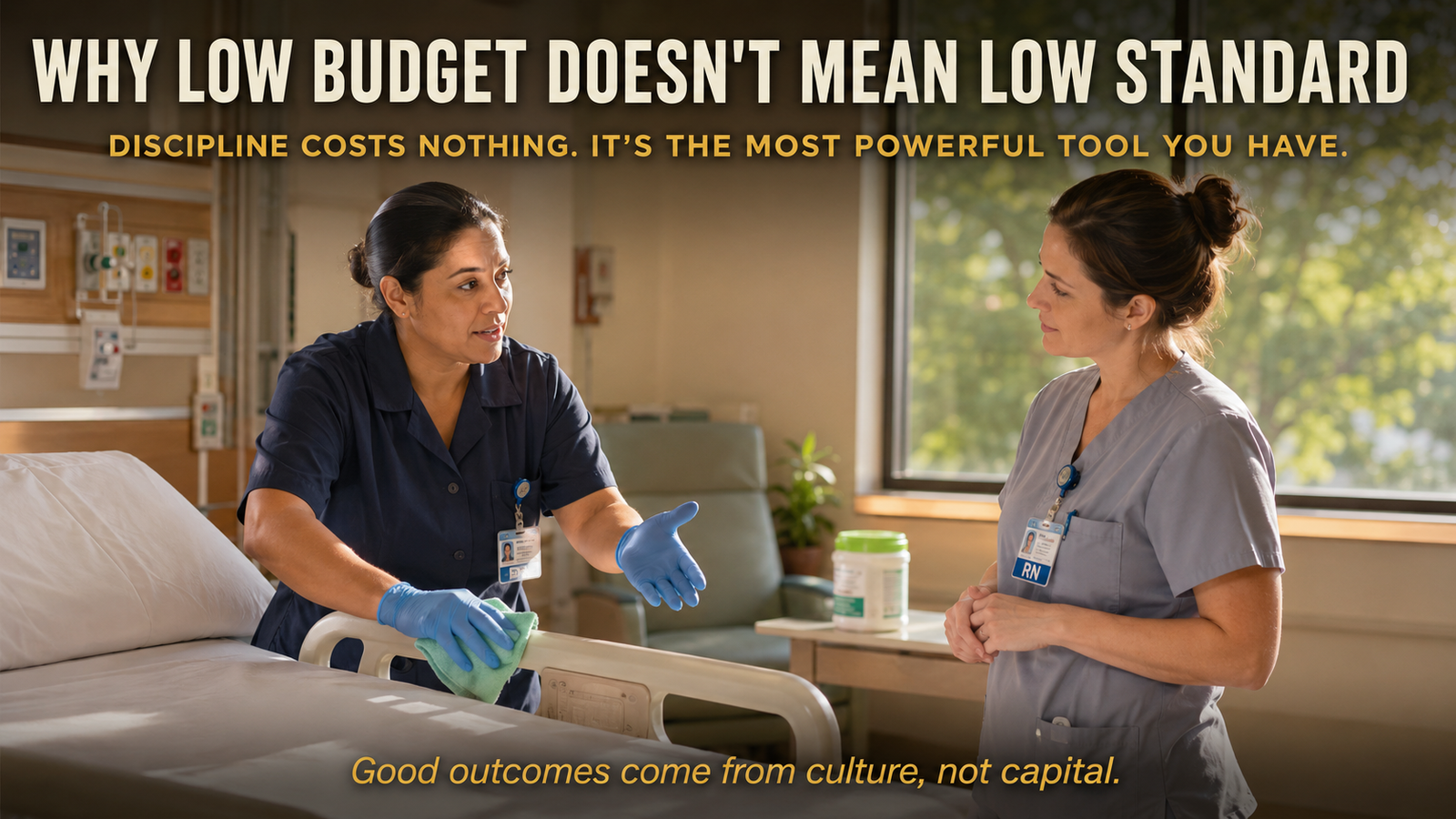
Why Low Budget Doesn’t Mean Low Standard
You don’t need a multi-million dollar capital equipment budget to lower your Hospital-Acquired Infection (HAI) rates. You need a better culture and a better process. Process improvement is free. It costs time and discipline, not capital. That makes it the lifeblood of healthcare, not something that gets skipped when budgets are tight. Every decision has to be looked at with continuous process improvement in mind.
What Process Improvement in Healthcare Actually Is
Process improvement is not a program you buy. It is a habit of looking at how work actually gets done, finding the step that is causing the problem, testing a small change, and checking whether it worked before you roll it out everywhere.
It matters because drift is real. Busy days and shortcuts pull a process away from what it is supposed to be, a little at a time, until the way work actually happens and the way it is written down are not quite the same thing anymore.
The basic structure is simple. Identify a specific problem, not a vague one. Test one change on a small scale, not a full rollout. Measure whether it actually worked. Then either adjust and try again, or standardize it and move on to the next problem. That is the whole cycle, and none of it requires a purchase order.
This is a shallow pass on purpose. If you want a deeper look at how to actually run this cycle in an Environmental Services (EVS) department, say so in the comments and I will write that piece next.
Why EVS Staff Have to Feel Safe Speaking Up
EVS staff are often the second most consistent presence a patient sees, right behind their nurse, and even that can change shift to shift. Physicians see a patient and move on to the next one. That kind of steady presence means EVS staff notice things a quicker visit might miss.
That visibility only matters if staff feel safe using it. They need to feel comfortable speaking up when they see a physician or nurse enter a patient’s room without sanitizing or washing hands, when someone leaves a room without using the foam sanitizer at the door, or when someone goes from one patient room to another without sanitizing in between. They need to feel just as comfortable saying something when a patient mentions something that does not sound right, or when isolation precautions are posted on a door and the person walking in is not following them.
There are other moments too, contact-precaution Personal Protective Equipment (PPE) sitting unused outside a door instead of being worn, or a visitor walking in and out of an isolation room without any guidance at all. None of these get reported because a policy said to report them. They get reported because someone felt safe enough to say something.
Every one of those moments is a potential HAI sitting in plain sight. An EVS department that trains its staff to notice and actually say something, without fear of stepping outside their lane, is running its own infection prevention program whether it gets credited for it or not.
The Safety Filter
Every EVS expenditure should pass through one question: does this improve patient outcomes? Not whether the vendor brochure looks convincing. Not whether it is the newest option on the market.
A few years ago I started what we call Bleach Wednesdays. One day a week, EVS cleans with a sporicidal disinfectant, Clorox Healthcare Germicidal Bleach Wipes, as a higher standard of clean specifically aimed at breaking the chain of infection. It costs more than our standard product. That cost has been offset by a real, measurable drop in hospital-acquired Clostridioides difficile (C. diff) cases.
That is the filter in practice. The expenditure was not justified by a sales pitch. It was justified by patients getting fewer infections. If a purchase cannot point to an outcome like that, it does not belong in the budget, no matter how good the pitch was.
Where This Leaves You
None of this requires new capital. It requires a team willing to look at its own process, staff who feel safe saying something when they see a risk, and a habit of asking what an expenditure actually buys your patients before you ask what it costs.
How is your facility doing more with less? Share your biggest win in the comments.
#EVS #Healthcare #Leadership #ContinuousImprovement #InfectionPrevention #PatientSafety #HospitalCleaning #EnvironmentalServices #CDiffPrevention #HealthcareLeadership #ProcessImprovement #HAIPrevention
