
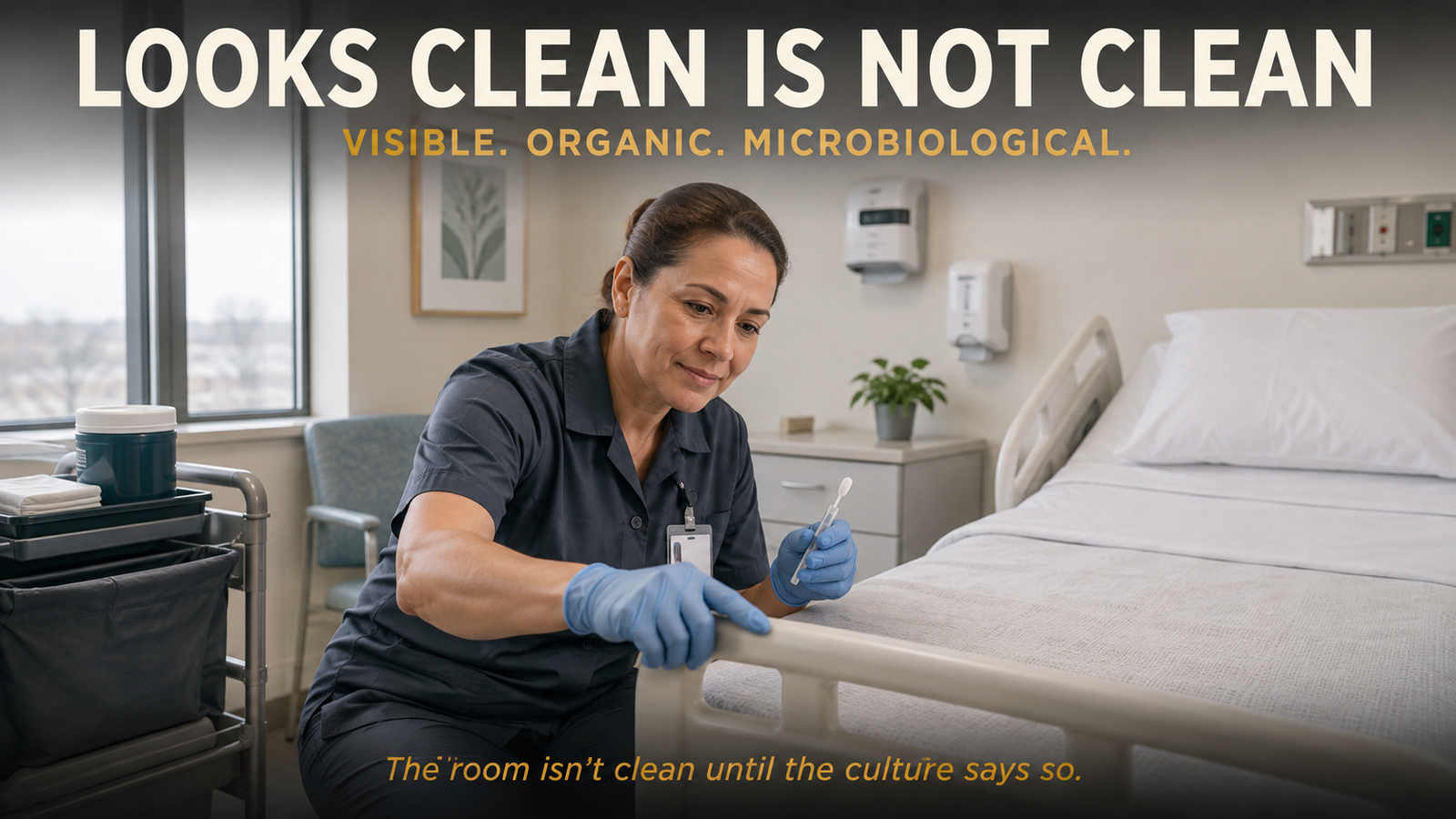
Looks Clean Is Not Clean
A room can look spotless and still fail. I wrote yesterday about why a fixed ATP (adenosine triphosphate) threshold borrowed from a study or a vendor is the wrong way to judge that failure. This is the piece underneath it: the three different things people mean when they say a room is clean, why many Environmental Services (EVS) programs only ever check one of them, and what that gap actually costs.
Visual clean is the standard patients see. It is also the easiest one to fake. A surface can look perfect and still carry an organic film that a swab and a wipe never fully broke down. That gap between what the eye can confirm and what is actually there is where infection risk lives.
The Three Levels of Clean
Many hospitals only ever check the first of these three levels, and many patients only ever see the first one too.
Visual clean is what you can see. No visible soil, no streaks, no debris. It is real and it matters, but it is a floor, not a ceiling. A room can pass every visual inspection and still be carrying a biological load a device would catch.
Organic clean is what an ATP luminometer measures. It tells you whether biological residue is present at a level the device can detect, expressed as a Relative Light Unit, or RLU, reading. This is the level I wrote about yesterday: there is no universal number here, only a number that means something once you know your own facility’s baseline.
Microbiological clean is what a culture tells you. This is the level that actually confirms whether specific pathogens are present, and it is the slowest and most resource-intensive of the three. Many EVS programs cannot run a culture on every high-touch surface every day. That is not a criticism. It is a resourcing reality, and it is exactly why the organic level matters so much: it is the fast, repeatable proxy that catches problems long before anyone would think to send a swab to the lab.
Three different questions, three different answers. Looks clean, tests clean, and is clean are not the same claim, and a program that only ever checks the first one is answering the easiest question instead of the one that matters.
Why Elbow Grease Alone Fails
Wiping visible soil off a surface is not the same as breaking down the organic film underneath it. Soil is the layer you can see. Biofilm and organic residue are what remains after the soil is gone, and they do not respond to friction the way visible dirt does. They respond to contact time: the disinfectant staying wet on the surface long enough to actually do its job, not just long enough to look wiped.
A tech who wipes fast and moves on can leave a surface looking perfect and testing high. That is not a training failure in the sense of not knowing how to wipe. It is a training gap in understanding what wiping is actually supposed to accomplish. Elbow grease handles the soil. Chemistry and contact time handle what soil was hiding.
What the Number Actually Means
An RLU reading is not a grade. It does not mean anything on its own, the way a body temperature or a blood pressure number does. It only means something next to your own facility’s baseline, which is the whole argument from yesterday’s piece: test your high-touch surfaces for at least two weeks, find out what your team’s normal actually looks like, and set three tiers from that data, one range that passes clean, one that passes but signals room for improvement, and one that fails and gets re-cleaned.
For a frontline supervisor standing in a room with a device in hand, here is what that translates to in practice. A reading inside your pass range means the surface is clean by your own standard and the room moves forward. A reading in your watch range is not a failure. It is a flag that the surface is trending toward the edge of what your team normally produces, worth a second look next time, not a re-clean today. A reading above your re-clean line means the surface gets redone before anyone uses the room, no exceptions and no debate.
The device does not replace judgment. It gives a supervisor something concrete to point to instead of an argument about whether a room looks good enough.
Building a Verification Culture Without Humiliating Staff
The fastest way to kill an ATP program is to use it as a gotcha. If the device only shows up to catch someone failing, staff will start treating the tool as the enemy, and you will lose the one thing that makes verification worth doing: honest reporting when something is off.
The goal of verification is finding system failures, not finding people to blame. A high reading on the same surface, on the same shift, week after week, is not evidence that one person is bad at their job. It is evidence that a process, a product, or a training gap needs attention. Treat the first high reading as information. Treat a repeated pattern as a coaching conversation, not a write-up.
The programs that get real value out of ATP testing are the ones where staff will tell a supervisor a surface might need a re-test, because the tool is understood as protection, not surveillance. That trust is built slowly, one blame-free conversation at a time, and it is worth more than any single number the device will ever produce.
Where This Leaves You
Visual clean, organic clean, and microbiological clean are three different claims, and many programs are only ever answering the first one. Closing that gap does not require running a culture on every surface. It requires taking the organic level seriously: understanding what an RLU number actually means, building your own baseline instead of borrowing someone else’s, and using the tool to coach your team instead of catching them.
That is the difference between a program that looks clean and one that is.
#LooksCleanIsNotClean #EnvironmentalServices #EVSLeadership #InfectionPrevention #InfectionControl #ATPTesting #OrganicClean #MicrobiologicalClean #DataDrivenCleaning #PatientSafety
