
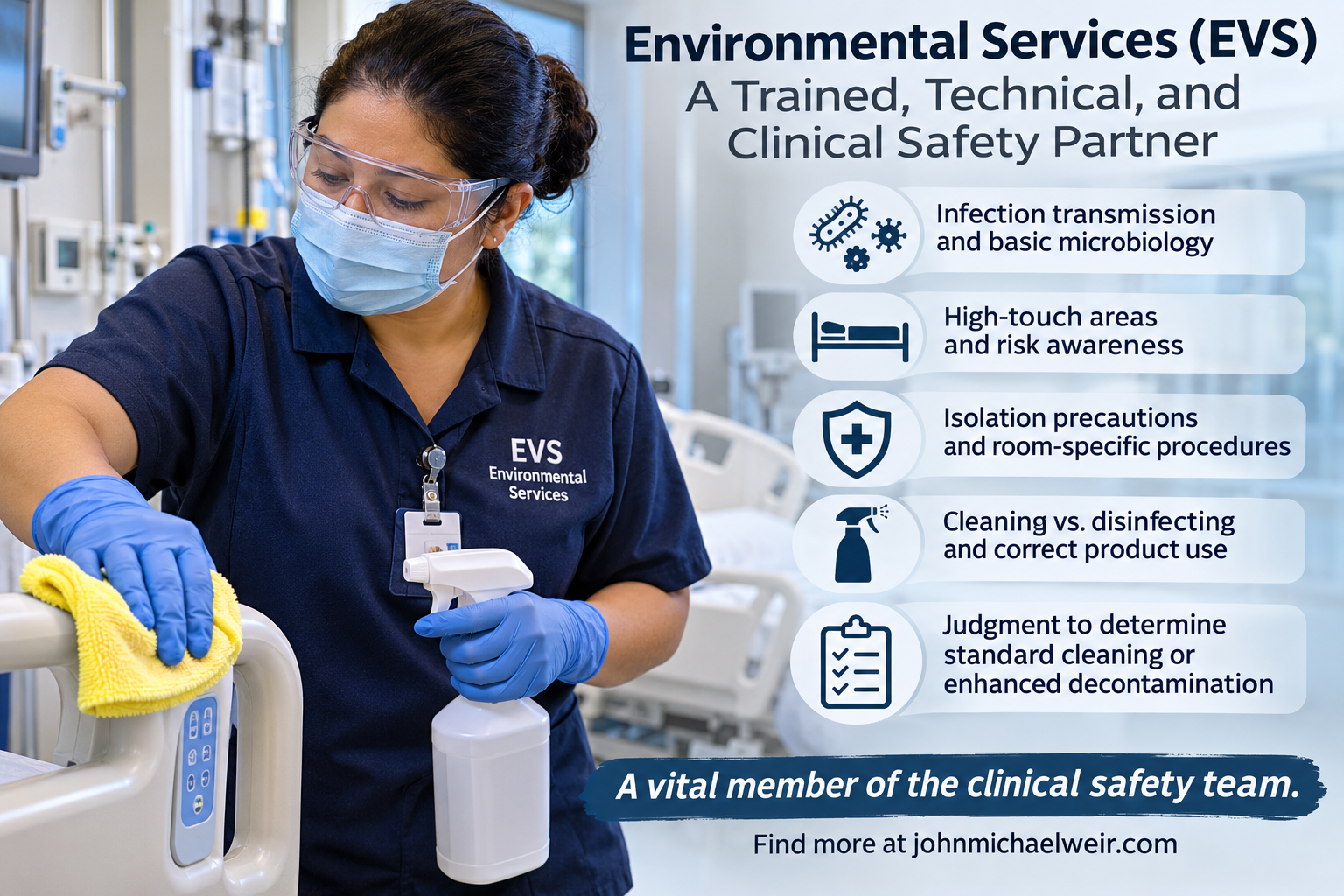
The old image of a janitor with a mop does not describe modern Environmental Services. EVS workers operate within a safety system that requires technical knowledge, careful judgment, and close coordination with clinical teams.
Today, Environmental Services work begins with understanding how infections move through a healthcare setting. EVS professionals learn basic microbiology, including how bacteria, viruses, fungi, and spores survive on surfaces and transfer to hands, equipment, clothing, and patients. They are trained to recognize high-touch areas such as bed rails, doorknobs, call buttons, light switches, and bathroom fixtures, because these surfaces are contacted repeatedly throughout the day.
Training also covers isolation precautions, room-specific cleaning procedures, and the difference between cleaning and disinfecting. Workers follow hospital policies, product instructions, and infection prevention standards rather than relying on guesswork.
The line between ordinary cleaning and enhanced decontamination is not always obvious. A room that looks clean can still harbor organisms that pose a serious risk to vulnerable patients. EVS professionals must recognize when standard procedures are sufficient and when the situation calls for something more, whether that means a different product, a longer contact time, or a complete change in method. That judgment is not something you pick up with a mop. It comes from training, repetition, and understanding what the consequences are when it is done wrong.
This is the knowledge that allows EVS staff to function as part of the clinical safety team, not alongside it, but within it.
#EnvironmentalServices #EVS #InfectionPrevention #HealthcareHygiene #PatientSafety #InfectionControl #HealthcareTraining #HealthcareWorkers #HospitalLife #Quality
