
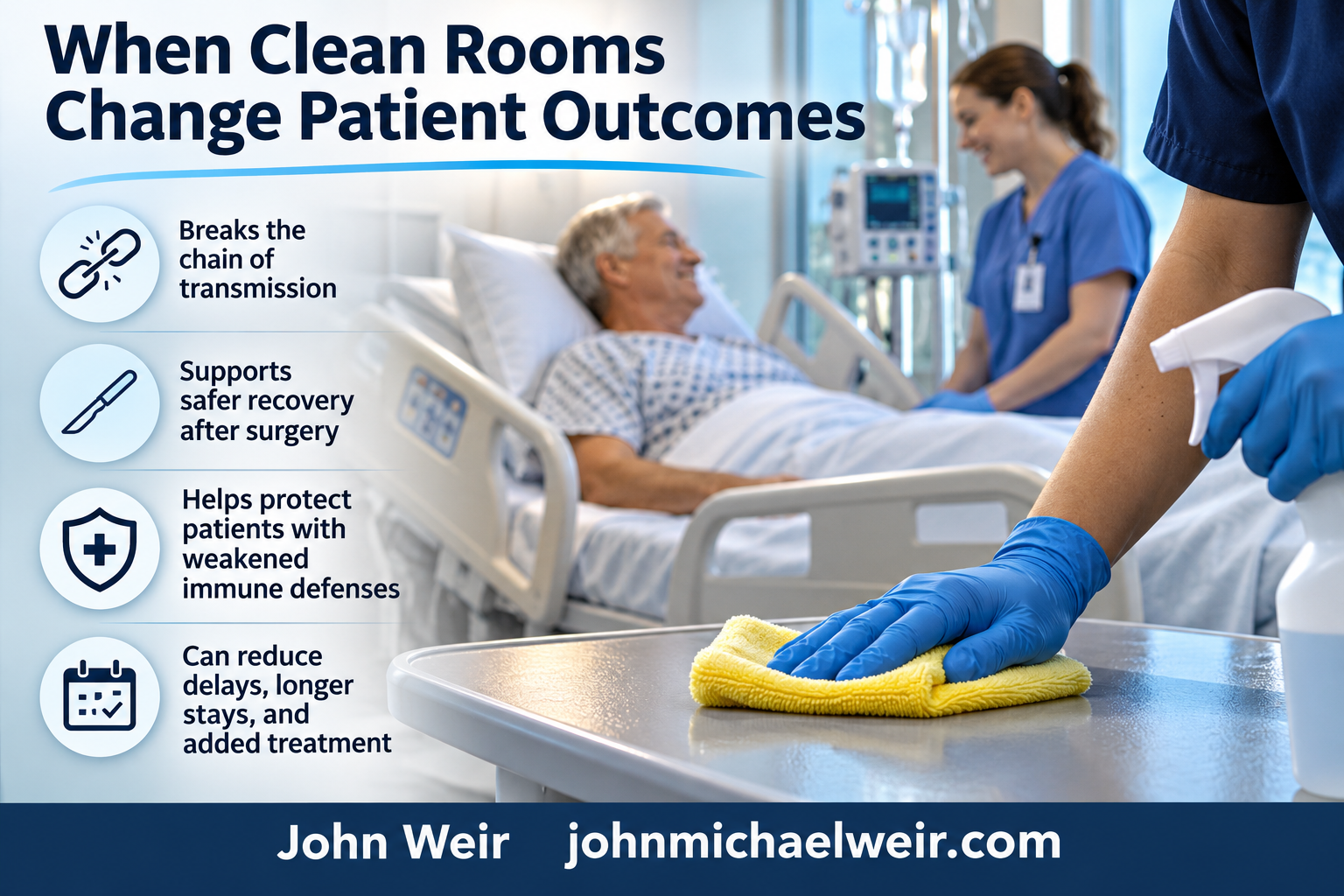
People often ask whether cleaning really changes what happens to patients. The honest answer: environmental cleaning is one part of a complicated picture, but it makes a real difference. Recovery depends on diagnosis, treatment, age, immune function, nutrition, staffing, medication, procedures, and many other factors. Still, when harmful organisms stay in the care environment, patients face an avoidable exposure. When cleaning is reliable, that source of risk goes down.
Research and hospital investigations have repeatedly shown that contaminated surfaces contribute to the movement of organisms. The connection matters most for organisms that survive long periods or transfer easily by hands and equipment. A patient does not always get sick because of one dirty surface, but a contaminated environment supports a chain of transmission. Breaking that chain reduces the number of opportunities an organism has to reach a vulnerable person.
Consider a patient recovering from surgery. That patient may have an incision, an intravenous line, a urinary catheter, or another device that creates a route into the body. These devices are often necessary, but they also raise vulnerability if organisms reach them. Clean hands and proper clinical technique are essential. So is an environment where high-touch surfaces, nearby equipment, and surrounding areas are cleaned according to policy.
Another example: patients receiving chemotherapy or other treatments that weaken immune defenses. Their bodies have less ability to fight organisms a healthy person could resist. For these patients, infection prevention can decide whether treatment continues on schedule or gets delayed. It can affect the length of a hospital stay, the need for additional medication, and the emotional burden on the patient and family. Environmental cleaning cannot remove every risk, but it lowers the background level of exposure.
#HealthcareEnvironmentalServices #InfectionPrevention #PatientSafety #EnvironmentalCleaning #HealthcareQuality #HospitalCleaning #HealthcareAssociatedInfections #EVS #PatientOutcomes #HealthcareLeadership
