
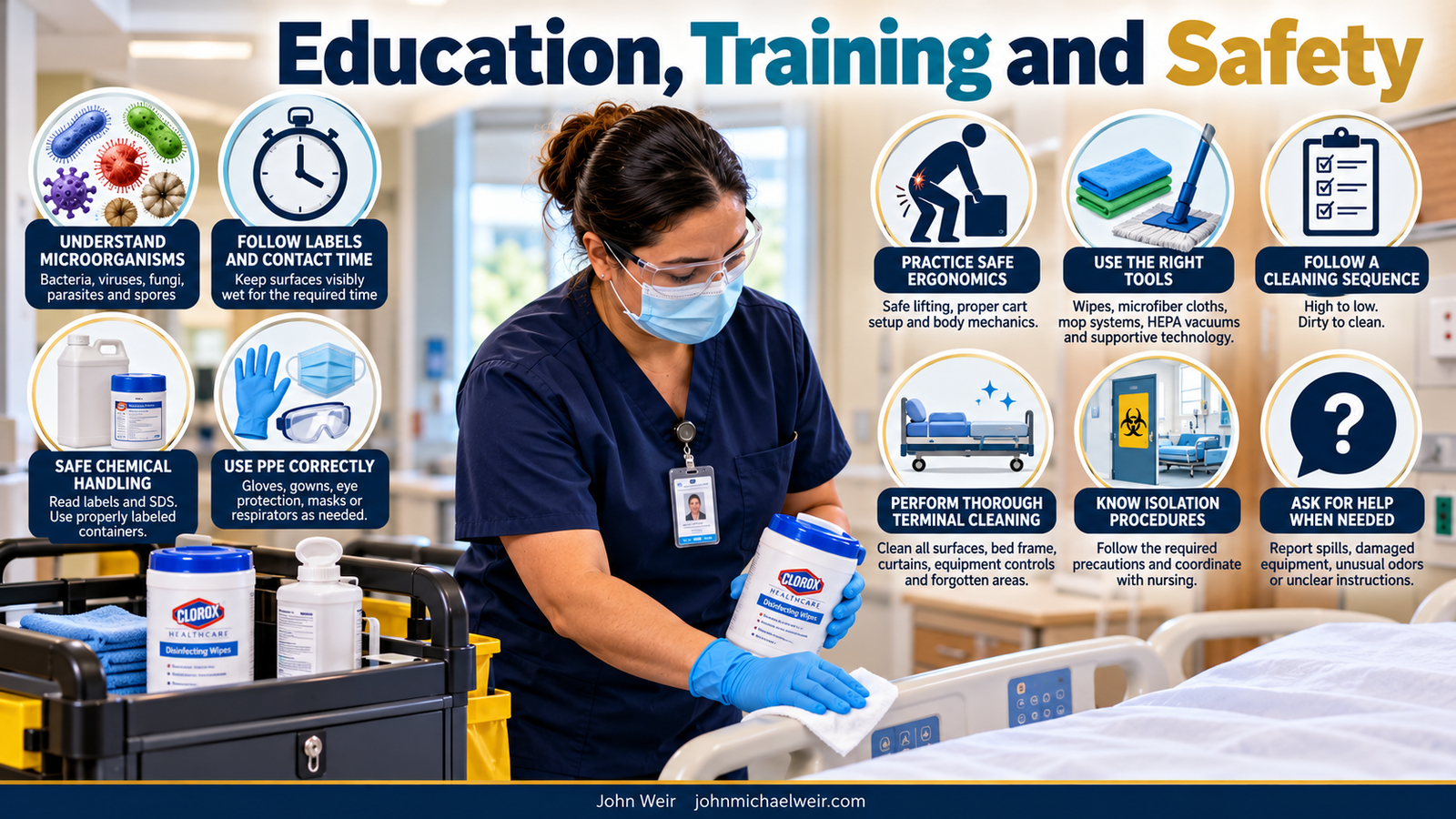
A strong EVS training program starts with the basics of microorganisms. Technicians learn that bacteria, viruses, fungi, and parasites behave differently. Some are easy to remove, some survive dry. Some are protected by spores. Some spread mainly through contact; others require respiratory precautions. EVS technicians do not need to become laboratory scientists but need enough knowledge to understand why a particular room surface, calls for special care.
Training also covers wet contact time. All disinfectants require a surface to stay visibly wet for a specific period. Contact time depends on the amount of product used, the condition of the surface and whether organic material is present. Following the label is part of the treatment.
Chemical handling requires the same level of attention. Products stay in their original or properly labeled containers. Diluted solutions have a limited use period. Some chemicals irritate skin, eyes, or lungs. Staff learn to read labels, safety data sheets, facility job aides, warning signs, and what to do after a splash, spill or exposure.
Personal protective equipment, PPE, is a layer of safety. Gloves protect the hands, but do not replace hand hygiene. Gowns protect clothing and skin. Eye protection stops splashes from reaching the eyes. Masks or respirators may be required for certain precautions or tasks. The correct equipment depends on the risk. Wearing PPE incorrectly creates a false sense of security, especially if a contaminated glove touches a clean door handle or a worker removes equipment in the wrong order.
EVS technicians protect themselves while protecting patients. They clean blood and body fluids, handle waste, move heavy equipment, push carts through crowded corridors, and work in awkward positions. Ergonomics reduces strains and injuries. Safe lifting, correct cart setup, appropriate footwear, and attention to wet floors are part of a professional program. A worker who is injured or exhausted cleans less carefully, so worker safety supports patient safety. Safety is a part of every task.
Tools get selected for specific purposes. Microfiber cloths and disposable wipes collect soil and microorganisms effectively when used properly. Mop systems use disposable or reusable heads. Vacuums reduce dust, but HEPA filters are necessary. Electrostatic or ultraviolet technologies can support cleaning verification in some facilities, but they do not remove the need for physical cleaning. Technology strengthens a process. It does not replace training and judgment used by a trained Environmental Services Technician.
The order of work matters. A worker starts by reviewing the room status and any isolation instructions, then gathers the correct supplies, puts on required PPE, removes waste, cleans high-touch surfaces, addresses the bathroom, cleans floors, and checks the room before leaving. High to low and dirty to clean. What matters is that the sequence is intentional and built to prevent cross-contamination.
Terminal cleaning needs special attention after a patient is discharged or transferred. The technician cleans surfaces that get routine attention and the areas that are easy to forget: bed frames, mattress edges, privacy curtain surfaces, call systems, equipment controls, and the underside of furniture. Curtains may need changing or special treatment. Disposable supplies get discarded, and reusable equipment may need separate processing. The room is not ready just because the bed is empty.
Isolation rooms add another level of planning. The tech needs to know what precautions apply, which PPE is required, whether the door stays closed, and how waste and linen get handled. They coordinate with nursing staff, so cleaning does not interrupt a procedure or expose the worker to unnecessary risk. The purpose of precautions is to reduce transmission while preserving respectful care.
We teach one of the most important skills, knowing when to ask for help. If a tech finds an unfamiliar spill, damaged equipment, an unusual odor, a suspected hazardous material, or a room with unclear precautions, stopping to get guidance is a sign of professionalism, not a lack of it. Hospitals are complex places. No employee should be expected to guess. Clear escalation systems handle problems before they become injuries or infection risks.
All of this requires continuous training, education, validation and competency checks. Training our teams to safely break the chain of infection and prepare a room to be fully safe for the next patient is leaderships job. It is not only rewardable; it is satisfying as well.
#Education #Training #Safety #EnvironmentalServices #PatientSafety #Leadership
