
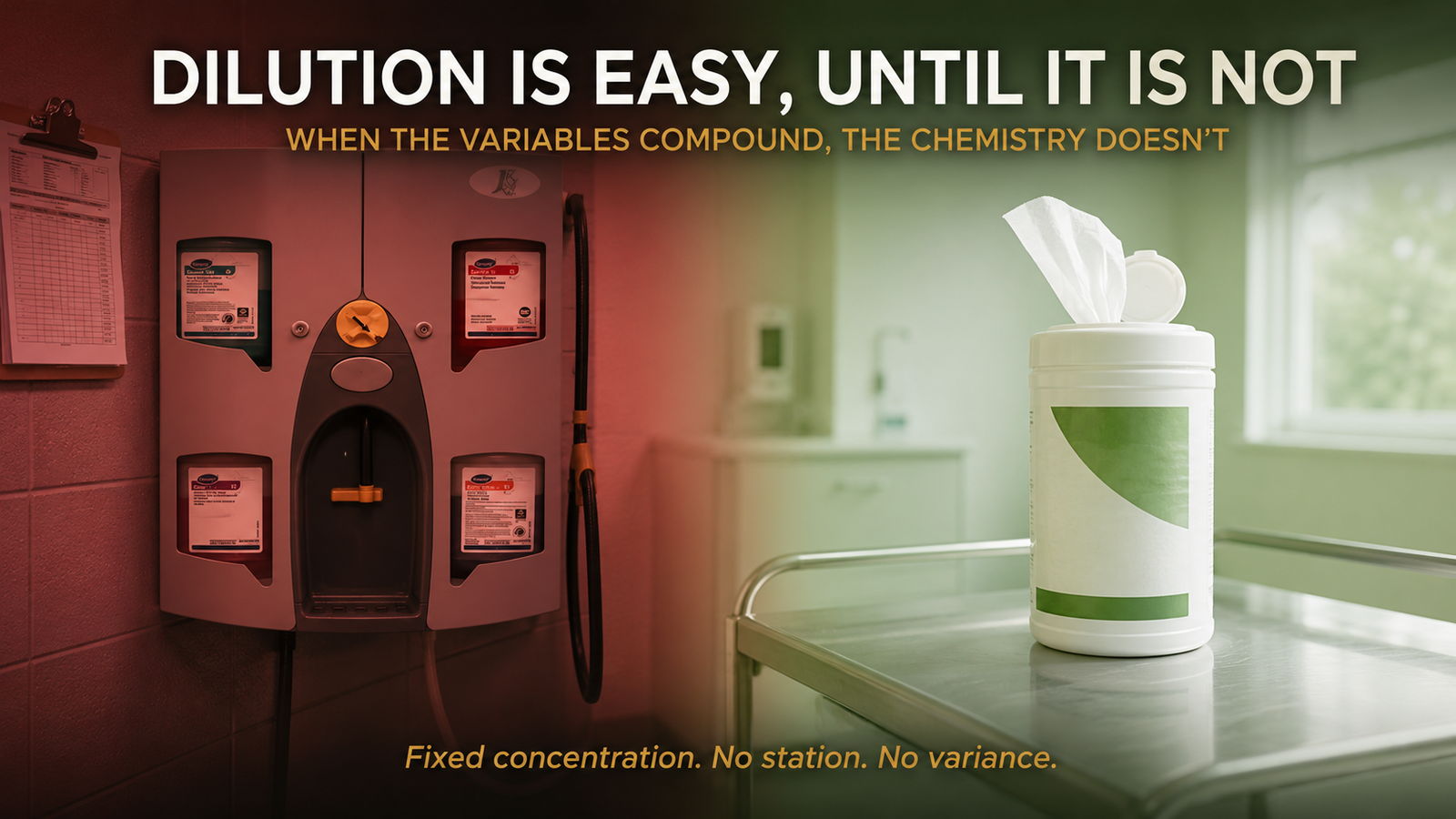
Mixing stations introduce variables that many cleaning programs don’t account for. Water pressure fluctuates throughout the day and across different locations in the building. Dispensers require regular maintenance to stay calibrated. Metering tips clog. One common dilution station manufacturer states water pressure minimum of 30lbs. That explained why I had a dispenser never meet standards of 800ppm, and after I had changed it out.
Any one of those factors can shift your concentration. When it does, you won’t know it happened. The solution goes into the bottle. The surface gets wiped. The assumption is that contact time did its job but it is hard to prove.
Under-diluted product doesn’t meet the kill claim. Over-diluted product wastes chemistry and can damage surfaces. Neither outcome is visible to the person doing the cleaning unless they are using test strips themselves.
This is why dilution testing has to be a routine practice, not a one-time setup verification. A test strip or titration check at the point of use tells you what’s actually going out the door. In infection prevention, trust without verification is a liability.
Ready-to-use products like Oxivir 1 wipes remove the variable entirely.
Concentration is fixed at manufacturing. One-minute wet contact time, every time. No mixing, no metering, no guessing. But the case for ready to use wipes goes beyond consistency.
Wipes go anywhere in the facility without infrastructure. No dispenser to maintain, no metering tip to unclog, no water pressure to account for. A housekeeper walks into any room with the kill claim already validated on the label.
Training is simpler. Open, wipe, wait one minute. The protocol is the same every time, for every person, in every location. That kind of standardization matters when you are managing a large team across a complex building.
The cost argument against ready to use is real but often overstated. When you factor in dispenser maintenance, testing supplies, time spent on dilution verification, and the cost of a cleaning failure when dilution is off, the gap between concentrates and ready-to-use narrows more than the upfront price comparison suggests.
A disinfectant that might be right is not the same as one that is always right. Many healthcare facilities are moving in this direction for a reason.
There is still a place for mixing stations, dilution chemistry, in a well-run EVS program. But on high-touch surfaces where consistency is the whole point, the case for ready-to-use is getting harder to argue against.
#EVS #InfectionPrevention #Disinfection #HealthcareHygiene #HospitalCleaning
