
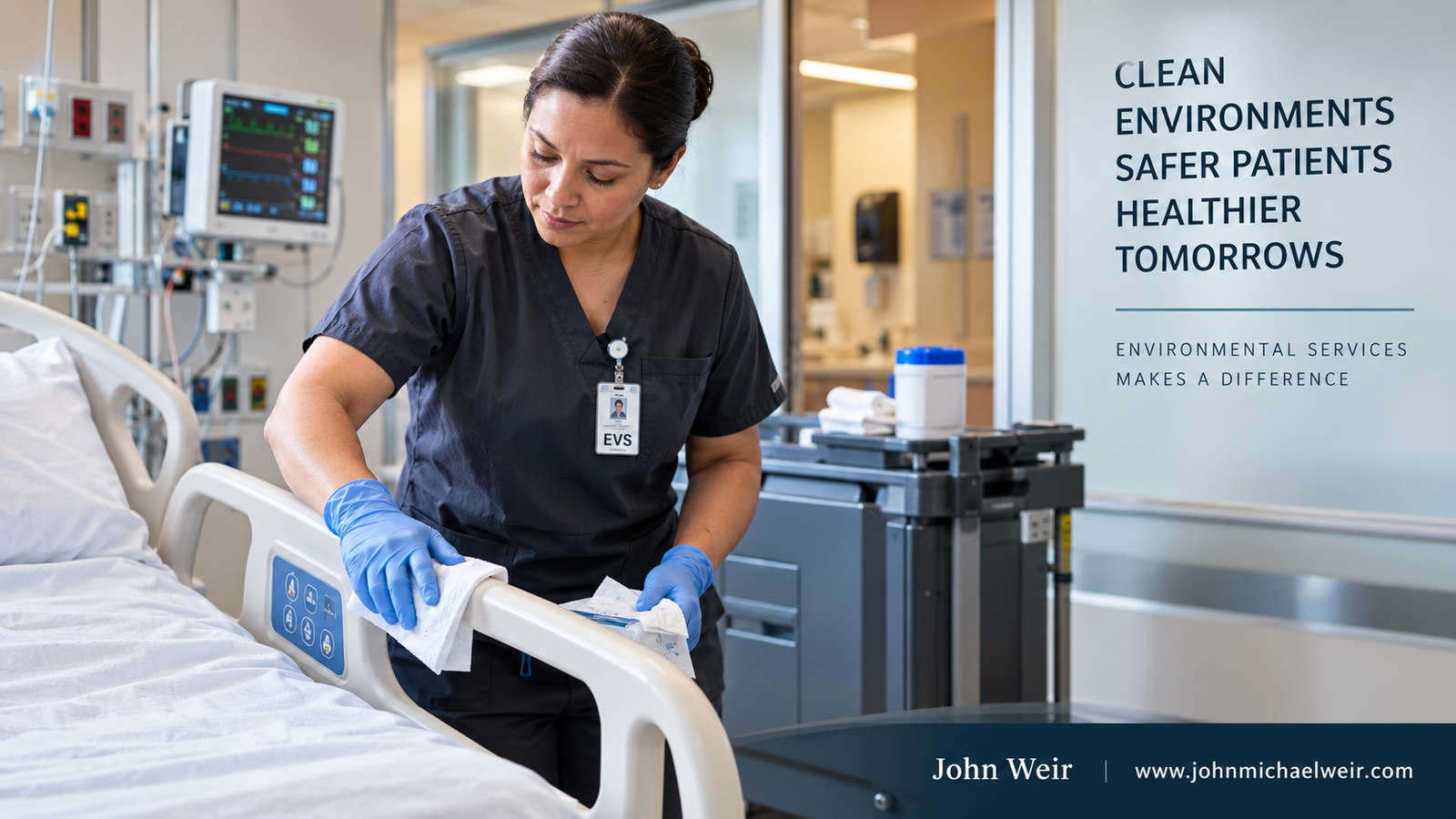
When hospital leaders see Hospital-Acquired Infections climb, the response is predictable. Leadership calls a meeting, clinical educators refresh hand hygiene audits, infection preventionists review catheter-associated urinary tract infection bundles and central line insertion checklists, and pharmacy revisits antibiotic stewardship protocols.
Every one of those steps matters, but in far too many facilities the single largest physical reservoir of pathogens in the building still gets treated as an operational afterthought: the high-touch surfaces surrounding the patient.
For decades, Environmental Services has lived on the margins of clinical quality discussions, treated as a custodial function rather than a clinical one. If a room looked clean, smelled fresh, and turned over fast enough to keep the emergency department moving, leadership considered the job done. But visual inspection cannot measure what actually matters: pathogens have no scent, and microscopic bioburden is invisible to the naked eye.
When facilities replace that kind of subjective assumption with objective, validated surface disinfection, the clinical data changes. EVS performance is not a facilities metric. It is a direct driver of patient survival and hospital-acquired infection rates.
Here is what the evidence shows.
The Decade-Long Case Study: Stamford Hospital
One of the clearest long-term demonstrations of this link comes from Stamford Hospital in Connecticut.
Hospital leadership recognized that visual auditing could not hold environmental hygiene to a clinical standard, so they built a program around transparent surface tracking, structured frontline training, objective monitoring, and accountability across departments.
The baseline audit was eye opening: surface cleaning performance sat at 74.7 percent, meaning roughly one out of every four high-touch surfaces was missing proper disinfection during room turnover.[1]
Stamford rebuilt the process from there: standardized chemical dwell times, structured wiping pathways, and clear auditing feedback loops for frontline technicians.
The results show what sustained operational discipline does to clinical outcomes:
- Surface cleaning compliance rose from 74.7 percent to sustained levels exceeding 90 percent.
- The facility held that 90-plus percent threshold for six consecutive years.
- Over the full decade, overall hospital-acquired infections fell 75 percent.
- Surgical site infections dropped 55 percent.
- Healthcare-associated Clostridioides difficile rates fell 70 percent.
These are not marginal month-over-month variances. They represent hundreds of patients spared secondary complications, thousands of avoided bed days, and real costs avoided in non-reimbursable treatment, and no new antibiotic produced them. The intervention was sustained, validated surface disinfection.
The 2022 CDC-Backed Findings: Why the Monitoring Tool Matters
Good intentions do not disinfect patient rooms, and neither does automated equipment layered on top of unverified cleaning practices.
A 2022 CDC-backed multicenter trial, funded through the CDC’s Prevention Epicenters Program, examined enhanced environmental cleaning across six intensive care units, comparing two disinfection verification methods over thousands of patient days.[2]
The finding challenged a popular industry assumption: technology alone is not a silver bullet.
One arm used an ultraviolet fluorescent-marker method to verify cleaning. The other used objective Adenosine Triphosphate (ATP) bioluminescence monitoring. Both arms gave feedback to frontline technicians. The fluorescent-marker arm showed no significant reduction in multidrug-resistant organism (MDRO) infection or colonization. The ATP arm was associated with a 12.4 percent relative reduction in MDRO infection or colonization compared with the fluorescent-marker periods.
The takeaway: how you monitor the work determines the quality of the execution.
When frontline technicians know their surfaces will be objectively checked, and when supervisors give real-time, non-punitive coaching based on the data, the cleaning process tightens. That 12.4 percent reduction in MDRO transmission was not bought with expensive equipment. It came from building accountability into the surface itself.
Validation changes behavior. Objective verification closes the gap between what an organization assumes is clean and what is actually safe.
The Biological Link: Colony Counts and Clinical Infections
Some in the executive suite argue that surface bioburden is an indirect risk factor, a theoretical concern next to direct person-to-person contact or invasive lines.
A 2025 study out of a tertiary hospital in Chongqing, China, took that argument apart.[3]
Researchers ran systematic microbiological sampling across multiple hospital units over more than two years, from July 2022 through December 2024. Instead of relying on process-compliance percentages, they measured actual surface bacterial colony counts across high-touch patient zones and compared those levels directly against the hospital’s monthly infection logs.
The result was unambiguous: surface bacterial colony counts were positively and significantly correlated with monthly hospital-acquired infection tallies. It’s a single-center study, but the mechanism it describes lines up with the broader infection-control literature: bioburden and transmission risk move together.
When environmental bioburden rose on bed rails, overbed tables, call buttons, and IV poles, hospital infection rates climbed with it in the following weeks. When targeted disinfection brought the colony counts back down, the infection spikes flattened out.
Pathogens do not stay put on plastic and stainless steel. They transfer to gloves during routine care, migrate to bed linens, and find their way into open wounds, surgical sites, and vascular access points. Every contaminated high-touch surface is an unmonitored staging ground for cross-contamination.
The Operational Reckoning for Leadership
The evidence leads to one conclusion: you cannot separate the quality of your EVS program from your facility’s clinical infection outcomes.
Treating environmental services as a cost center to be trimmed, outsourced to the lowest bidder, or measured only by room-turnaround speed creates real clinical exposure. Every time a technician is rushed through a terminal clean without proper chemical dwell time, patient risk goes up. Every time high-touch auditing is skipped to hit a bed-turnover metric, clinical safety is compromised.
If your hospital is fighting persistent HAI rates, take a hard look at how you manage environmental operations:
- Move from visual inspection to objective validation. A visual check only confirms that clutter is gone. Use quantitative methods, fluorescent marking or ATP bioluminescence, on a regular daily schedule.
- Close the feedback loop right away. Auditing data sitting in a supervisor’s spreadsheet does nothing for the patient being admitted tonight. Get pass and fail data back to the frontline technician within hours, not weeks, and use every failure as a coaching moment on technique and dwell time.
- Put EVS leadership on the quality committee. The leader responsible for environmental hygiene should sit alongside the chief medical officer, the chief nursing officer, and the director of infection prevention. EVS metrics belong on the executive quality dashboard next to CAUTI, CLABSI, and SSI rates.
The evidence is clear. Healthcare leadership needs to treat environmental operations as a clinical function, not a facilities one. The work done on a patient’s bed rail between discharge and admission is a clinical intervention. Treat it like one.
References
- Parry MF, Sestovic M, Renz C, Pangan A, Grant B, Shah AK. Environmental cleaning and disinfection: sustaining changed practice and improving quality in the community hospital. Antimicrobial Stewardship & Healthcare Epidemiology. 2022;2(1):e113. doi:10.1017/ash.2022.257
- Ziegler MJ, Babcock HH, Welbel SF, Warren DK, Trick WE, et al. Stopping Hospital Infections With Environmental Services (SHINE): a cluster-randomized trial of intensive monitoring methods for terminal room cleaning on rates of multidrug-resistant organisms in the intensive care unit. Clinical Infectious Diseases. 2022;75(7):1217-1223. doi:10.1093/cid/ciac070
- Li R, Wang Z, Huang M, Liao D, Yuan Z, Qian K. Environmental hygiene and healthcare-associated infection: a time-series study based on generalized additive model. Frontiers in Public Health. 2025;13:1592700. doi:10.3389/fpubh.2025.1592700
#HealthcareLeadership #EnvironmentalServices #PatientSafety #QualityImprovement #InfectionPrevention #HospitalOperations
