
The Hidden Frontline: Why Cleaning is the First Step in Clinical Care
Intervention: an action taken to prevent, treat, or change the course of a medical condition. That is the dictionary definition, and it belongs at the front of this conversation, because Environmental Services (EVS) performs one every day whether the industry gives it credit or not.
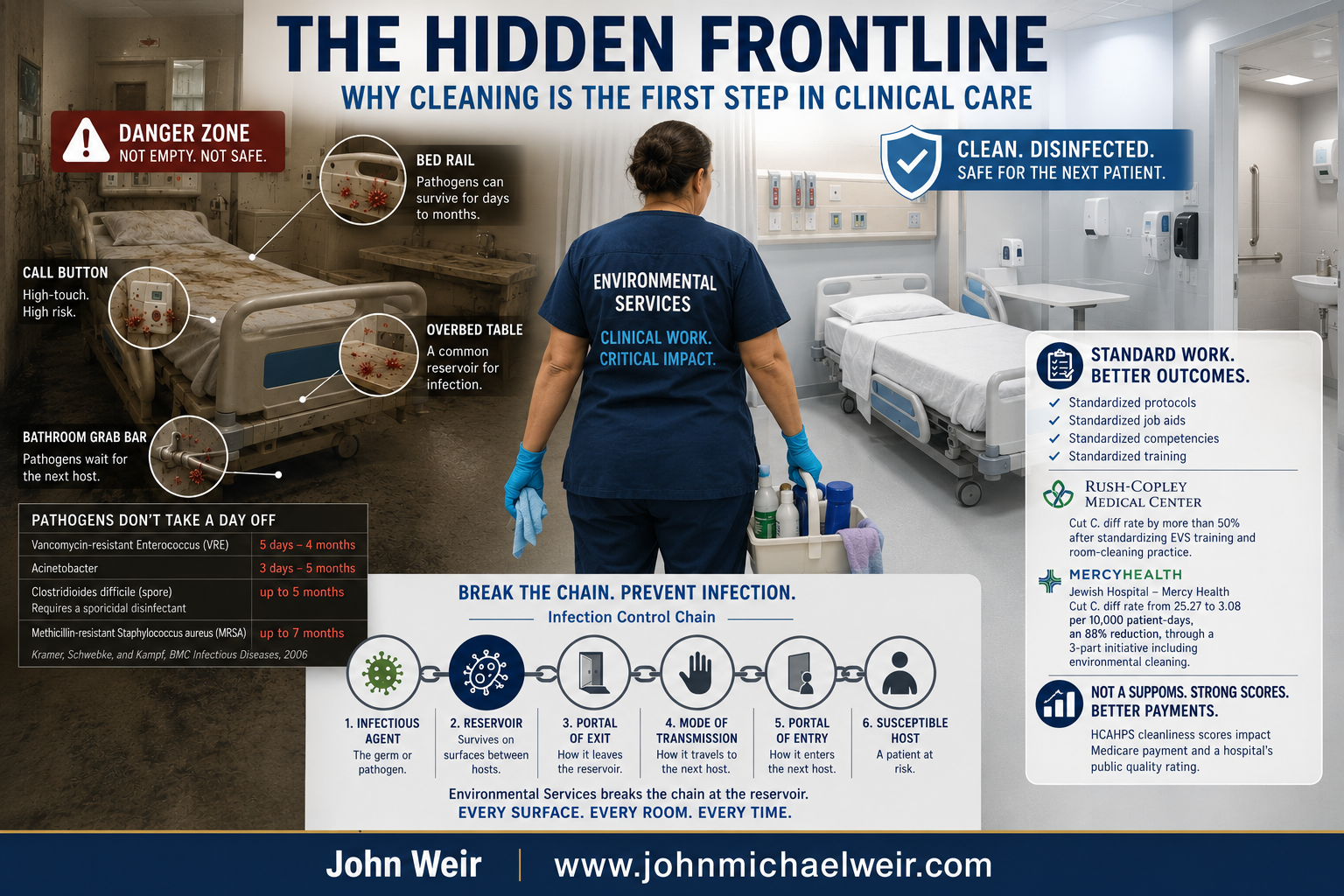
A patient discharges, and the room they leave behind looks empty. It is not safe. It is a danger zone. Pathogens sit on the bed rail, the call button, the overbed table, the bathroom grab bar, waiting for the chance to transfer to the next host. Clinically, that transfer leads to a variety of sicknesses, healthcare-associated infections (HAI) that extend a stay or complicate a recovery. That is a clinical problem. It needs a clinical intervention. That intervention is proper cleaning.
Environmental Services has been looked at as a support services department for many years, something that happens after the real clinical work is finished rather than part of it. That is the problem. We need to elevate our industry to the clinical level it already operates at. Surface cleanliness, HAI prevention, breaking the chain of infection: that is what Environmental Services does. It is not incidental to patient care. It is patient care.
When we say surface cleanliness, we are not talking about the freedom from removable marks and soil. We are talking about pathogens invisible to the eye. Kramer, Schwebke, and Kampf’s 2006 review in BMC Infectious Diseases, still the standard reference on this question, found that the organisms behind many healthcare-associated infections survive on dry hospital surfaces far longer than a visual check would ever suggest. Vancomycin-resistant Enterococcus survives five days to four months. Acinetobacter survives three days to five months. Clostridioides difficile forms a spore that can persist up to five months and needs a sporicidal disinfectant, not the standard daily product, to kill it. Methicillin-resistant Staphylococcus aureus (MRSA) has been documented surviving up to seven months. Many of these organisms can live for days and weeks on a surface that looks clean. Some can live for months. That is why Environmental Services is providing the first clinical intervention after a patient leaves a room, not the last chore before the next one arrives.
Infection control describes transmission as a chain: an infectious agent, a reservoir where it survives between hosts, a portal of exit, a mode of transmission, a portal of entry, and a susceptible host. A contaminated surface is a reservoir. Break that link and the chain does not complete. Every surface my team disinfects to the correct standard is a link broken before it ever reaches a patient. That is infection prevention, performed by the department positioned to perform it first.
Standardization of practices is necessary across a health system in many respects, and it is most critical in Environmental Services: standardized protocols, standardized job aids, standardized competencies, standardized training. Rush-Copley Medical Center cut its C. diff rate by more than half after standardizing EVS training and room-cleaning practice, and its ranking for room cleanliness improved with it. Jewish Hospital-Mercy Health cut its C. diff rate from 25.27 to 3.08 per 10,000 patient-days, close to an 88 percent reduction, through a three-part initiative that combined antibiotic stewardship, clinical-care standardization, and environmental cleaning. Environmental cleaning did not produce that number alone, but it carried its share of the result. Neither case came from working harder. Both came from working the same way, every room, every shift, every technician.
Hospital Consumer Assessment of Healthcare Providers and Systems (HCAHPS), the patient experience survey every hospital reports to the Centers for Medicare & Medicaid Services (CMS), includes a cleanliness domain, and that domain is tied to Medicare payment and to a hospital’s public quality rating. A hospital that standardizes its cleaning protocols is not only lowering its infection rate. It is protecting the score tied to how it gets paid and how it is rated publicly. That standing does not stay local. It builds the reputation of the whole system behind it.
A support department gets measured on how fast a room turns. A clinical department gets measured on what that room stops. Environmental Services has been doing clinical work under a support title for years. The work is not going to change. It is time the title caught up to it.
References:
Kramer A, Schwebke I, Kampf G. (2006). How long do nosocomial pathogens persist on inanimate surfaces? A systematic review. BMC Infectious Diseases, 6, 130. https://doi.org/10.1186/1471-2334-6-130
Centers for Disease Control and Prevention / National Institute for Occupational Safety and Health. Chain of Infection Components. https://www.cdc.gov/niosh/learning/safetyculturehc/module-2/3.html
UMF Corporation. Improved Environmental Hygiene Lowers Infections and Raises HCAHPS Scores at Rush-Copley. Intervention Series. Syndicated by CleanLink and Healthcare Facilities Today, August 2013.
Wachter, Sharon. Environmental Hygiene Case Studies. Infection Control Today, August 30, 2012.
Centers for Medicare & Medicaid Services. Hospital Value-Based Purchasing Program, HCAHPS Patient Experience of Care domain. cms.gov
#HealthcareLeadership #EnvironmentalServices #PatientSafety #FrontlineLeadership #QualityImprovement #InfectionPrevention #ChainOfInfection #CDC #NIOSH
