
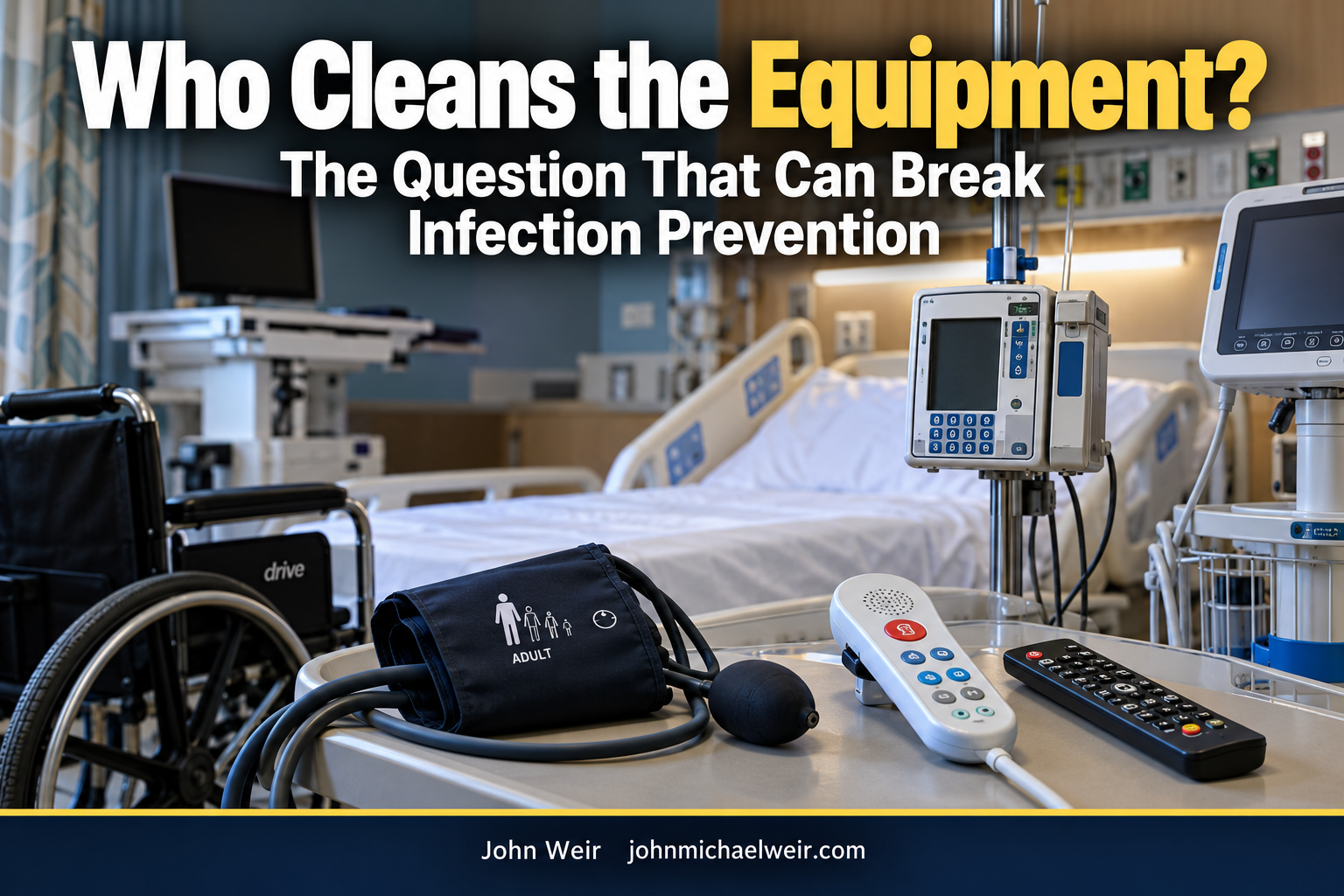
A hospital room can be cleaned correctly and still have an infection-prevention gap sitting right beside the bed. It may be a blood-pressure cuff, IV pump, TV control or bed call device. Perhaps a wheelchair or mobile computer. Everyone knows the equipment needs to be cleaned. The problem starts when nobody is completely sure whose job it is to clean it.
Who Is Responsible for Shared Equipment?
CDC’s updated Candida auris guidance specifically warns that mobile and reusable equipment can contribute to transmission. It also notes that outbreak investigations have found healthcare personnel are not always clear about who is responsible for cleaning shared equipment.
That is an important message for EVS leaders. Environmental Services usually has clear responsibility for the room itself. We know who cleans the bed, bathroom, floor, and bedside table. Shared equipment is different. Sometimes Nursing owns the cleaning. Sometimes EVS does. Sometimes another department is responsible.
Any of those systems can work. The dangerous answer is when nobody knows.
CDC specifically identifies equipment such as blood-pressure cuffs, glucometers, ultrasound machines, nursing carts, ventilators, and physical-therapy equipment as items that need to be cleaned and disinfected appropriately between patients.
This matters because contamination can travel with the equipment. A wheelchair leaves the room. An IV pump moves to another patient. A portable device goes to another unit.
The room may have been cleaned perfectly. The equipment can still carry organisms into another care environment.
Ownership Has to Be Clear
One of the simplest infection-prevention tools a hospital can create is an equipment-cleaning ownership matrix.
For commonly shared equipment, define:
Who cleans it?
When is it cleaned?
What product is used?
What does the manufacturer allow?
How does the next employee know it is clean?
Start with the ten most commonly shared devices.
During leadership rounds, point to a piece of equipment and ask:
“Who cleans this?”
Then ask someone from the department they named.
If one person says EVS and another says Nursing, you have found a problem.
Then ask:
“How do you know it has been cleaned?”
That question can reveal even more.
Do Not Automatically Give Every Task to EVS
EVS may be the right department to clean some equipment, but simply saying “EVS cleans it” is not enough.
Before responsibility is assigned, leaders should confirm:
- The manufacturer allows the cleaning product. Read the IFU.
- The employee has been trained.
- Competency has been verified.
- The task fits safely into the workflow.
- Clean and dirty equipment can be clearly identified.
A responsibility transferred without the resources and process to perform it correctly does not eliminate risk. It simply moves the risk.
The Bottom Line
Some infection-prevention failures happen between departments. EVS thinks Nursing cleaned the equipment. Nursing thinks EVS cleaned it. The equipment moves to another patient. Everyone did the job they thought they owned. The system failed anyway.
Sometimes preventing infection starts with one simple question:
Who cleans it?
References:
Centers for Disease Control and Prevention. Infection Control Guidance: Candida auris. Updated September 30, 2026. cdc.gov/candida-auris/hcp/infection-control
#HealthcareLeadership #EnvironmentalServices #InfectionPrevention #PatientSafety #HospitalOperations #QualityImprovement #CandidaAuris
