
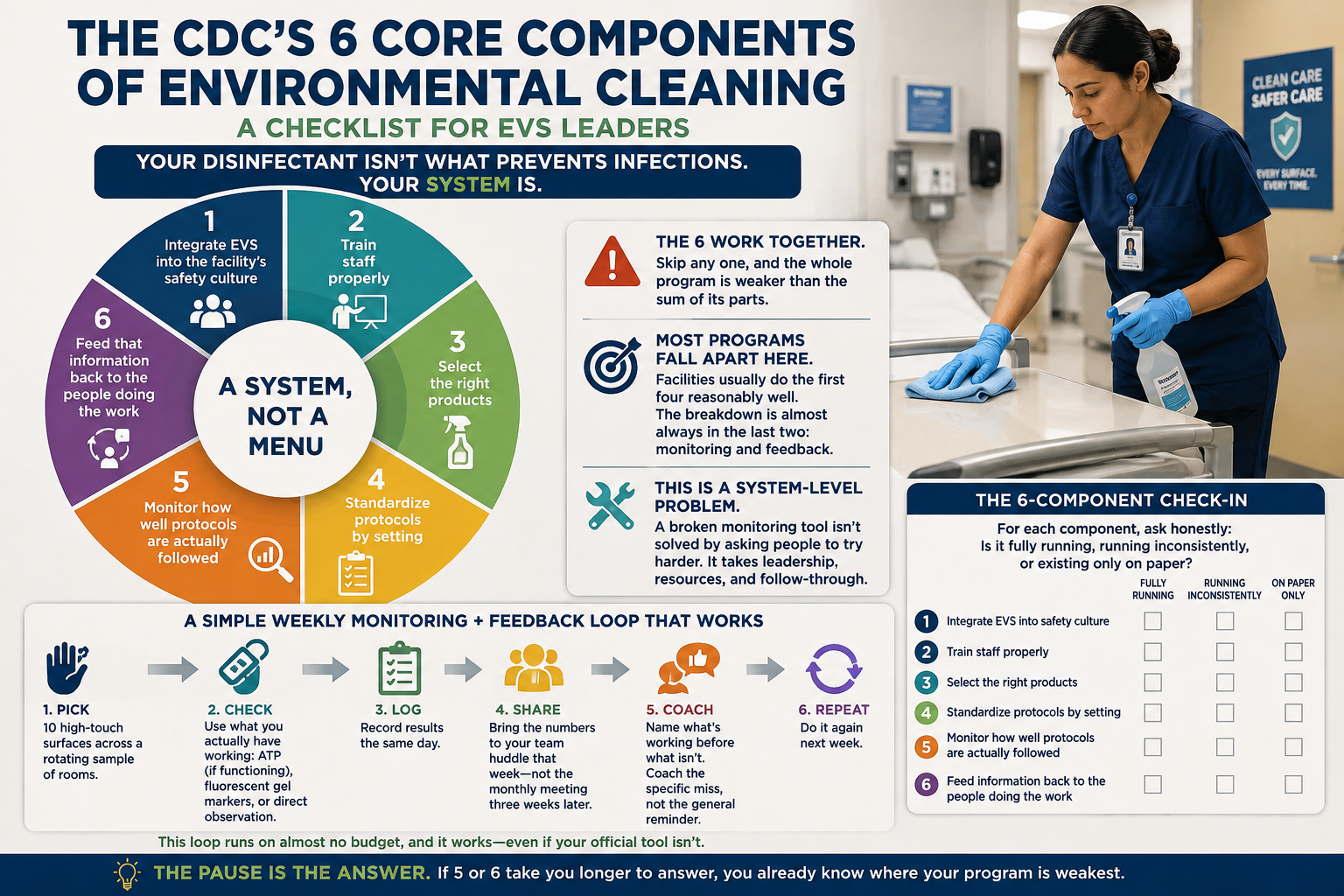
The CDC’s 6 Core Components of Environmental Cleaning: A Checklist for EVS Leaders
Your disinfectant isn’t what prevents infections. Your system is.
The Centers for Disease Control and Prevention, the CDC, lays out six core components for an environmental cleaning program:
- Integrate Environmental Services, EVS, into the facility’s safety culture
- Train staff properly
- Select the right products
- Standardize protocols by setting
- Monitor how well those protocols are actually followed
- Feed that information back to the people doing the work
CDC is explicit about one thing that gets lost in the summary version: these six work as a system, not a menu. You don’t get to run four of them well and skip the other two. Skip any one, and the whole program is weaker than the sum of its parts.
Here’s the problem. Most programs I’ve seen do the first four reasonably well. Facilities train people. They pick products. They write protocols. Where programs actually fall apart is the last two: monitoring and feedback.
Monitoring means knowing, with real data, whether a protocol is being followed and whether it’s working, not assuming it is because someone signed a checklist. Feedback means that data actually gets back to the people who did the cleaning, in time for it to change anything.
I’ve seen a monitoring tool sit broken for a long stretch, long enough that people around it adjusted instead of getting it fixed. The department didn’t create that gap, and it can’t close it alone either. That’s what makes it a system-level problem instead of a local one: it doesn’t get solved by asking the people already doing the work to try harder.
If your monitoring tool has been down longer than you’re comfortable saying out loud, you already know which of the six components your facility is actually running on paper only.
A working monitoring and feedback loop doesn’t have to be complicated. Here’s a simple weekly version:
Pick 10 high-touch surfaces across a rotating sample of rooms. Check them with whatever method you actually have working: adenosine triphosphate, ATP, testing if it’s functioning, fluorescent gel markers if it’s not, direct observation if neither is available. Log the results the same day. Bring the numbers to your team huddle that week, not the monthly meeting three weeks later. Name what’s working before you name what isn’t. Coach the specific miss, not the general reminder. Do it again next week.
That loop is monitoring and feedback both, running on almost no budget, and it works whether your facility’s official tool is functioning or not.
If you want to know where your own program actually stands, ask yourself this about each of the six, one at a time: is it fully running, running inconsistently, or existing only on paper? Most leaders can answer that honestly about culture, training, products, and standardization in about 30 seconds. The two that take longer to answer are always the same two. That pause is the answer.
Sources: CDC, Healthcare-Associated Infections, Cleaning Programs (cdc.gov/healthcare-associated-infections/hcp/cleaning-global/programs.html)
#Quality #Environmental Services #Leadership #CDC #ATP #BlackLight #QualityAssurance
