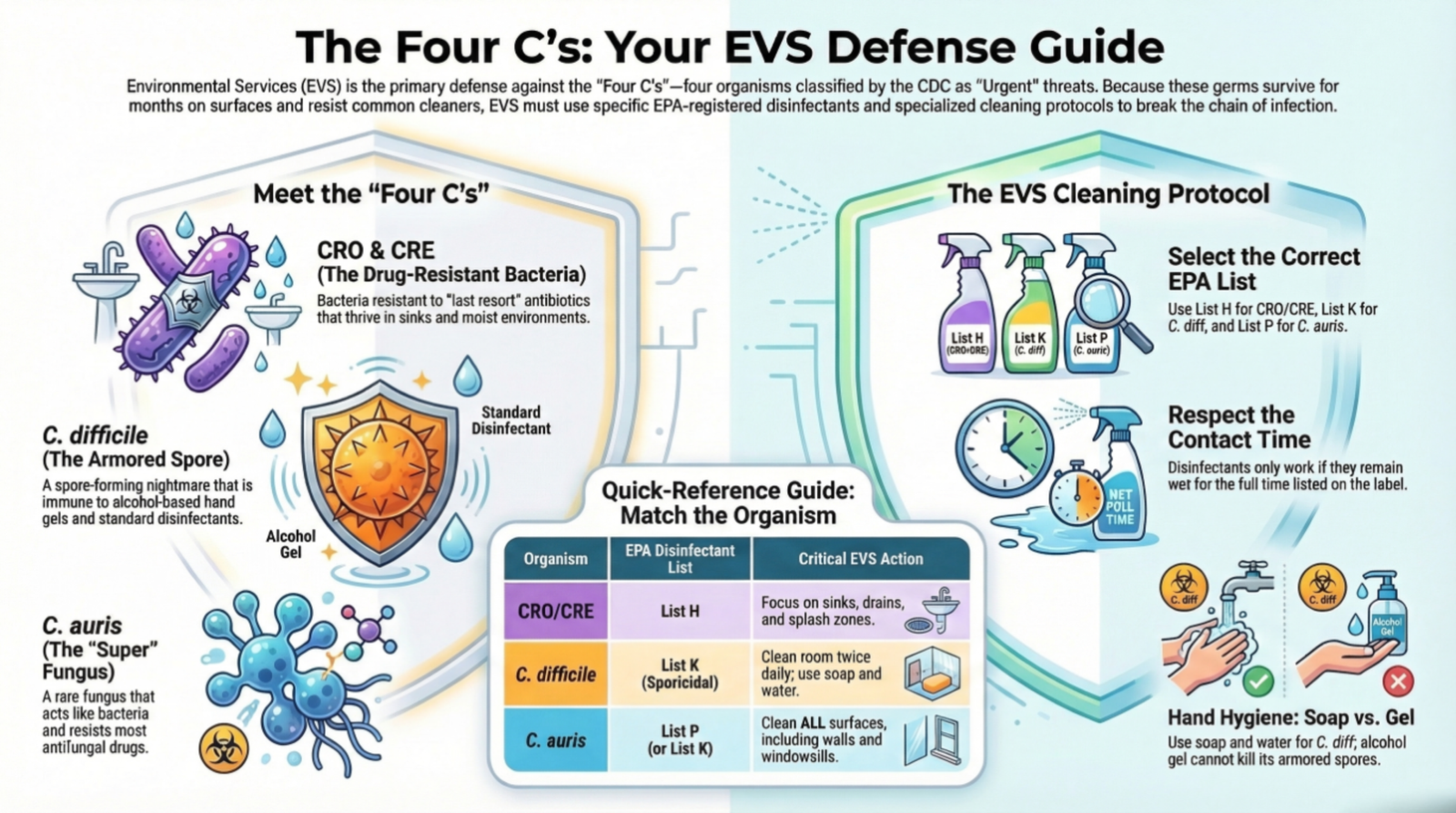
I have developed a full staff training on the Four C’s that we will be rolling out next week. These are four of the most dangerous drug-resistant organisms in healthcare settings, and I want to share some of the key points from that training here.
If you walked into a hospital room and tried to spot the most dangerous item in it, you might look at the ventilator or the surgical equipment. You would be looking in the wrong place. The most dangerous tools in that room are the mop, the cleaning cloth, the supply cart, and the hands carrying them. That is not an exaggeration. It is the reality of how hospital-acquired infections spread.
When it comes to fighting these organisms, Environmental Services staff are the most critical line of defense. Not the nurses or the physicians. EVS. When the antibiotics fail and they increasingly do, the only thing standing between a pathogen and the next patient is a clean surface.
The first two C’s are CRO and CRE, which stand for Carbapenem-Resistant Organisms and Carbapenem-Resistant Enterobacterales. Carbapenems were once considered the last resort of antibiotics, the big guns. These organisms developed an enzyme that literally chews them up and makes them useless. CRE alone was responsible for an estimated 1,100 deaths in the United States in 2017, and a 2015 outbreak linked to an improperly disinfected scope at UCLA put the danger of small hygiene lapses on national display. The right disinfectant for these organisms comes from EPA List H, and wet contact time is not optional.
The third C is C. difficile, which earns its name. Difficile is Latin for difficult. It forms spores that survive on surfaces for months and laugh at standard disinfectants. It spreads through fecal-oral contact, meaning spores on a surface become a patient’s infection. And perhaps most importantly, alcohol hand sanitizer does nothing against C. diff spores. Soap and water is the only effective hand hygiene method when leaving a C. diff room. For environmental surfaces, only a sporicidal product from EPA List K will do the job.
The fourth C is Candida auris, and it may be the most alarming of all. It is a fungus that behaves like a superbug. It appeared simultaneously on multiple continents in 2009 with no connection between outbreaks, which is something scientists had never seen before. It can kill up to 57 percent of patients with invasive infections, it survives for weeks on environmental surfaces including walls and windowsills, and standard quat disinfectants do not reliably kill it. The right products come from EPA List P, with List K as a backup.
One last thing worth highlighting is what I call the splash zone. Sinks and drains are prime reservoirs for CRO and CRE. Turning on a faucet can actually aerosolize these organisms and contaminate anything stored nearby. Patient supplies should never be stored near a sink. Cleaning around drains is not a detail, it is a priority.
These four organisms are formidable. But they are not invincible. They survive because of missed contact time, wrong products, and overlooked surfaces. When EVS does it right, the chain of infection breaks. That is the whole point of this training, and I am proud of the team we are bringing it to next week.
If you are interested in the training for your staff, I have a PowerPoint, instructor script, staff handout and a 10 question quiz with answers. I also have a great video, less than 8 minutes long, that works well as a stand alone to encourage our staff as hero’s. You can get the files here: