What is the first thing you notice when you enter a hotel or hospital room? I believe, most people register a simple impression: it is either clean and smells fresh, or it isn’t. This feeling of cleanliness gives us a sense of safety and comfort, a sign that professionals have worked tirelessly to prepare the space just for us. But what if that sterile scent masks an invisible world with a dramatic history of its own?

Behind that spotless surface lies a complex, hidden world. Environmental service professionals are on the front lines of a daily battle against microorganisms, many of which are far more than just generic “germs.” These pathogens have unique identities, surprising origins, and counter-intuitive histories that read like scientific detective stories. Here are a few of the most fascinating backstories hiding in the microscopic world from my upcoming Pathogen Playbook.

1. Discovery Can Be Accidental, and Naming Can Be Mythological

In 1928, scientist Alexander Fleming returned from holiday to find a forgotten petri dish held a world-changing secret: a halo of death where a stray mold spore had landed, dissolving the deadly Staphylococcus aureus bacteria around it. In that moment of chance, the age of antibiotics was born. Yet even then, Fleming presciently warned that bacteria could learn to resist his new wonder drug. His warning was a prophecy, and today’s environmental service professionals are on the front lines of the war he foresaw, fighting organisms that have long since learned to outsmart our best medicines.

Other discoveries reveal a flair for the dramatic. In 1819, Italian pharmacist Bartholomeo Bizio was confronted with polenta that appeared to be bleeding. He identified the cause as a bacterium he named Serratia marcescens. Initially, it was considered so harmless that its distinctive red pigment made it a popular biological marker in experiments. Decades later, a German pathologist named Gustav Hauser observed another bacterium’s astonishing behavior. He saw not just a microorganism, but a living tide that spread across the culture plate in a mesmerizing, coordinated wave—a performance so uncanny he reached not for a scientific manual, but for ancient Greek myth, naming it Proteus mirabilis after the shape-shifting sea god who could alter his form to escape his captors.

2. What’s in a Name? Sometimes, a Misconception.

While some pathogen names are poetic, others can be outright misleading. Mpox, for instance, was first identified in research monkeys in 1958, which is how it got its name. However, scientists now believe its natural hosts in the wild are not monkeys at all, but various species of African rodents.

The story of the genus Salmonella is a classic case of mistaken identity and misplaced credit. In 1885, Theobald Smith, an assistant to the American veterinary pathologist Daniel Elmer Salmon, isolated a new bacterium from sick pigs. Despite Smith doing the brilliant work, the organism was named after his boss. To add another layer of irony, the bacterium they found turned out not to be the cause of the hog cholera they were investigating—that was a virus. Another misnomer is the Pseudorabies virus. Despite a name that suggests a connection to the infamous rabies virus, it is not related. It is a type of suid herpesvirus, getting its name from the rabies-like symptoms it can cause in animals.

3. The Unseen Enemy is Incredibly Resilient.

The incredible resilience of certain pathogens makes the work of environmental services both critical and immensely challenging. The spores of Clostridioides difficile, for example, are extreme survivalists that can remain viable on surfaces for up to five months. They are also notoriously resistant to common alcohol-based hand sanitizers, meaning that only the diligent application of soap, water, and sporicidal disinfectants can break the chain of infection.

Some organisms thrive where they are least expected. Burkholderia cepacia, first discovered on rotting onion roots, is so persistent it has been found thriving even in antiseptics like betadine—a substance designed specifically to kill germs. A more modern threat, Candida auris, underscores the ongoing battle. First identified in a patient’s ear in Japan in 2009, this fungus is a healthcare nightmare because it spreads easily, persists on surfaces for extended periods, and is often resistant to multiple classes of antifungal drugs. These organisms don’t just exist; they endure. Their tenacity is a constant reminder of the vigilance required to maintain a safe healthcare environment.

4. There’s a Long, Slow Fuse Between Finding a Germ and Knowing What It Does.

The gap between discovering a new microorganism and understanding its impact can be dangerously long. For 43 years, a devastating hospital-acquired infection spread unchecked because its true cause remained a mystery. Clostridioides difficile was first identified in 1935, but its role in causing antibiotic-associated diarrhea was not established until 1978. This gap underscores how EVS teams are not just cleaning rooms; they are breaking chains of infection that science itself was once slow to understand.

A more recent drama unfolded with Legionella pneumophila. This bacterium was only identified after a deadly and mysterious pneumonia outbreak at a 1976 American Legion convention in Philadelphia. The disease was named “Legionnaires’ disease” after its first victims. After the culprit was found, however, retrospective analysis of previous unsolved outbreaks identified cases dating as far back as 1957. These stories show that scientific understanding is a process, not an event, and the journey from isolating an organism to containing it often has life-altering consequences.

The invisible world of pathogens is far from a simple list of faceless menaces. It is filled with fascinating stories of accidental discovery, mythological naming, extreme resilience, and long-delayed understanding. From a contaminated petri dish to a discolored serving of polenta, the history of these organisms reveals as much about human curiosity and perseverance as it does about the microbes themselves.

This knowledge reinforces the importance of what professionals like me call a “PMA – Positive Mental Attitude.” The fight for a clean, safe environment is a fight against organisms with incredible, complex backstories. It requires not just the right tools and techniques, but a vigilant, proactive mindset.

Knowing the incredible backstories of these organisms, how might it change our perspective on the importance of a positive, vigilant attitude toward cleanliness in our daily lives?

Healthcare_Cleaning__Cover_for_Kindle


When was the last time you were at your doctors office, or (and I hope not) at a hospital, and it was not as clean as you would expect? Unfortunately with the cleaning being demanding physical labor, it takes a good management team to bring out the best in cleaning results.

As one who believes your healthcare deserves having the cleanest space to be treated in I have worked with hundreds of cleaning staff and I know how to bring out the best. After all, I started in this business as a part time housekeeper and worked my way up the hard way.

The housekeepers of years ago have to know so much more then they use to the job has evolved into Environmental Services. With knowledge in basic microbiology, infection control, regulatory compliance, customer service and so much more needed to do their jobs today these hard working individuals deserve recognition and the best supervisors and managers.

I have written a primer for the successful housekeeping department called Healthcare Cleaning Success.  In this book I break down the essential steps needed for success in easy to understand modules. I wrote this book to help supervisors and managers in environmental services move beyond the ordinary and improve the cleanliness of their facilities.

So why did I ask if you have been to a facility that was not as clean as you expected? You can help by getting this book and giving it to your doctor, or to a hospital that you feel needs some help. I’m sure they would appreciate you caring enough to bring this to their attention. There is link to my book on Amazon on the right side of this page.

You should also ask your caregiver if he or she has washed their hands before treating you. They will appreciate that as well.

Hey if you like this post, please share it with someone or just let me know.

Another Question and Answer:

Q. In the healthcare or residential setting, what does the “environment” or “environmental surface” mean?

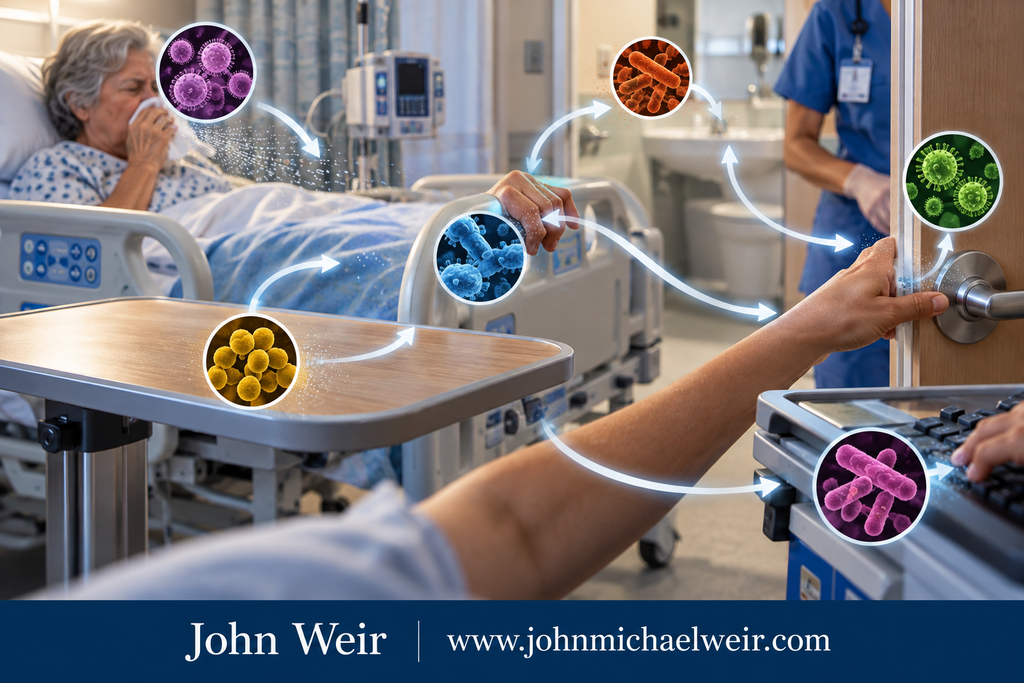
A. The environment refers to the patient or resident’s surroundings. When we talk about cleaning the environment, typically we are referring to cleaning and disinfecting objects, like housekeeping surfaces (e.g., floors, tabletops) and medical equipment. It is particularly important to focus on cleaning and disinfecting frequently touched items, such as bed rails, tray tables, IV poles, call button, monitor screens and controls and cables, pump controls, bedside tables, telephones, carts, toilets, bedpans, sinks, door knobs and levers, light switches, and faucet handles.


training staff

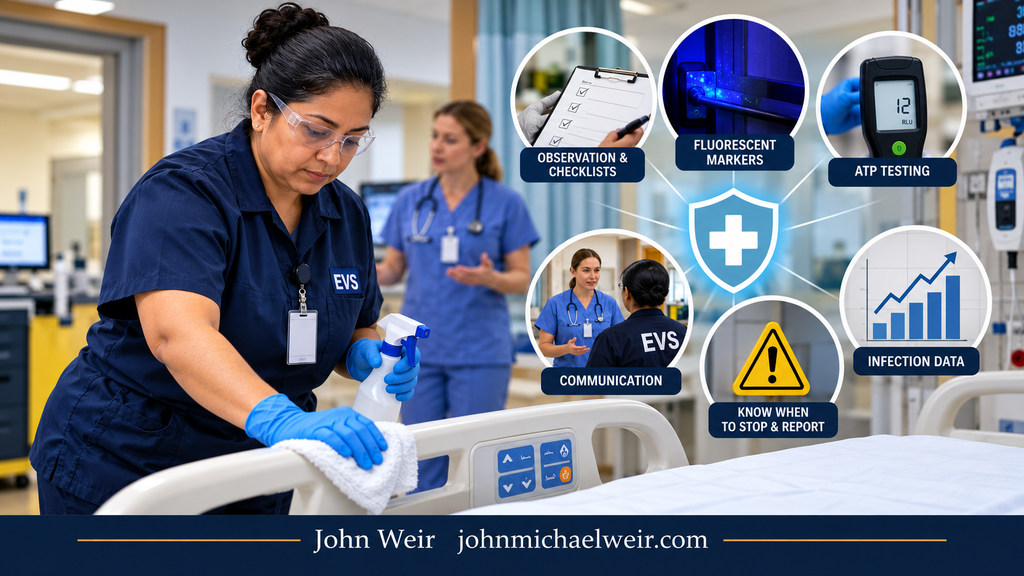
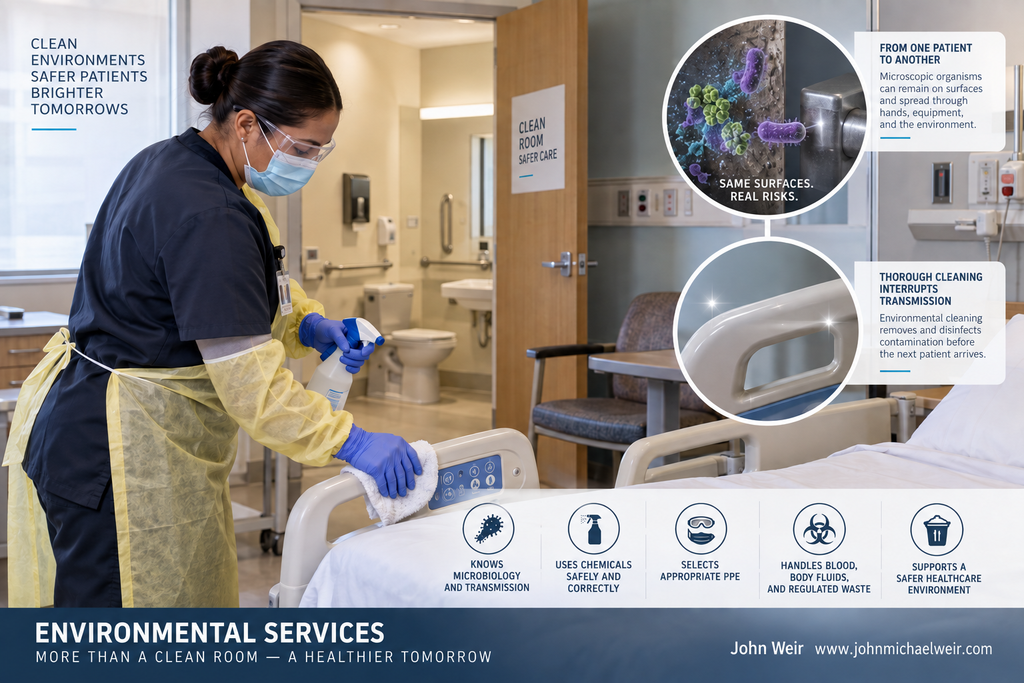
The goal of any Environmental Services Department within a healthcare facility should be to prevent the spread of infectious agents among patients and healthcare workers by meticulous cleaning and appropriate disinfection of environmental surfaces. To reach this goal, the EVS department will need to have a comprehensive training program, the objective of which should be to provide department staff with the information they need to accomplish their jobs safely. The training program should be a part of the big picture of “How to Protect Yourself.” At a minimum the training program should include the following:

  1. Identification of occupational risks and hazards associated with handling infectious waste.
  2. Sharps safety.
  3. Blood borne pathogens.
  4. Infection control training – (a) Microbiology and (b) Transmission.
  5. Hand hygiene.
  6. Personal Protective Equipment (PPE) including donning and doffing.
  7. MSDS and hazards associated with using chemicals (cleaning agents, disinfectants, etc.)
  8. Product usage training including proper cleaning and disinfection techniques.

The benefit behind breaking the training into sections is two-fold. First, it allows the person responsible for training to involve other departments such as Infection Control or Occupational Health & Safety where specific knowledge and expertise can be called upon. Second, by segmenting the areas into shorter pieces the trainee is not overwhelmed. The individual sections also allow for developing unique methods of delivery. Education should be tailored to the size, topic and needs of the group. Not all programs must be instructor-led in classroom setting. They can also consist of CD programs and/or video-based programs or a series of self-study modules. For example, the product usage training may be better suited to a traditional classroom setting where employees can observe someone performing the task while other sections such as Blood Borne Pathogens can use video-based training. Switching up the method of delivery helps keep the trainee engaged.

A basic understanding of these eight topics doesn’t require a stethoscope or coke-bottle glasses, or even the ability to squint. It takes knowledge, imagination and responsibility. Knowledge… to know basic microbiology, where pathogenic microbes are found, and how they cause disease; to know how cleaning and disinfectant products should be used; to know how to be protected from exposure to blood borne pathogens and sharps injuries; about the proper use of PPE. Imagination… to be able to actually picture the microbes all around us. Responsibility… to take reasonable action to prevent disease.

One person dies every six minutes from hospital-acquired infection. It’s tragic that this is allowed to continue and that an Environmental Services department can be allowed to operate without ongoing, targeted and evolving education.

photo_wipe

Time spent properly training staff is an investment that pays dividends for a long time. Training should be a constant process, not just something you do for new employees or to meet the annual requirement. Whenever new products, equipment or procedures are introduced into your department, all staff should be trained on their safe and proper use. Research has shown that adults learn differently than children do, they generally learn more and retain more if they are involved in the training process. Adults learn best by doing, not by listening to lectures or by viewing videos. Lectures and videos have a place in the training process, but trainee involvement needs to be included.

Feel free to share your thoughts and comments.

Here is the two step cleaning training video I participated in as a technical consultant. We filmed this video at the new beautiful Mercy Medical Center in Merced California. The purpose of this video is to help Environmental Services staff save lives. We believe it is not enough to simply clean with a disinfectant anymore. Microfiber, two step cleaning, and a move away from “quat” based cleaners is long overdue.

Our profession is so immensely diverse because of the level of talent and professionalism our members bring to the table. Many years ago, various housekeeping departments were just that–housekeeping–but due to the evolution of health care environmental services managers, we have become multifaceted department managers with responsibilities encompassing a wider array of functions.

With the increased complexity of the job, such as emerging pathogens and potential worldwide outbreaks like avian bird flu, there is demand for professionals who are both experienced and have Certified Healthcare Environmental Services Professional (CHESP) certifications in health care systems throughout the world. We all need to be ready to step up and take the extra challenge on, view it as an opportunity and allow it to shape us as professionals.

Another impacting grand approach is to ensure you have an active succession-planning program in place for your future environmental champions. This profession has provided a lifelong career to many individuals and provides a clean, safe, healthy and healing environment to the patients we serve every day.

Health Care Reform

As part of the proposed changes to healthcare, reimbursement for hospital care and post-acute care will be bundled; patient readmission’s will be at a lower rate in some cases; hospital reimbursement and performance will be directly linked; and physician self-referral will be more closely regulated. Out of those four important items, environmental services has a direct impact on two—readmission rates and performance-based reimbursements. A sufficiently staffed environmental services department plays a major role in minimizing patient readmission’s. The proliferation of microorganisms affecting our communities and the patient population demands a properly cleaned and disinfected care environment. It is my belief that investing in the environmental services department and assuring proper funding, staffing, training, and consistent cleaning procedures and protocols will have a positive impact on lowering the infection rates, lowering the rate of “never” events like patient falls and improving patient satisfaction rates. Each of these examples provides a direct link between our departments and performance-based reimbursements.

So what does this all mean to the environmental services department? This is an opportunity to position the department as the front-line quality assurance and infection control team able to facilitate cost containment for the health care facility and ensure a proper setting for care delivery throughout the continuum of care. Speak up and make sure your senior leaders know the value you and the departmental staff bring to the health care facility. Make the business case for what you do and the big-picture impact on finances, patient readmission and performance-based reimbursement.

There are thousands of health care facilities in the United States. I imagine there are mock surveys and actual surveys everyday somewhere. And during each one, many regulations and requirements are checked for compliance. An increasing focus is being paid to regulated medical waste or RMW.

Most health care facility professionals understand the need to be familiar with the regulatory complexities of managing waste. In Environmental Services we deal with a lot of waste, including RMW.

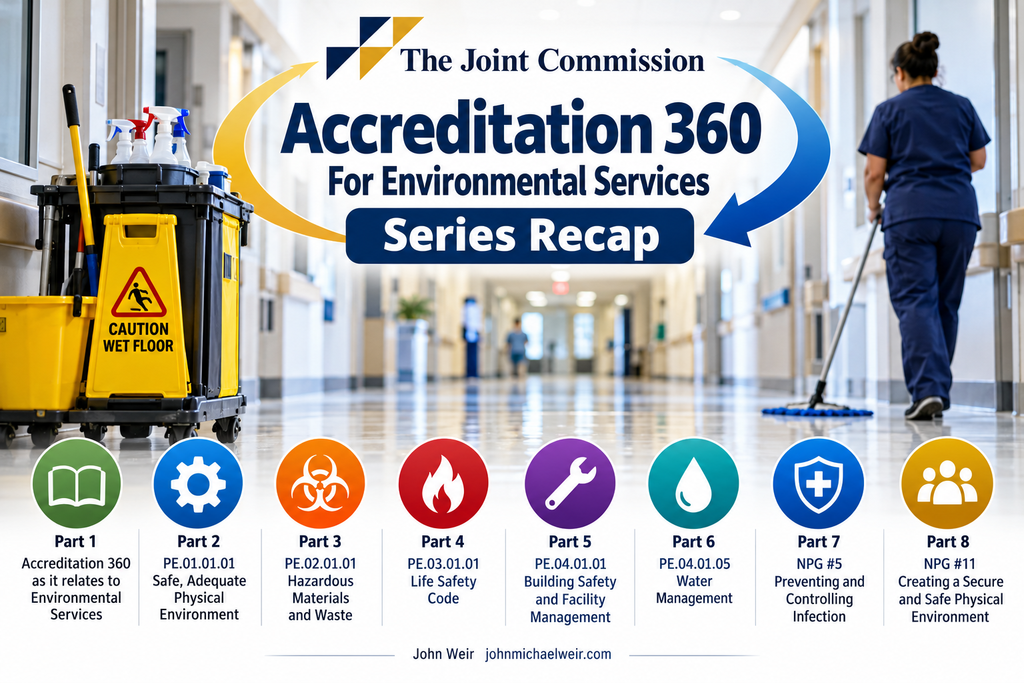
There are many regulations and standards, including the Joint Commission’s Leadership (LD), Environment of Care (EC) and Emergency Management (EM) standards, as well as the federal Department of Transportation, Environmental Protection Agency and many state and local rules and regulations.

Quite a few of the standards related to regulated medical waste can be found in these standards:

  • LD.04.01.01
  • EC.01.01.01 (EP 5)
  • EC.02.02.01 (EP 11, 12)
  • EC.04.01.01 (EP.01, 8, 15)
  • EM.02.02.05 (EP 4)

An organization can be fined thousands of dollars per day per violation by local, state and federal authorities if it is found noncompliant with waste regulations. Many of these fines vary by state. It is very important to be familiar and understand your own state’s current and emerging regulations to avoid these costly fines and remain a compliant leader within the health care industry and their community

image

At our hospital we are in year three of a Service Excellence Initiative. Partnering with Custom Learning Systems we have been been teaching all our staff hard and soft skills to improve customer service through service excellence. Being on the Service Excellence council has given me many opportunities to directly and indirectly influence the process and see first hand the cause and effect results of the program.

Here on my website I try to focus on Environmental Services related topics and the all important “room and restroom always clean” question.

Here are some initial steps for improving your HCAHPS scores:

Train and implement patient visits and staff rounding, utilizing HCAHPS scripting

Have regular, (daily or weekly) 15 minute stand up huddle with each shift to share HCAHPS scores, patient satisfaction and tips to continuously improve the patients experience

Create a regular report to share with your staff and direct reports recapping your scores, efforts and results

Pick one thing to focus on each month to increase your performance. Preferably something you can tie back into your HCAHPS questions.

One of the organizations I am a member of, and actually the first that I joined, is the International Executive Housekeeping Association or IEHA.

Since 1930, the International Executive Housekeepers Association (IEHA) has been a non-profit organization committed to raising professionalism in the cleaning industry and providing a cleaner, safer, healthier environment.

IEHA members are Executive Housekeepers—managers who direct housekeeping programs in commercial, industrial or institutional facilities. IEHA provides members with an array of channels through which they can achieve personal and professional growth. Some are: leadership opportunities; resource materials; education program designation; employment referral service; a Technical Question Hotline (1-800-200-6342); networking; an annual convention and trade show, including several educational sessions; and a monthly trade publication, Executive Housekeeping Today.

Take a moment and learn more about our professional organization:

I hope there is some relief in the activity at your institution now that we have made it through another heavy viral season. Not that there really is a slow season in health care anymore, just a less busy one. So, welcome to the less busy season, when there is time to think and plan.

Environmental services departments are pivotal in the “flow” process, but it must be balanced with proper infection control practices. The challenge is timely, thorough communication—getting and giving good information.

Let’s imagine the emergency room waiting area is filled to capacity and census is at 99 percent. The health care institution has a patient throughput initiative and, hopefully, all of you have been involved in this initiative.

Here is the scenario:

The emergency room has just informed Patient A that he will be admitted. Bed management then scurries to see where the patient can be placed. For purposes of this scenario, we will assume Patient A is a cardiac patient and will need to be admitted into the cardiac intensive care unit, which is currently full. This means the patient shuffle will now occur.

This pending admittance is happening after 7 p.m., when staffing is at a lower level. The most stable patient, Patient S in the cardiac intensive care unit, will move to the step-down unit. But Patient O, who is currently in the step-down unit, needs to be relocated since there is now no need for monitoring this patient, but he is still not ready for discharge. We will now have to move multiple patients to get emergency room Patient A into a necessary room, but the only data that will be looked at is the time it takes to get Patient A to his room, although this is not the only process that is occurring.

The race is on to get Patient A into an intensive care unit room within a certain time frame. Patient S, who is in an intensive care unit room, has to move to the step-down unit room occupied by Patient C. Patient C is stable enough to move to Patient H’s room, which was discharged earlier in the day during the shift change.

This means either there was a lack of communication or miscommunication both from human beings and/or from the “fail-safe” electronic system to notify the incoming environmental services shift of the discharge. The room now resides in “neitherland”; hopefully, it will be discovered and cleaning completed within the required amount of time of the patient flow initiative. If not, we just encountered our first “dam” in the flow.

The current status for environmental services is one critical patient in the emergency room, two patients needing relocating, four rooms counting the ER exam room needing to be cleaned, with the emergency room waiting area overflowing and the health care institution on the verge of going into divert. Contact time to properly disinfect surfaces is 10 minutes, and two of the three rooms are in the same cleaning zone of one person. Patient C needs to go into Patient H’s room, which is the empty discharge room that is lost in the communication process. Patient A, who will move when Patient O moves, can go into Patient S’s room. What does all this mean for the hospital’s environmental services department?

Well if you played along with my little word game, the answer is “chaos”! Most hospitals spend from November to April in this type of scenario. Though the patient flow initiative may not have been accomplished, patients are treated in a timely, effective and safe manner with positive outcomes.

Now, when things are calmer, evaluate your turnaround times, your communication methods and your systems and start to develop process improvement initiatives. Use this time to document, evaluate your data and present this information to your administrator with improvement suggestions. This will assist you and your staff to develop, acquire or change initiatives that will lessen the burden next viral season.

On the road to excellence!

Tina L. Cermignano, CHESP
Operations Manager
Children’s Hospital of Philadelphia
Philadelphia

This article first appeared in the June 2008 issue of HFM Magazine.