Managing Discipline

Sometimes, despite your best efforts, there are problems with individual performance. As a manager, you have to deal with these promptly. If you don’t discipline, you risk negative impacts on the rest of the team as well as your customers, as poor performance typically impacts customer service, and it hurts the team and everything that the team has accomplished. It’s very demotivating to work beside someone who consistently fails to meet expectations, so if you tolerate it, the rest of the team will likely suffer. In our article on team management skills, we explore this issue in further detail and give you some examples.

Team performance will also suffer when differences between individual team members turn into outright conflict, and it’s your job as team manager to facilitate a resolution. Read our article on Resolving Team Conflict for a three-step process for doing this. However, conflict can be positive when it highlights underlying structural problems – make sure that you recognize conflict and deal with its causes, rather than just suppressing its symptoms or avoiding it.


Team Dynamaics, Motivation, Teamwork, Management, John Weir

Good management means understanding how teams operate. It’s worth remembering that teams usually follow a certain pattern of development. It’s important to encourage and support people through this process, so that you can help your team become fully effective as quickly as possible.

When forming teams, managers must create a balance so that there’s a diverse set of skills, personalities, and perspectives. You may think it’s easier to manage a group of people who are likely to get along, but truly effective teams invite many viewpoints and use their differences to be creative and innovative.

Here, your task is to develop the skills needed to steer those differences in a positive direction. This is why introducing a team charter and knowing how to resolve team conflict are so useful for managing your team effectively. Finding great new team members, and developing the skills needed for your team’s success is another important part of team formation.

Please comment or share this article.


dialysis center cleaning

The process of physical cleaning of environmental surfaces using detergent (soap), water, and friction is the critical step required prior to surface disinfection. The combination of the cleaning and disinfection processes is designed to remove and kill vegetative microorganisms on surfaces. Disinfection will not be effective in the presence of dirt, blood, or other bio burden. The  goal of the cleaning step is to remove bio burden and with it, the majority of pathogens. Disinfection is designed to be a synergistic and somewhat redundant step to ensure comprehensive removal/kill of pathogens on surfaces.

The CDC’s Guideline for Disinfection and Sterilization in Healthcare Facilities, 2008, states that, “noncritical surfaces (e.g., dialysis bed or chair, countertops, external surfaces of dialysis machines) should be disinfected with an EPA-registered disinfectant unless the item is visibly contaminated with blood. In that case, an EPA registered tuberculocidal agent with specific label claims for HBV and HIV should be used.”1 the commonly used disinfectant for blood contaminated environmental surfaces is a 1:100 dilution of bleach (500–600 parts per million [ppm] free chlorine).

The environmental surfaces in HD settings at highest risk of transmitting germs are described using different terms. From the perspective of the patient, the term “patient zone” is used to refer to the surfaces which the patient can touch, or can touch the patient, including the chair, armrests, bedside table top/counter, and drawer/cupboard handles. From the HCW or dialysis staff perspective, the term “high touch surfaces” is used to describe surfaces which are frequently touched by HCWs. These include the same surfaces in the patient zone in addition to others such as the exterior surfaces of the HD machine, computer screens, and keyboards. Cleaning and disinfection of these surfaces (patient zone/high touch surfaces) should be performed between all patient treatments, no matter what the patient diagnosis is, in order to prevent spread of environmentally transmitted pathogens including MDROs (e.g., MRSA, VRE, C. difficile) and bloodborne pathogens (e.g., HBV, HCV). Of note, microorganisms can live for varying periods of time in the environment. MRSA has been documented as viable at 38 weeks on external sterile packaging and VRE at 6 months on a wheelchair. HBV can survive for 7 days in dried blood.

There are certain products and principles which are recommended in order to optimize environmental cleaning in healthcare settings, including HD facilities. These include the following tasks which are typically performed by the dialysis nurse or technician.

• Store cleaner/disinfectant separately from skin antiseptics/patient supplies (separate shelves and below patient supplies to avoid potential contamination).

• Perform hand hygiene before and after cleaning the patient station.

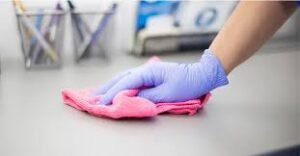
• Don gloves when using cleaner/disinfectants.

• Use one set of cleaning cloths or disposable germicidal wipes for each patient station.

• Use microfiber cloths and mops if possible (more effective cleaning products than regular cotton cleaning cloths).

• Clean all frequently touched or “high touch” surfaces in the “patient zone” between patient treatments (chair, armrests, counters, drawer/cupboard handles, exterior surface of the HD machine)—please note that some of these high touch surfaces may be right outside the patient zone (e.g., computer stations), and must also be cleaned between patient treatments.

• Clean the top of an object first and work down to avoid soiling surfaces just cleaned.

• If using cleaning cloths instead of disposable germicidal wipes:

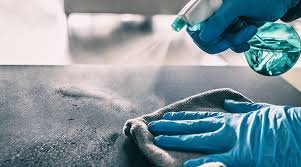
• When using a disinfectant cleaner, wet the surface, use friction to clean, and allow to air dry.

• Fold the cleaning cloth in a series of squares to provide a number of potential cleaning surfaces. A wadded cloth does not clean efficiently.

• Replace cloth as needed. More than one cloth may be required for a patient station.

• Never use the same cleaning cloth for more than one patient unit.

• Never re-dip used cloth into clean disinfectant solution.

Additional cleaning functions, typically performed by housekeeping staff in HD facilities, should include:

• At the end of the day:

• Wet mop the floor

• Clean patient/staff bathrooms and restock paper products/hand hygiene supplies

• Check and refill all hand hygiene product dispensers in nursing stations and at patient stations (soap, paper towels, lotion, alcohol-based hand sanitizer)

• On a routine basis, walls and high dusting should be performed.

Multi Drug Resistant Organisms Cleaning and Disinfection

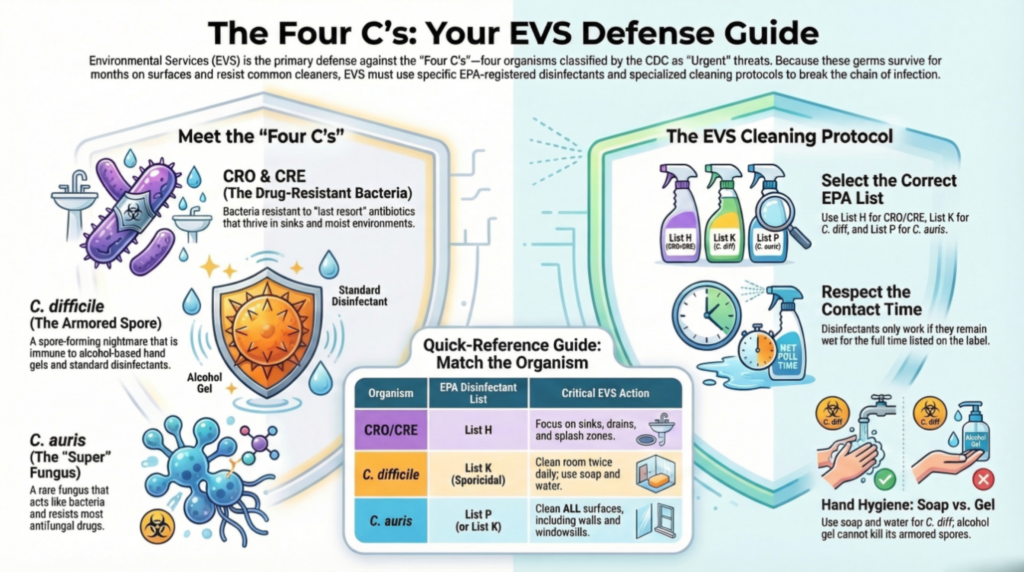
Many healthcare workers believe the environment of patients with MDROs require special cleaning. Healthcare workers in HD facilities should clean the environment of the MDRO patient as they would for any patient, as many more patients than are known are colonized/infected with an MDRO. Cleaning involves the use of friction on environmental surfaces to physically remove the soil and germs. The wet contact time of the germicide on the surface helps kill or inactivate any remaining microorganisms. The exception is C. difficile, which requires removal by friction and is not inactivated by any surface disinfectant except bleach.

The key is that sanitation, safety, and quality cannot be assured for items – particularly paper, textile products such as mops and cloths, and chemicals – that are kept in janitor/housekeeping, soiled utility, and other such areas.  When it comes to soiled utility rooms, it might be good for the EVS profession to stop using the term "Soiled Utility Room" and change it to "Contaminated Utility Room."  If it’s soiled, it should be considered contaminated and treated/handled accordingly.  When thinking of sanitation, safety, and quality our profession must consider broader aspects of each word. 

EVS is a proud and honorable profession and as such it must always insist on doing the best and taking the extra steps to ensure that everyone and everything associated with it is held to the highest standards and goals.  If our professionals do not do so, we will see other disciplines encroaching upon and annexing what is currently EVS. 

I would suggest that you look for the following on-line: State Operations Manual, Appendix A – Survey Protocol, Regulations, and Interpretive Guidelines for Hospitals or go to this link to download a PDF document that you may find invaluable:

www.hcmarketplace.com/supplemental/8987_browse.pdf

For assistance in reasoning out the excluding of the rooms in question, I refer everyone to the following.  They are two typical CMS Guidelines cited.  I’ve also provided an OSHA Website that might interest you.

Interpretive Guidelines §482.41(c)(2) – Facilities, supplies, and equipment must be maintained to ensure an acceptable level of safety and quality. Interpretive Guidelines §482.42 Condition of Participation: Infection Control.

https://www.osha.gov/SLTC/etools/hospital/housekeeping/housekeeping.html#ContaminatedWorkEnvironments

patient-room

For any healthcare administrator to discount quality results – with documented evidence – and revert to justification based on square footage borders on the unconscionable and very possibly unethical.  To ignore your results and measures and revert to staffing levels and budget levels based only on square feet of floor surface will certainly have a detrimental effect on overall patient health, outcomes, and survival.  Just as proper staffing and proper processes in place by nursing saves lives, proper staffing and proper processes used by Environmental Services saves lives.  Environmental Services should be viewed by everyone in healthcare as an investment in patients and quality outcomes, not an expense to the bottom line.

Important areas to clean in a patient room

I consider myself a very progressive person who stays current with the latest technology and methods for cleaning and disinfecting healthcare facilities.  I learn and share best practices. I communicate with my peers all over the country and I have more than a few years experience in healthcare cleaning.  That said, I am getting more than a little tired of so called “experts” who think they know better how we should run our business.

It is my firm conviction that the EVS profession has allowed itself to be corralled, hobbled, hoodwinked, and kidnapped by so many experts doing time studies specifying cleanable square feet.  It’s time for EVS professionals to take back our profession and present the facts of life to the number crunchers, statisticians, human resources, CFOs and the like by doing their own time studies based on their own individual facilities.  No one knows, or can know, their facility and what it takes – people, time, equipment, and supplies –  to clean and disinfect their facility better than EVS.  The problem is that many EVS directors and managers have not taken the initiative to know what it takes to produce a quality outcome for their facility.  Too many want someone else to give them a formula, a policy, a procedure, practice, numbers, metrics, guidelines or whatever to get the job done then they complain when their Administration brings in an “expert” who tells them they should execute a terminal cleaning of a patient room in 12 minutes!  The experts bring in their BRIM, their ISSA, Premier, or other “studies” and handcuff the EVS department and who suffers?  Patients!  We are here for the patients, to give to them a clean and disinfected, and safe patient care environment.  No one can do it better.  But when EVS professionals abdicate their position and authority to others who many be experts in their field but don’t know EVS from shine-ola, well we asked for it and what else would we expect?

As far as these “benchmarks” are concerned, I have one question for everyone who is being asked to follow those guidelines (as good as they may be for non-healthcare) and others like them:  “What is their definition of ‘cleanable square feet?’  If it’s just the floor surface, I would ask what about the number of square feet of wall space that needs to be dusted down and cleaned?  Ceilings?  What about the square feet of windows that need cleaning?  How many square feet are they allowing for the surfaces of a patient bed – six sides plus the bed frame? A barbaric bed?  An over-the-bed table? Chair surfaces?  Bathtubs and showers?  A toilet?  How many square feet are granted in time allowance to remove and replace a cubicle/privacy curtain? You get the picture.  A cookie cutter “standard” cannot address all of the variables found in a patient room.  But EVS professionals can and should.

Do your own time study; you clean a discharged room and an occupied room.  Then have a similar room cleaned by your “slowest” and “fastest” staff members (be sure you inspect the rooms afterward to ensure completeness).  Take the average and you have then done a very basic time study.  Be sure you do rooms at different times of the day to take into account the energy levels of the staff because as the day progresses their energy level decreases.  Cleaning patient rooms has so many variables its not an assembly line.

The truth is that you must set your own time standards and be prepared to defend them against all comers!

[imaioSend][/imaioSend]

I had a great question last Friday… How would you review a housekeeping operation?

Here are some of the steps I said would be important in reviewing their existing housekeeping operations or developing new outsourcing initiatives.

Two key phases of review include:

Analysis

  • Interviews with administration/housekeeping/staff
  • Facility inspection
  • FTE analysis
  • Existing support contracts
  • Departmental policies & procedures
  • Review of housekeeping requirements
  • Budget review
  • Review of supplies & equipment

Scope

  • Physical auditing process
  • FTE determination
  • Training requirements
  • Contractor performance expectations
  • Quantifiable & measurable performance requirements
  • Quality control processes
  • Benchmarking
  • Selection of qualified contractors and contract type
  • Work loading

These are first steps, and make a great start. Contact me if you want to discuss this further.

Here is the two step cleaning training video I participated in as a technical consultant. We filmed this video at the new beautiful Mercy Medical Center in Merced California. The purpose of this video is to help Environmental Services staff save lives. We believe it is not enough to simply clean with a disinfectant anymore. Microfiber, two step cleaning, and a move away from “quat” based cleaners is long overdue.

Here are seven *spectacular* ways to make your Monday rock – and I bet they get you off to such a great start the whole week will rock too!

1. Take time to set your mind. A little time in prayer, meditation or just reflecting on all the amazing blessings you have does *marvelous* things for setting your mind and spirit in a great state to start the week.

2. Stretch! Stretching does *great* stuff for body. It promotes blood flow, it works out kinks and aches and it makes you feel more flexible. And really, when we’re more flexible and we feel good our minds are more flexible too!

3. Do a bit of exercise. You bet. Strong bodies help build strong minds. Get those endorphins flowing, build muscle, feel buff.

4. Picture your week. Create the image of the week that you’re starting – and see it all going GREAT! See it just the way it should be. Don’t worry, even if things come up, you’d be amazed at how easily you can adapt those surprises in and help make them part of how great the week is!

5. Make today’s to do list. If you haven’t already done it the night before, do one now. Don’t make it exhaustive and don’t make it for the rest of the month. Today’s list is fine. Then find one thing you can get done straight away and get your first check mark!

6. Smile and say hello to everyone (yes, even "them") that you work with on the way into your desk/office/cube/work station. You’d be surprised at how much starting with a smile will make both their week and yours better!

7. Be *positive*! For real! This is pithy, but true. Look at things with a glass half full – heck – even go 3/4 full! – mentality. Sure, stuff happens, but look at it as an opportunity! Yes, I hear some of you thinking that you’re a "realist" or " too pragmatic" for that. Well, guess what! The most pragmatic thing you can do is to change the reality by going after those opportunities by unleashing your creative mind with a positive outlook for creative solutions with enthusiasm!

Sometimes you are not in a position to give your employees more in terms of tangible rewards. Increases in pay or benefits, for example, may not be possible.

But there is no limit to the intangible rewards you can give them. These "psychological paychecks" require little effort and cost the company nothing. They represent an excellent way for you to compensate your people during times of transition and change.

Don’t underestimate the value employees place on simple things such as a word of encouragement or a compliment from you. Give them a listening ear and show empathy. Ask their opinions about things. Call them by name, ask about their family, say thank you when they have the right attitude and effort. Write a short note to the employee expressing appreciation for quality work, initiative, etc. When you hold staff meetings, single out individuals and give them a word of praise or commendation for good job performance.

If you take the time to be nicer, you will energize, and encourage your staff. This has many far reaching benefits, particularly during periods of organizational change. There is a real payoff for you, the employee, and your company.

BedBug_1

Don’t start itching, and then check underneath your bed! You see it seems that bedbugs, also known as Cimex Lectularius are showing up in many places.

The bloodsucking bugs were virtually eradicated in the United States in the 1950s. But they are now showing up practically everywhere, nursing homes, jails, apartment buildings, dormitories, even hospitals. There has been a 500% increase in the last few years!

Experts blame the resurgence on increased international travel, immigration, changes in pest-control practices, and the bugs’ growing resistance to insecticides.

Bedbugs can live for a year without a blood meal, but once they start biting their victims may be plagued with multiple bites each night.

The EPA has made some information available to the general population that should be of interest to healthcare professionals.

https://cfpub.epa.gov/oppref/bedbug/

https://www.epa.gov/bedbugs/

Here is a link to the CDC as well:

https://www.cdc.gov/nceh/ehs/Publications/Bed_Bugs_CDC-EPA_Statement.htm

I hope this is of benefit to all of you with problems or concerns.  Please pass this information along to your staff, your Infection Preventionist, Facilities department, and anyone that can be of assistance in addressing the infestations.


Bed Bugs!

I am currently investigating a disposable curtain that does not require a ladder to change. We need a easy way to change curtains much more often then when they look soiled, or every six months. Studies have shown that bacteria can live without the source of a host for months at a time, depending on the bacteria.

What good is it to terminally clean a room including wiping down all of the People Contact Points/Touch Points to rid them of potential microbes that cause HAIs and yet leave curtains that have been touched countless times by contaminated hands?

Curtains should be changed at each and every terminal cleaning – period.  Is it done? No.  Is there documentation that curtains act as vectors for microbes? Yes. You can download the report below.

Infection Control and Hospital Epidemiology November 2008, Vol. 29, No 11; 1074-1076


hcahps

HCAHPS results are publicly reported on Hospital Compare as “top-box,” “bottom-box” and “middle-box” scores. The “top-box” is the most positive response to HCAHPS survey questions. The “top-box” response is "Always” for five HCAHPS composites (Communication with Nurses, Communication with Doctors, Responsiveness of Hospital Staff, Pain Management, and Communication about Medicines) and two individual items (Cleanliness of Hospital Environment and Quietness of Hospital Environment), "Yes" for the sixth composite, Discharge Information, "‘9’ or ‘10’ (high)" for the Overall Hospital Rating item, and "Would definitely recommend” for the Recommend the Hospital item.

The “bottom-box” is the least positive response category for HCAHPS measures. The “bottom-box” response is "Sometimes or never” for five HCAHPS composites (Communication with Nurses, Communication with Doctors, Responsiveness of Hospital Staff, Pain Management, and Communication about Medicines) and two individual items (Cleanliness of Hospital Environment and Quietness of Hospital Environment), "No" for the sixth composite, Discharge Information, "‘6’ or lower (low)" for the Overall Hospital Rating item, and "Would not recommend” for the Recommend the Hospital item.

The “middle-box” captures intermediate responses to HCAHPS survey items. The “middle-box” response is "Usually” for five HCAHPS composites (Communication with Nurses, Communication with Doctors, Responsiveness of Hospital Staff, Pain Management, and Communication about Medicines) and two individual items (Cleanliness of Hospital Environment and Quietness of Hospital Environment), "‘7’ or ‘8’ (medium)" for the Overall Hospital Rating item, and "Would probably recommend” for the Recommend the Hospital item. There is no “middle-box” response in the Discharge Information composite.

HCAHPS On-Line, the official HCAHPS Web site, houses a series of tables that summarize current and historic HCAHPS results. These HCAHPS Tables, available exclusively on HCAHPS On-Line, are based on the HCAHPS data participating hospitals submit to CMS. Before being publicly reported, data are adjusted for the effects of patient-mix and mode of survey administration.

To view the full set of current results on each HCAHPS measure for individual hospitals, please visit the "Survey of Patients’ Hospital Experiences" section of the Hospital Compare Web site (www.hospitalcompare.hhs.gov).

cleaning-supplies

I wrote some general cleaning procedures back here and several people thanked me and asked for more. So I want to take some time and give you some more general and some specific cleaning procedures, along with some important definitions.

I have two ways to explain what I feel clean is. First, the absence of removable soil. Sometimes that means the object may be clean but still look bad, such as a wall that needs paint, or a desk that is scratched. It might also be that there is a stain, something that is not removable so the object does not really look clean. Second, I like to say that it will look brand new, or as close to that as possible.

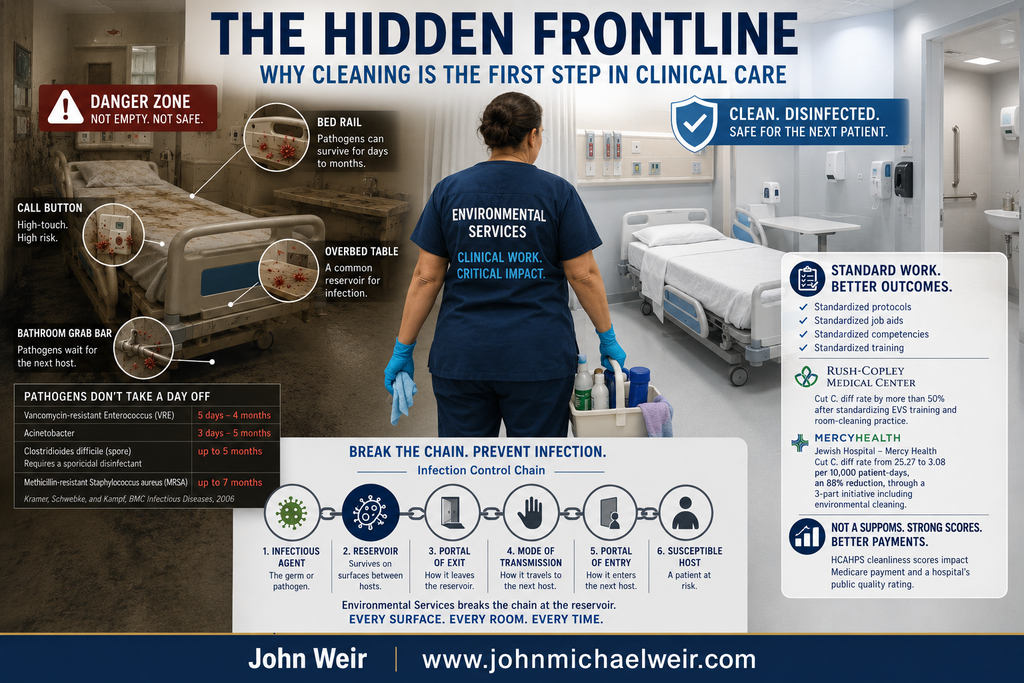
In healthcare cleaning, we go beyond the look of something. It is the visible dirt that makes us unhappy, but it is the invisible “dirt” that makes us sick. We clean surfaces that may already look clean to the naked eye but under a microscope it could be crawling with bacteria.

So what is cleaning?

cleaning present participle of clean (Verb)

1. Make (something or someone) free of dirt, marks, or mess, esp. by washing, wiping, or brushing: "chair covers should be easy to clean"; "he expected other people to clean up after him"; "Anne will help with the cleaning".

What is green cleaning?

Green cleaning can be defined as “effective cleaning that protects health without harming the environment.”

The federal government has defined “green” and “environmentally preferred purchasing” as “…products and services that have a lesser or reduced effect on human health and the environment when compared with competing products and services that serve the same purpose.” — Executive Order 13101 which can be seen at www.ofee.gov/eo/13101.htm.

Both definitions focus on the impact cleaning has on the health of people as well as the impact it has on the environment. Both definitions also describe a goal of striving to make sure cleaning has as positive an impact on human health and the environment as possible. (1)

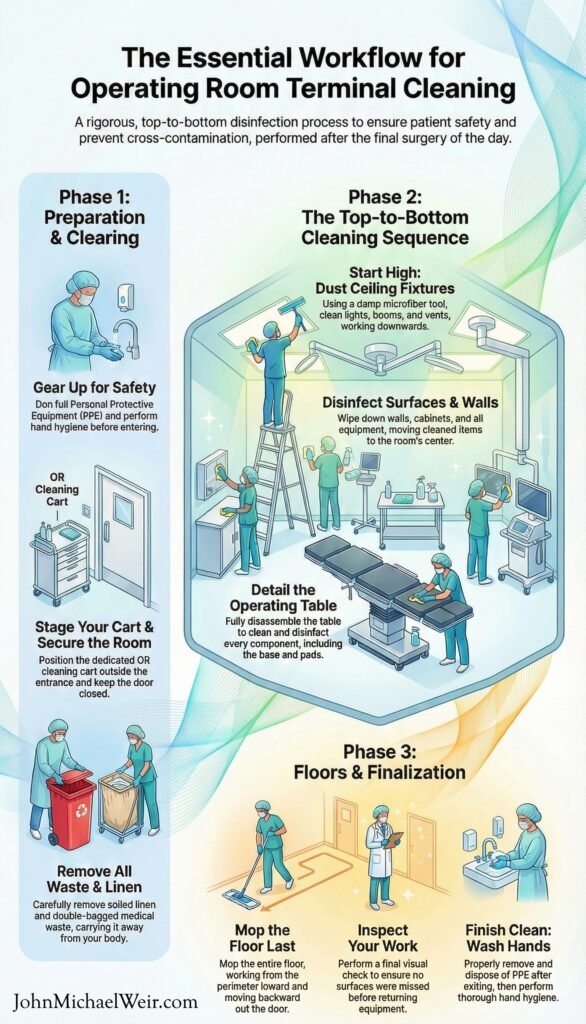
What is Terminal Cleaning?

Terminal cleaning methods vary, but usually include removing all detachable objects in the room, cleaning lighting and air duct surfaces in the ceiling, and cleaning everything downward to the floor. Items removed from the room are disinfected or sanitized before being returned to the room. Terminal cleaning of patient rooms should include the following steps: (2) 

• Using an EPA-approved, hospital-grade disinfectant, the following items should be cleaned:

> Top, front and sides of the bed’s headboard, mattress, bedframe, foot board and side rails, and between side rails

> TV remote

> Nurse-call device and cord

> All high-touch areas in the room including tabletops, bedside tabletop and inner drawer, phone and cradle, armchairs, door and cabinet handles, light switches, closet handles, etc.

• In the bathroom, start with the highest surface and clean the toilet last; clean the sink and counter area, including sink fixtures, and if there is a shower, the support bars and shower fixtures and surfaces

• Privacy curtains should be removed, placed in a plastic bag in the room and double bagged into a laundry bag with the assistance of another member of the ES staff standing at the door outside the room. The person outside the door should wear gloves. After completing the task this person should remove gloves, wash hands with an antimicrobial soap and water or apply an alcohol rub to their hands.

• Cleaning of window curtains, ceiling or walls is not necessary unless visibly soiled.

• Following patient discharge, clinical equipment must be cleaned and disinfected, moved to the door of the room for removal to central supply or to the sterile processing department.

• Following the terminal cleaning of a patient room, gloves should be removed so as to avoid touching the outside of the gloves. Hands should be washed with an antimicrobial soap and water or an alcohol rub applied to the hands prior to donning a new set of gloves.

Best Tip for cleaning:

Use microfiber towels and mops. This is the single most effective change you can make. Microfiber is a scientific discovery that is the foundation for a greener, safer, healthier environment. Microfiber is able to accumulate and absorb more particles of dirt and bacteria than any other fabric known. It can absorb up to 7 times its weight in dirt or liquid. Microfiber is a lint free, non-abrasive, and hypoallergenic product that allows you to clean without the use of chemicals. Unlike ordinary cotton towels that move, or push, the dirt and dust from one point to another, Microfiber actually gets underneath the dirt and lifts it from the surface. It then stores the dirt particles in the towel, until it is washed. Microfiber dust cloths are safe on all surfaces.

Using a traditional cotton loop mop for wet mopping in hospitals has been standard operating procedure in floor cleaning for healthcare facilities for decades. Recently, the healthcare industry has begun to look long and hard at evaluating a different method for cleaning hard surface floors within healthcare facilities with the hope of reducing chemical use, water use and increasing employee and patient health as well as improving overall cleanliness on site. (3)

Microfiber mops are densely constructed polyester and nylon fibers able to hold 6 times their weight in water. Because the fibers are positively charged, it attracts and picks up dust (which is negatively charged), and these microfibers are able to penetrate the microscopic surface pores of any material.

Using the traditional cotton loop mop, it was required that the mop head and water be changed every two or three rooms to reduce the risk of cross contamination. This meant dumping gallons of water and chemical down the drain along with the hardship on employees of lifting the heavy bucket to do so.

Using the microfiber mops, the risk of cross contamination is reduced greatly in that you use one mop per room. With the microfiber system, 20 rooms can be cleaned using 1 and ½ gallon of water and 1 and ½ ounces of chemical.

Use of microfiber in hospitals and other organizations has been endorsed by:

    • The Environmental Protection Agency (EPA)
    • The American Hospital Association
    • The American Nurses Association
    • Association for Professionals in Infection Control and Epidemiology (APIC)
    Microfiber Technology

Last but not least, use some Elbow Grease                                                                elbow grease

Elbow grease is an idiom for working hard at manual labor, as in "You need to use some elbow grease." It is a humorous reflection of the fact that some tasks can only be achieved by hard effort and human energy, contrasting with the idea that there should be some special oil, tool or chemical product to make the job easier. Even with green chemicals and microfiber, cleaning takes effort. You can’t swish a towel around and expect a surface to be clean. You need to put some effort in and scrub. This is one area where there are no shortcuts. Can’t get those minerals off the toilet?, scrub. Shower walls have a film? scrub it.

References:

1 https://www.waxie.com/what_is_green_cleaning_.html

2 “Practice Guidance for Healthcare Environmental Cleaning” from the American Society for Healthcare Environmental Services (ASHES).

3 American Journal of Infection Control Volume 35, Issue 9, November 2007, Pages 569 – 573 William A. Rutala PhD, MPH, Maria F. Gergen MT (ASCP) and David J. Weber MD, MPH