
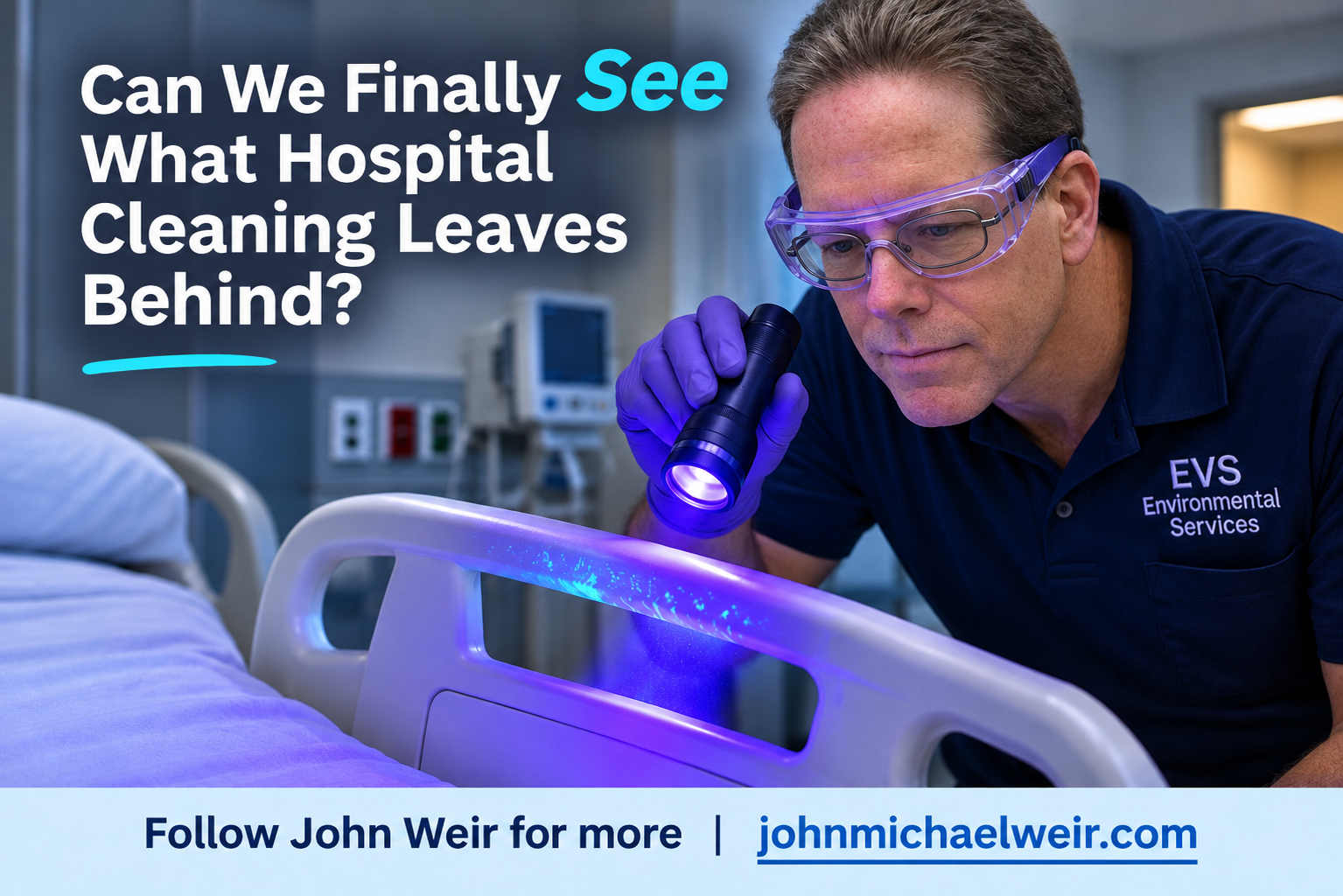
One of the greatest challenges in healthcare Environmental Services is that a surface can look perfectly clean and still harbor dangerous microorganisms. For decades, EVS professionals have relied on established cleaning procedures, disinfectants, training, and monitoring tools to reduce that invisible risk. But what if we could actually see some of the contamination we’re trying to eliminate?
On November 2, 2026, Lakeland Regional Health in Florida announced its use of a technology designed to make viable Clostridioides difficile (C. diff) spores visible on environmental surfaces.
Developed by LivProcess, the technology uses a specialized solution, forensic lighting, and protective goggles to reveal contamination that would otherwise go unnoticed.
The hospital began using the technology in May 2026, incorporating its findings into EVS cleaning practices and surface verification.
This is particularly interesting because C. diff spores can survive on environmental surfaces for months and are difficult to eliminate without appropriate cleaning and sporicidal disinfection.
But how does this compare with the tools we already use?
Visual inspections help identify visible soil and missed cleaning.
Fluorescent markers help determine whether specific surfaces were physically wiped, but they do not measure microbial contamination.
ATP monitoring detects residual biological material and provides rapid feedback, but it cannot identify specific pathogens or establish that a surface is free of infectious organisms.
Environmental cultures can detect microbial contamination, but they require laboratory resources and time, making them impractical for most routine cleaning assessments.
The emerging ability to visualize C. diff spores could provide another valuable tool for infection prevention.
A study published October 31, 2026, in the American Journal of Infection Control reported that 81.7% of surfaces treated with a novel fluorescent tagging solution illuminated, revealing opportunities to improve environmental cleaning. The researchers also reported strong engagement among frontline staff. Additional research is needed to establish how accurately this technology identifies viable spores in routine practice and whether its use reduces infections.
Technology should support EVS professionals, not replace their knowledge, judgment, or training.
Ultimately, the goal is not simply to demonstrate that contamination exists. It is to use that information to improve cleaning practices, strengthen infection prevention, and protect patients.
The question I find most interesting is this:
If we could routinely see what our cleaning processes leave behind, how much would it change the way we train, evaluate, and support our EVS teams?
#EnvironmentalServices #HealthcareEVS #InfectionPrevention #HospitalCleaning #PatientSafety #CDiff #HealthcareQuality
References
Lakeland Regional Health. (November 2, 2026). Lakeland Regional Health First in Florida to Use Innovative Technology That Makes Invisible C. diff Spores Visible. https://www.mylrh.org/lakeland-regional-health-first-in-florida-to-use-innovative-technology-that-makes-invisible-c-diff-spores-visible/
Bailey, P., et al. (2026). Visualizing Clostridioides difficile: Seeing Spores in a Different Light. American Journal of Infection Control. Published online October 31, 2026. https://doi.org/10.1016/j.ajic.2026.10.024
Centers for Disease Control and Prevention. Environmental Cleaning Procedures: Methods for Assessment of Cleaning and Cleanliness. https://www.cdc.gov/healthcare-associated-infections/hcp/cleaning-global/procedures.html
Centers for Disease Control and Prevention. (April 15, 2024). Considerations for Reducing Risk: Surfaces in Healthcare Facilities. https://www.cdc.gov/healthcare-associated-infections/hcp/infection-control/index.html
