
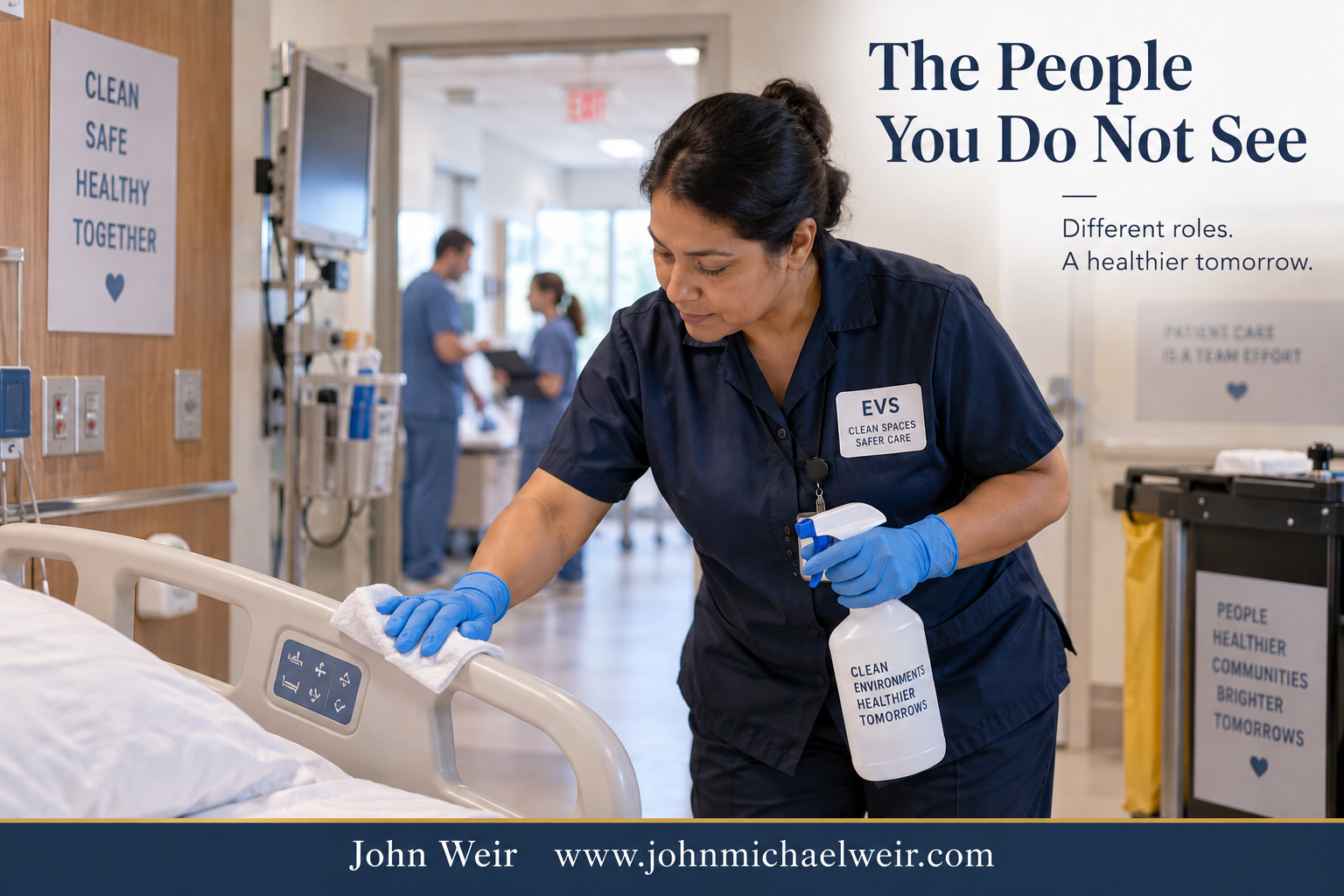
When you walk into a hospital, you see the doctors and nurses. You notice the monitors, the uniforms, the bright lights, and the steady movement in the hallways. You may remember the person who checked your blood pressure or explained your treatment. Many people do not remember the worker who cleaned the bed rail, disinfected the call button, emptied the waste container, or prepared the room for the next patient. Those workers are among the most important people protecting your recovery.
This is the world of Environmental Services, or EVS for short. These teams are responsible for much more than making a hospital look neat. Their work helps control the spread of microorganisms, removes infectious material from patient-care areas, supports safe procedures, and keeps rooms ready for people whose bodies are already under serious stress. A clean-looking room is pleasant. An effectively cleaned and disinfected room is a safety measure.
The central idea is simple: healthcare environmental services is part of patient care. EVS professionals do not prescribe medicine or insert an intravenous line, but their actions affect the environment where every treatment happens. A missed surface, an incorrect disinfectant, or a rushed cleaning step gives harmful pathogens another opportunity to travel from one person to another. A careful, well-trained worker breaks that chain.
Hospitals are full of activity. Patients move between rooms, staff move between departments, visitors touch doors and counters, and equipment travels from one bed to another. Bodily fluids, dust, skin cells, respiratory droplets, and tiny particles settle on surfaces. Some microorganisms survive for minutes. Others remain for hours or days, especially on high-touch objects: bed rails, light switches, overbed tables, remote controls, bathroom handles, and computer workstations. A surface does not need to look dirty to carry a risk.
This does not mean every hospital surface is dangerous, or that patients should be afraid to touch anything. Infection prevention rests on measured risk, consistent practice, and teamwork. EVS workers follow written procedures: what to clean, which product to use, how long it must stay wet, what order tasks follow, and how to handle equipment afterward. These details matter because cleaning is a process, not a quick spray and wipe.
Cleaning and disinfecting are not the same thing. Cleaning removes soil, organic material, and many microorganisms from a surface. Disinfection uses an approved chemical or another method to destroy the disease-causing microorganisms that remain. Disinfection works best when the surface is cleaned first, the product fits the organism, and the instructions are followed correctly. A product that kills one germ may not touch another.
EVS professionals work within a larger infection-control system. Nurses, physicians, infection preventionists, laboratory staff, supply teams, facility engineers, and patients all carry responsibility. Hand hygiene, personal protective equipment, safe injection practices, isolation precautions, ventilation, laundry handling, and environmental cleaning all support each other. If one part fails, the whole system weakens. EVS is not a separate activity that happens after healthcare. It is part of healthcare.
Today, stop and thank your Environmental Services team members for saving lives and making your hospital a nicer place to work.
