
King County Washington. In January 2024, Washington State confirmed its first locally acquired cases of Candida auris there, traced to a Seattle hospital. By July, the state health department confirmed transmission was still ongoing, and a second King County facility was involved. This isn’t a headline from somewhere else. It’s the same referral region a lot of us actually work in.
Candida auris is a fungus, and it’s a genuinely dangerous one. Of over 8,000 clinical isolates the CDC’s lab network tested in 2022 and 2023, 95 percent were resistant to fluconazole, the standard first-line antifungal. Fifteen percent were resistant to amphotericin B. A small number of isolates, documented in real CDC outbreak investigations in Texas and DC, were resistant to all three major antifungal drug classes at once. In that outbreak, the resistance appears to have spread patient to patient, not developed independently in each case. That’s a new kind of problem for US healthcare.
Mortality numbers get thrown around loosely with this organism, so here’s the CDC’s own figure. More than 1 in 3 patients with an invasive C. auris infection, one that reaches the blood, heart, or brain, die. These are already critically ill patients with serious comorbidities, so that number isn’t purely the fungus’s doing. It’s still a number worth taking seriously.
Here’s why this is an EVS problem and not just a clinical one. Candida auris survives on a plastic surface for at least 14 days, and stays detectable for close to a month, at conditions no different from a normal patient room. Compare that to the hours or single days most of what you train against actually survives. A 2018 outbreak investigation in a UK ICU traced transmission directly to reusable temperature probes, not patient contact, patients monitored with them had roughly seven times the risk of picking it up. A separate US investigation in New York skilled nursing and ventilator units found colonization spread across units rather than clustering by roommate, which pointed straight at shared equipment and environmental disinfection gaps as the actual pathway. The room and the equipment in it are doing the spreading, not just the people in the beds.
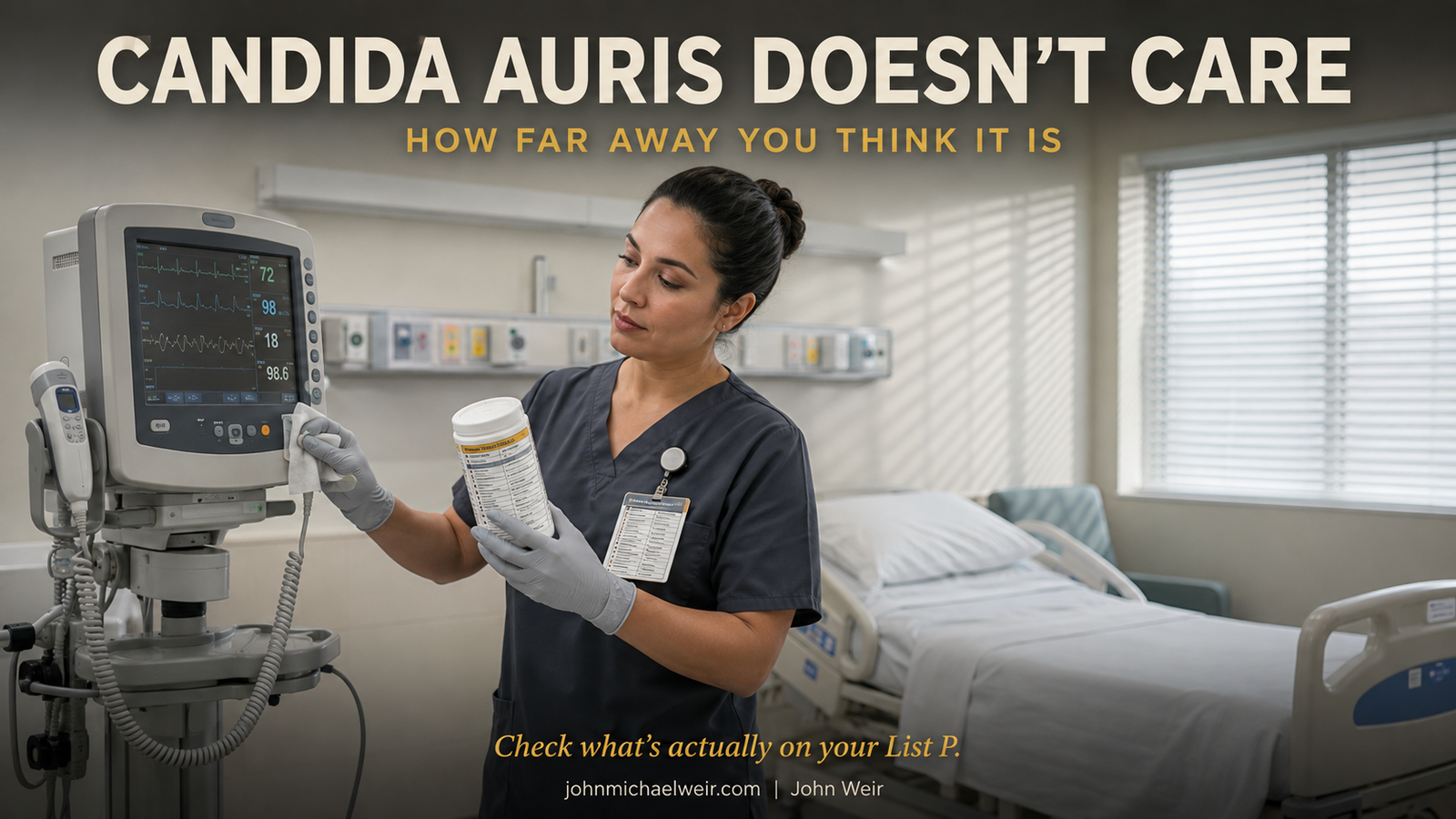
The disinfection story here runs parallel to C. diff, and it’s worth knowing both pieces even though the organisms have nothing to do with each other. Standard quaternary ammonium products, the everyday disinfectant most departments already use, are largely ineffective against C. auris. Chlorine-based and peracetic acid products achieve strong, real log reduction against it. EPA maintains List P specifically for products registered against C. auris, the same way List K exists for C. diff spores. If your daily product isn’t on that list, it’s not doing the job the label implies.
This isn’t a distant emerging-pathogen story anymore. It’s in a hospital an hour or two from most of us, it survives on surfaces for weeks, and the equipment your team touches every shift is a documented transmission route. Know which products in your closet are actually on List P. That’s the whole first step, and it’s one most departments haven’t taken yet.
#EnvironmentalServices #CAuris #CandidaAuris #InfectionControl
References:
Laury JE, Forsberg K, Berkow EL, et al. (2026). Candida auris testing by the Antimicrobial Resistance Laboratory Network, United States, 2022-2023. Emerging Infectious Diseases, 32(2), 308-310. https://doi.org/10.3201/eid3202.251043
Lyman M, Forsberg K, Reuben J, et al. (2021). Notes from the Field: Transmission of Pan-Resistant and Echinocandin-Resistant Candida auris in Health Care Facilities, Texas and the District of Columbia, January-April 2021. MMWR Morbidity and Mortality Weekly Report, 70(29), 1022-1023. https://doi.org/10.15585/mmwr.mm7029a2
U.S. Centers for Disease Control and Prevention. General Information about Candida auris. cdc.gov/candida-auris
Welsh RM, Bentz ML, Shams A, et al. (2017). Survival, Persistence, and Isolation of the Emerging Multidrug-Resistant Pathogenic Yeast Candida auris on a Plastic Health Care Surface. Journal of Clinical Microbiology, 55(10), 2996-3005. https://doi.org/10.1128/jcm.00921-17
Eyre DW, Sheppard AE, Madder H, et al. (2018). A Candida auris Outbreak and Its Control in an Intensive Care Setting. New England Journal of Medicine, 379(14), 1322-1331.
Rossow J, Ostrowsky B, Adams E, et al. (2021). Factors Associated With Candida auris Colonization and Transmission in Skilled Nursing Facilities With Ventilator Units, New York, 2016-2018. Clinical Infectious Diseases, 72(11), e753-e760. https://doi.org/10.1093/cid/ciaa1462
Cadnum JL, Shaikh AA, Piedrahita CT, et al. (2017). Effectiveness of Disinfectants Against Candida auris and Other Candida Species. Infection Control & Hospital Epidemiology, 38(10), 1240-1243.
Haq MF, Pearlmutter BS, Cadnum JL, Donskey CJ. (2024). Efficacy of 23 commonly used liquid disinfectants against Candida auris isolates from the 4 major clades. Infection Control & Hospital Epidemiology, 45(1), 127-131. https://doi.org/10.1017/ice.2023.157
Washington State Department of Health. (2024, January 30). Health Advisory: Candida auris Reported in Two Washington Counties.
Washington State Department of Health. (2024, July 30). Health Update: Ongoing transmission of Candida auris in Washington healthcare facilities.
