
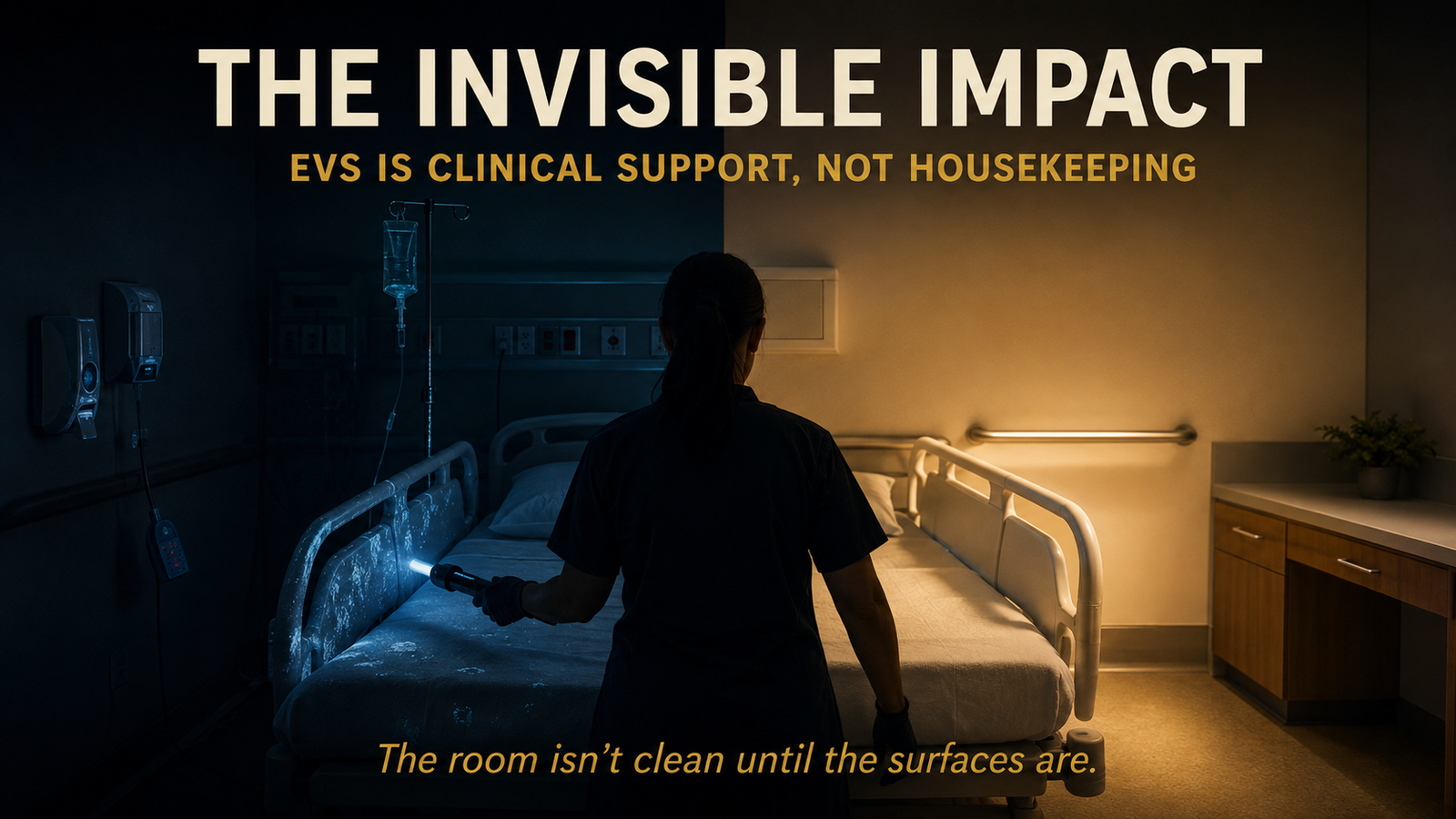
A lot of the attention in healthcare goes to the surgeon’s skill or the nurse’s bedside manner, and both of those matter. But a patient’s recovery often comes down to something they never think to ask about: how clean the room actually is, not how clean it looks.
A real share of HAIs still trace back to environmental transmission: a contaminated high-touch surface, a terminal clean that was skipped or rushed, a disinfectant that never met its required contact time. That’s not a knock on the people doing the work. It’s a statement about how much the work matters. When a bed rail, an IV pole, a call button, or a grab bar isn’t disinfected to protocol, the room doesn’t fail an inspection. It fails a patient.
Clostridioides difficile (C. diff), methicillin-resistant Staphylococcus aureus (MRSA), and vancomycin-resistant Enterococcus (VRE): none of those organisms care how polished the floor looks. They care whether contact time was met, whether the wipe was fresh, whether the person doing the cleaning had the training and the time to do it right.
Every hospital tracks HAI rates as a quality measure. Very few connect that number back to the environmental services (EVS) program that plays one of the biggest roles in it. That’s not a data problem. That’s a leadership problem.
That description is out of date, and it costs hospitals more than they realize. A terminal clean isn’t tidying up. It’s a clinical handoff between one patient’s risk and the next patient’s safety. A tech who understands contact time, product selection, and high-touch surface protocol isn’t a housekeeper. They’re part of the infection prevention team, and they should be trained and spoken of that way.
I’ve watched this play out the same way over and over: the departments that get it right don’t think of themselves as a cleaning crew. They think of themselves as clinical support services, with the training and accountability that title requires. The ones that struggle almost always have a language problem before they have a performance problem. You can’t hold a team to a clinical standard while calling the job something domestic.
Changing a title on an org chart is easy. Changing the culture behind it means building onboarding around infection prevention, not just task lists, and training people to explain why a protocol exists, not just follow it.
That’s fixable. If HAI rates are a quality measure, and environmental transmission is a real part of them, then the numbers that measure environmental cleanliness belong on the same dashboard as the outcomes they affect, not as a footnote but as a driver.
Leadership that wants to lower HAI rates has to stop treating EVS as a cost center to trim and start treating it as a quality function to measure and resource, the same way nursing and infection prevention already are. That means ATP testing and UV verification built into quality reporting instead of sitting in a supply closet. It means EVS leaders in the room when quality and infection prevention decisions get made, not reading the minutes afterward. It means weighing the cost of an HAI against the cost of proper staffing and training, instead of treating EVS staffing as the easiest line to cut.
The hospitals that lead on outcomes over the next decade will be the ones that stop relying on how a room looks and start relying on what the data says about it.
That gap is where environmental services either protects a patient or fails one. Closing it takes leadership willing to name the work correctly, measure it honestly, and put it next to every other clinical function that decides whether a patient goes home well.
If you lead an EVS department, or you’re responsible for what one affects, my book, Healthcare Cleaning Success: EVS Leaders Guide, covers the standards, training, and leadership behind everything in this piece. You can find it here: https://www.amazon.com/dp/B0GWZJWZHD
John Weir is Director of Environmental Services at MultiCare Auburn and Covington Medical Centers and MHS Behavioral Health Network. He holds credentials as a Certified Healthcare Environmental Services Professional (CHESP) and Certificate of Mastery in Infection Prevention (CMIP).
