When you think of the word “clean,” you might picture a sparkling kitchen counter. But in a hospital operating room, “clean” is a term of microscopic precision, where the stakes are infinitely higher. For the highly trained Environmental Services (EVS) technicians responsible for this environment, cleaning is not about tidiness, it is a critical, non-negotiable component of patient safety.

This process is not a chore but a set of rigorously validated protocols, a choreographed system where every variable is controlled to mitigate the risk of infection. It is a profound contribution to healing and patient care.

We say hello to human kindness by providing a clean safe environment as we help save lives. It is our contribution to The Healing Ministry.

What follows are five secrets from this unseen ballet, revealing the meticulous contamination control protocols that ensure a truly sterile environment for every patient.

1. Cleaning Follows a Strict Choreography

Environmental Services Technicians don’t simply start wiping surfaces at random. Every movement in the operating room follows a predetermined path, such as moving clockwise or counterclockwise. This systematic approach is a core principle of quality control, designed to eliminate variables and ensure complete, verifiable coverage so that no surface is ever missed.

The choreography is governed by two rigid principles of contamination control:

• Top-to-Bottom: The performance always begins with the highest surfaces, like ceiling-mounted lights, and works down to the floor. This logic prevents microbes from high surfaces from re-contaminating an already-sterilized lower area.

• Cleanest-to-Dirtiest: The choreography dictates a path from the cleanest zones to the dirtiest, strategically corralling and removing contaminants rather than simply displacing them.

These “unidirectional” movements are intentional. In a striking example of foresight, technicians place fresh, disinfectant-charged microfiber cloths at the start of each wall before beginning their path. This planning “ensures that you have a wipe that is fresh and clean at each place where you transition areas within the room,” guaranteeing process integrity and minimizing cross-contamination.

2. Friction Is Part of the Formula

Spraying a surface with disinfectant is only half the battle. As process experts know, “physical mechanical action and scrubbing is a part of the disinfecting process.” This is because microbes often shield themselves within a protective matrix called a biofilm, which can render chemical disinfectants ineffective.

To break their grip, technicians engage in a direct assault on these microbial defenses. They apply “flat Palm pressure” and use methodical “s-stroke” motions when wiping. This isn’t just cleaning; it’s creating the necessary friction to trap, capture, and physically remove the bio-burden that could otherwise lead to a life-threatening infection. It is a process executed with focused intent and efficacy.

…always clean it like you mean it.

3. Every Bag of Trash Could Hide a Danger

In the high-stakes environment of an operating room, every item is treated as a potential vector for harm. EVS technicians are trained with a mindset of absolute threat assessment. They are taught to “treat all linen as though it could contain sharps” and to “always treat every bag of waste as if it could have a sharp object in it.”

This translates into a visceral choreography of safety:

• Before removing soiled linen, technicians carefully “fold the linen corners into the middle of the table forming a small bundle,” containing any potential hazards within.

• They never compress waste into a container with their hands, as a hidden sharp could cause serious injury.

• Waste bags are secured with a “gooseneck knot,” and all waste is carried away from the body to prevent accidental puncture.

Furthermore, a strict separation protocol is followed. General waste in clear bags is kept apart from red-bagged medical waste, as they are handled and disposed of via entirely different protocols at significantly different costs.

4. The Color of Your Cleaning Cloth Matters—A Lot

To make process errors nearly impossible, technicians can employ a robust visual control system known as color-coding. This suggested approach uses different colored microfiber cloths for specific zones, preventing the microscopic transfer of pathogens from one area to another. A typical system includes:

• Red cloths: Reserved exclusively for the operating table, the most critical surface.

• Green cloths: Used for high-touch general surfaces like worktables, overhead lights, and door handles.

• Light blue cloths: Designated for glass and reflective surfaces for a streak-free clean.

To maximize the efficacy of each cloth, technicians use an “eight-sided fold method.” By folding a cloth in half, and then in half again, they create eight distinct wiping surfaces. After cleaning a small area, the technician refolds the cloth to expose a fresh, uncontaminated face, effectively turning to a new “page” for the next surface. Crucially, a used cloth is never placed back into a pail of clean solution, an act that would instantly compromise the entire bucket.

5. Take it apart to clean properly

Cleaning the operating table is the final act in this meticulous performance, a complete deconstruction and reconstruction. The table isn’t simply wiped down; technicians methodically take it apart, removing table pads and all other components to expose every hidden surface.

The process is exhaustive. Each removable component is cleaned on all sides—top, bottom, and edges. Then, the area of the bed underneath where that component sat is thoroughly disinfected before the clean part is reinstalled. The bed itself is raised to expose “additional components and areas that may get missed,” and every surface down to the “legs and casters” is scrubbed. This painstaking disassembly ensures that the hidden nooks and crannies where pathogens “hang out” are systematically eliminated.

Conclusion: A New Respect for an Invisible Art

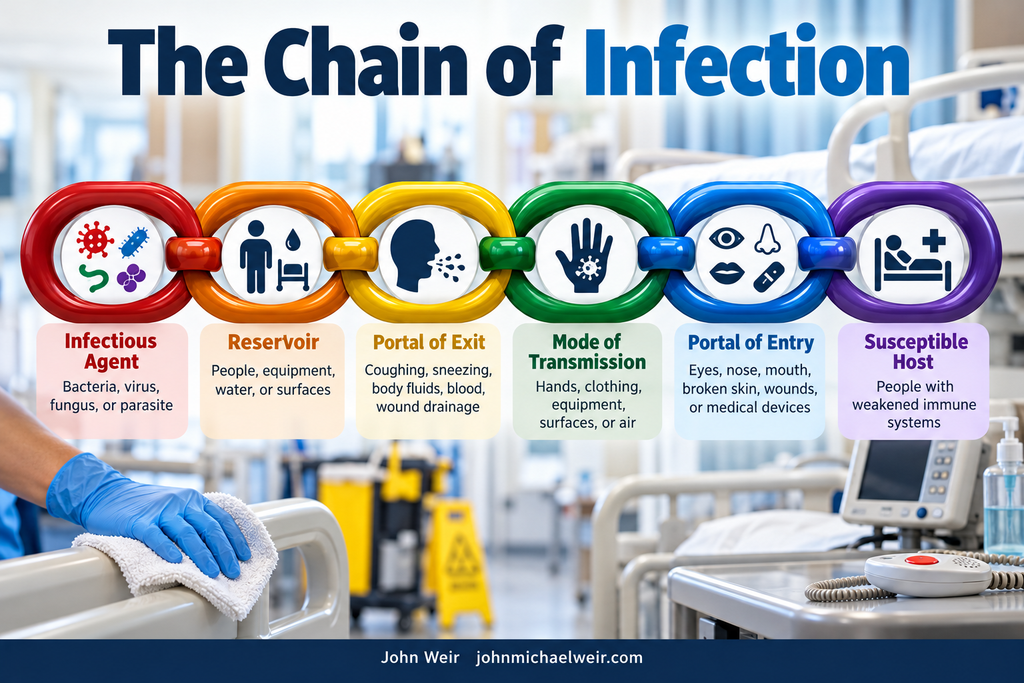
Cleaning an operating room is far more than a janitorial task. It is a science-based, high-stakes discipline performed by dedicated professionals. These five principles—systematic paths, physical force, threat assessment, zone separation, and complete disassembly—are not merely cleaning tips. They form an integrated system of risk mitigation where every action is designed to break a potential chain of infection. This invisible process, full of precise rules and methodical actions, is a fundamental pillar of patient safety in modern medicine.

It makes you wonder: what other lifesaving, invisible actions are being performed around us every single day?

What is the first thing you notice when you enter a hotel or hospital room? I believe, most people register a simple impression: it is either clean and smells fresh, or it isn’t. This feeling of cleanliness gives us a sense of safety and comfort, a sign that professionals have worked tirelessly to prepare the space just for us. But what if that sterile scent masks an invisible world with a dramatic history of its own?

Behind that spotless surface lies a complex, hidden world. Environmental service professionals are on the front lines of a daily battle against microorganisms, many of which are far more than just generic “germs.” These pathogens have unique identities, surprising origins, and counter-intuitive histories that read like scientific detective stories. Here are a few of the most fascinating backstories hiding in the microscopic world from my upcoming Pathogen Playbook.

1. Discovery Can Be Accidental, and Naming Can Be Mythological

In 1928, scientist Alexander Fleming returned from holiday to find a forgotten petri dish held a world-changing secret: a halo of death where a stray mold spore had landed, dissolving the deadly Staphylococcus aureus bacteria around it. In that moment of chance, the age of antibiotics was born. Yet even then, Fleming presciently warned that bacteria could learn to resist his new wonder drug. His warning was a prophecy, and today’s environmental service professionals are on the front lines of the war he foresaw, fighting organisms that have long since learned to outsmart our best medicines.

Other discoveries reveal a flair for the dramatic. In 1819, Italian pharmacist Bartholomeo Bizio was confronted with polenta that appeared to be bleeding. He identified the cause as a bacterium he named Serratia marcescens. Initially, it was considered so harmless that its distinctive red pigment made it a popular biological marker in experiments. Decades later, a German pathologist named Gustav Hauser observed another bacterium’s astonishing behavior. He saw not just a microorganism, but a living tide that spread across the culture plate in a mesmerizing, coordinated wave—a performance so uncanny he reached not for a scientific manual, but for ancient Greek myth, naming it Proteus mirabilis after the shape-shifting sea god who could alter his form to escape his captors.

2. What’s in a Name? Sometimes, a Misconception.

While some pathogen names are poetic, others can be outright misleading. Mpox, for instance, was first identified in research monkeys in 1958, which is how it got its name. However, scientists now believe its natural hosts in the wild are not monkeys at all, but various species of African rodents.

The story of the genus Salmonella is a classic case of mistaken identity and misplaced credit. In 1885, Theobald Smith, an assistant to the American veterinary pathologist Daniel Elmer Salmon, isolated a new bacterium from sick pigs. Despite Smith doing the brilliant work, the organism was named after his boss. To add another layer of irony, the bacterium they found turned out not to be the cause of the hog cholera they were investigating—that was a virus. Another misnomer is the Pseudorabies virus. Despite a name that suggests a connection to the infamous rabies virus, it is not related. It is a type of suid herpesvirus, getting its name from the rabies-like symptoms it can cause in animals.

3. The Unseen Enemy is Incredibly Resilient.

The incredible resilience of certain pathogens makes the work of environmental services both critical and immensely challenging. The spores of Clostridioides difficile, for example, are extreme survivalists that can remain viable on surfaces for up to five months. They are also notoriously resistant to common alcohol-based hand sanitizers, meaning that only the diligent application of soap, water, and sporicidal disinfectants can break the chain of infection.

Some organisms thrive where they are least expected. Burkholderia cepacia, first discovered on rotting onion roots, is so persistent it has been found thriving even in antiseptics like betadine—a substance designed specifically to kill germs. A more modern threat, Candida auris, underscores the ongoing battle. First identified in a patient’s ear in Japan in 2009, this fungus is a healthcare nightmare because it spreads easily, persists on surfaces for extended periods, and is often resistant to multiple classes of antifungal drugs. These organisms don’t just exist; they endure. Their tenacity is a constant reminder of the vigilance required to maintain a safe healthcare environment.

4. There’s a Long, Slow Fuse Between Finding a Germ and Knowing What It Does.

The gap between discovering a new microorganism and understanding its impact can be dangerously long. For 43 years, a devastating hospital-acquired infection spread unchecked because its true cause remained a mystery. Clostridioides difficile was first identified in 1935, but its role in causing antibiotic-associated diarrhea was not established until 1978. This gap underscores how EVS teams are not just cleaning rooms; they are breaking chains of infection that science itself was once slow to understand.

A more recent drama unfolded with Legionella pneumophila. This bacterium was only identified after a deadly and mysterious pneumonia outbreak at a 1976 American Legion convention in Philadelphia. The disease was named “Legionnaires’ disease” after its first victims. After the culprit was found, however, retrospective analysis of previous unsolved outbreaks identified cases dating as far back as 1957. These stories show that scientific understanding is a process, not an event, and the journey from isolating an organism to containing it often has life-altering consequences.

The invisible world of pathogens is far from a simple list of faceless menaces. It is filled with fascinating stories of accidental discovery, mythological naming, extreme resilience, and long-delayed understanding. From a contaminated petri dish to a discolored serving of polenta, the history of these organisms reveals as much about human curiosity and perseverance as it does about the microbes themselves.

This knowledge reinforces the importance of what professionals like me call a “PMA – Positive Mental Attitude.” The fight for a clean, safe environment is a fight against organisms with incredible, complex backstories. It requires not just the right tools and techniques, but a vigilant, proactive mindset.

Knowing the incredible backstories of these organisms, how might it change our perspective on the importance of a positive, vigilant attitude toward cleanliness in our daily lives?

Pursuing a Career in Healthcare Environmental Services: A Critical and Rewarding Path

The healthcare industry is a dynamic, ever-growing field offering numerous career opportunities that contribute significantly to public health and safety. Among these, Healthcare Environmental Services (EVS) stands out as a critical and impactful career path that ensures safe, clean, and healthy environments for patients, staff, and visitors. This recommendation explores the compelling reasons to pursue a career in Healthcare Environmental Services, highlighting its importance, opportunities for growth, and intrinsic rewards.

The Vital Role of Healthcare Environmental Services

Healthcare Environmental Services professionals are unsung heroes in the healthcare system. They are responsible for maintaining the cleanliness, safety, and functionality of healthcare facilities, which directly affects patient outcomes and operational efficiency. Key aspects of their role include:

1. Infection Prevention and Control

• EVS teams are at the forefront of infection prevention. They implement rigorous cleaning protocols to reduce healthcare-associated infections (HAIs), safeguarding patient and staff health.

• Their work ensures compliance with standards set by organizations such as the Centers for Disease Control and Prevention (CDC), the Joint Commission, and the Association for the HealthCare Environment (AHE).

2. Patient and Staff Safety

• A clean and sanitized environment minimizes risks of slips, trips, and falls while ensuring proper waste management.

• EVS professionals contribute to emergency preparedness by managing hazards and maintaining readiness for crises, such as pandemics or natural disasters.

3. Enhancing Patient Experience

• Clean and welcoming facilities are essential for patient satisfaction. EVS teams play a crucial role in shaping perceptions of care quality through their meticulous attention to detail.

Compelling Reasons to Choose a Career in EVS

1. Making a Meaningful Impact

Working in EVS allows individuals to directly contribute to the health and safety of others. Every cleaned surface, sanitized room, and properly disposed waste item plays a role in saving lives and improving care outcomes. This is a career where your efforts are visible, essential, and deeply appreciated.

2. Career Stability and Demand

• Healthcare is one of the fastest-growing industries, and the demand for skilled EVS professionals is increasing. With a heightened focus on infection prevention due to global health crises like COVID-19, the role of EVS is more critical than ever.

• According to the U.S. Bureau of Labor Statistics, the healthcare and social assistance sector is projected to add more jobs than any other industry over the next decade.

3. Diverse Career Opportunities

EVS professionals can work in a variety of settings, including:

Hospitals and Clinics: Maintaining cleanliness in high-risk environments.

Long-Term Care Facilities: Supporting vulnerable populations.

Ambulatory Surgery Centers: Ensuring sterile conditions for outpatient procedures.

Specialized Healthcare Settings: Such as laboratories or mental health facilities.

There are also opportunities for advancement into leadership roles, such as EVS Manager, Director of Environmental Services, or Infection Control Specialist.

4. Professional Development and Certification

The field of EVS offers numerous professional development opportunities:

• The Association for the HealthCare Environment (AHE) provides certifications like the Certified Healthcare Environmental Services Professional (CHESP), which enhance skills, credibility, and career prospects.

• Continuous education and training keep EVS professionals updated on the latest techniques and regulatory requirements.

5. Flexibility and Variety

EVS careers offer flexibility in work hours and environments. Professionals often appreciate the variety in daily tasks, from handling advanced cleaning equipment to collaborating with clinical teams.

6. Inclusive Career Path

This field is welcoming to individuals from diverse backgrounds. Whether you’re starting your career or seeking a meaningful career change, EVS provides an entry point into the healthcare industry with opportunities for growth and advancement.

Core Competencies and Skills Gained in EVS

A career in Healthcare Environmental Services helps individuals develop valuable skills, including:

Leadership and Teamwork: Working in multidisciplinary teams and leading cleaning crews.

Attention to Detail: Ensuring compliance with stringent cleaning protocols.

Technical Proficiency: Operating advanced cleaning technologies, such as UV disinfection robots and electrostatic sprayers.

Problem-Solving: Addressing unique cleaning challenges in complex healthcare environments.

Regulatory Knowledge: Understanding healthcare compliance standards from OSHA, EPA, and CDC.

Intrinsic Rewards of an EVS Career

Pride in Work: Knowing that your efforts contribute to healing and recovery for patients.

Appreciation from Stakeholders: EVS professionals are recognized and valued by healthcare teams for their essential contributions.

Personal Fulfillment: This is a career where you can make a difference every single day, knowing your work supports life-saving healthcare.

Testimonials from Healthcare Environmental Services Professionals

Maria S., CHESP: “In my 15 years in EVS, I’ve learned that every job we do is important. The patients and staff depend on us, and that gives me a sense of purpose every day.”

James T., EVS Manager: “I started as a floor technician and worked my way up to management. The opportunities in EVS are limitless if you’re willing to learn and grow.”

Karen L., Infection Prevention Specialist: “The knowledge I gained in EVS laid the foundation for my career in infection control. It’s a rewarding path with real impact.”

Conclusion

A career in Healthcare Environmental Services is more than a job—it is a calling to make a meaningful impact on patient care, safety, and the overall healthcare system. With strong demand, opportunities for growth, and the chance to work in a role that directly supports life-saving efforts, EVS offers a compelling career path for individuals who value service, diligence, and making a difference.

By choosing a career in EVS, you are stepping into a role where your contributions are essential, appreciated, and impactful. Whether you aspire to advance within the field, gain a foothold in healthcare, or simply seek a career with purpose, Healthcare Environmental Services is a fulfilling and promising choice.

I wanted to try a new approach with the staff so I shared with them the following in our morning huddle today:


Question: What is the first thing that we notice when we enter a hotel room that we have paid for?


Answer: We notice if it is clean and smells fresh. ( staff shared that they also noticed if the bathroom toilet and shower looked cleaned, and if the carpets, furniture and bedding looked and smelled clean).


My point: We judge cleanliness by our senses, what we see, and smell in this case.


The same holds true for our patient rooms and areas, our customers judge our cleanliness of our environment by what they see, and smell.


We are responsible for Infection Control #1 and Perception Control #2:


Infection Control


Our choices regarding what we clean and disinfect will determine whether we are part of the solution or the problem regarding infection control.


Will someone be contaminated with C-diff because we chose not to clean a high frequency touch item?


We will never know how many lives we effect either in a positive or negative manner each day.


Outcome: Our cleaning and disinfecting choices are important we effect lives.


Perception Control


Fact: When we enter a room every moment we are in that room our patients and their families are very aware of our presence. They see and watch what we do, they hear what we are doing, and they can smell what we have done in the room and bathroom.


Seeing – They watch everything that we do, what we clean and what we don’t.

Hearing – When we are in the bathroom they can hear if we run water, flush and scrub toilets, open and close shower doors.

Smell- They can smell the cleaning and disinfecting products that we used when we were in their room and bathroom.


Our challenges:


SHOW YOU CARE – ask if it is ok to clean their room or should you come back later?


BE SEEN – or leave a card on their table so they know you were there.


BE HEARD – let them hear you working and scrubbing.


Leave their environment clean and refreshed, so there will be no doubt that their room was always cleaned.


The Outcome: When asked if their room was always cleaned? There will be no doubt in their minds because of our intentional efforts.

2013_es_week_bookcover


Happy Environmental Services and Housekeeping week to all the very hard service workers in our industry.

In a department comparison test we:

Serve more people on a daily basis

Save more lives through infection control

Clean up the health care environment than any other

Talk with more patients each day

Handle hundreds more pounds of materials

Report more maintenance items

and the list goes on…

Thank you for all the hard work day after day. Without you, our hard-working staff, we would be nothing. I’m proud to work with such awesome individuals.


training staff

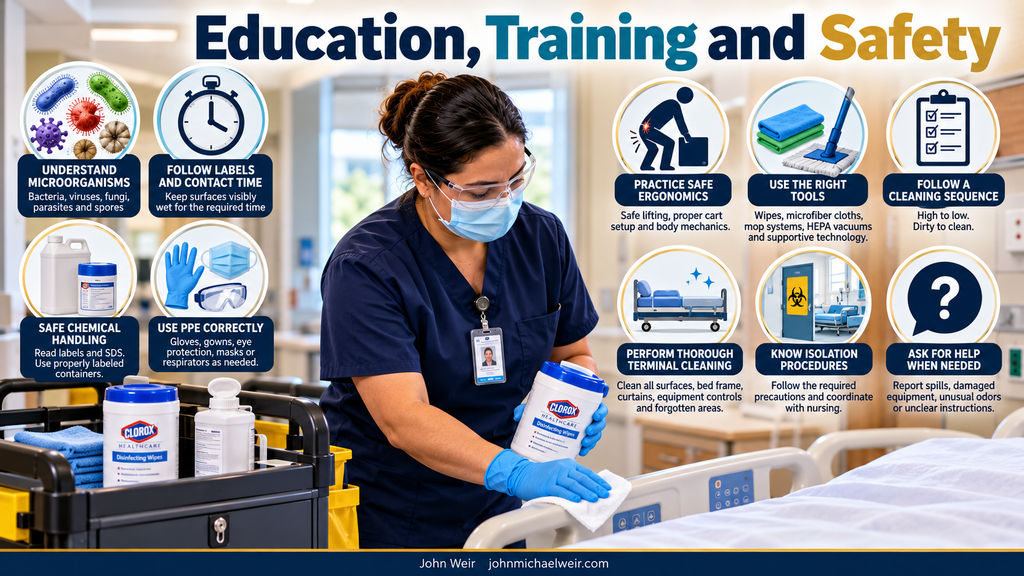
The goal of any Environmental Services Department within a healthcare facility should be to prevent the spread of infectious agents among patients and healthcare workers by meticulous cleaning and appropriate disinfection of environmental surfaces. To reach this goal, the EVS department will need to have a comprehensive training program, the objective of which should be to provide department staff with the information they need to accomplish their jobs safely. The training program should be a part of the big picture of “How to Protect Yourself.” At a minimum the training program should include the following:

  1. Identification of occupational risks and hazards associated with handling infectious waste.
  2. Sharps safety.
  3. Blood borne pathogens.
  4. Infection control training – (a) Microbiology and (b) Transmission.
  5. Hand hygiene.
  6. Personal Protective Equipment (PPE) including donning and doffing.
  7. MSDS and hazards associated with using chemicals (cleaning agents, disinfectants, etc.)
  8. Product usage training including proper cleaning and disinfection techniques.

The benefit behind breaking the training into sections is two-fold. First, it allows the person responsible for training to involve other departments such as Infection Control or Occupational Health & Safety where specific knowledge and expertise can be called upon. Second, by segmenting the areas into shorter pieces the trainee is not overwhelmed. The individual sections also allow for developing unique methods of delivery. Education should be tailored to the size, topic and needs of the group. Not all programs must be instructor-led in classroom setting. They can also consist of CD programs and/or video-based programs or a series of self-study modules. For example, the product usage training may be better suited to a traditional classroom setting where employees can observe someone performing the task while other sections such as Blood Borne Pathogens can use video-based training. Switching up the method of delivery helps keep the trainee engaged.

A basic understanding of these eight topics doesn’t require a stethoscope or coke-bottle glasses, or even the ability to squint. It takes knowledge, imagination and responsibility. Knowledge… to know basic microbiology, where pathogenic microbes are found, and how they cause disease; to know how cleaning and disinfectant products should be used; to know how to be protected from exposure to blood borne pathogens and sharps injuries; about the proper use of PPE. Imagination… to be able to actually picture the microbes all around us. Responsibility… to take reasonable action to prevent disease.

One person dies every six minutes from hospital-acquired infection. It’s tragic that this is allowed to continue and that an Environmental Services department can be allowed to operate without ongoing, targeted and evolving education.

photo_wipe

Time spent properly training staff is an investment that pays dividends for a long time. Training should be a constant process, not just something you do for new employees or to meet the annual requirement. Whenever new products, equipment or procedures are introduced into your department, all staff should be trained on their safe and proper use. Research has shown that adults learn differently than children do, they generally learn more and retain more if they are involved in the training process. Adults learn best by doing, not by listening to lectures or by viewing videos. Lectures and videos have a place in the training process, but trainee involvement needs to be included.

Feel free to share your thoughts and comments.

BedBug_1

Don’t start itching, and then check underneath your bed! You see it seems that bedbugs, also known as Cimex Lectularius are showing up in many places.

The bloodsucking bugs were virtually eradicated in the United States in the 1950s. But they are now showing up practically everywhere, nursing homes, jails, apartment buildings, dormitories, even hospitals. There has been a 500% increase in the last few years!

Experts blame the resurgence on increased international travel, immigration, changes in pest-control practices, and the bugs’ growing resistance to insecticides.

Bedbugs can live for a year without a blood meal, but once they start biting their victims may be plagued with multiple bites each night.

The EPA has made some information available to the general population that should be of interest to healthcare professionals.

https://cfpub.epa.gov/oppref/bedbug/

https://www.epa.gov/bedbugs/

Here is a link to the CDC as well:

https://www.cdc.gov/nceh/ehs/Publications/Bed_Bugs_CDC-EPA_Statement.htm

I hope this is of benefit to all of you with problems or concerns.  Please pass this information along to your staff, your Infection Preventionist, Facilities department, and anyone that can be of assistance in addressing the infestations.


Bed Bugs!

objectives

I wrote about goals a few days ago and one question I received was “what are your department goals for this year? That is a great question because I make it a practice to write out what I call major objectives for the new year each December. These are sort of mid-range goals, not short term, and not long term. That is why they are objectives. Sometimes they continue for more than one year. No serious rules here, just get some things down on paper you so you can plan the necessary action steps to achieve them.

Here are my four major objectives in 2011

1. To improve Infection control within the medical center

2. To improve environmental services staff knowledge of their role in infection control

3. To monitor the cleanliness of the facility with data driven results

4. Better patient outcomes

There you go. Those are the foundational objectives that I have used to develop a number of goals and an even greater number of action items to achieve them.

Enjoy…

Health Care Reform

As part of the proposed changes to healthcare, reimbursement for hospital care and post-acute care will be bundled; patient readmission’s will be at a lower rate in some cases; hospital reimbursement and performance will be directly linked; and physician self-referral will be more closely regulated. Out of those four important items, environmental services has a direct impact on two—readmission rates and performance-based reimbursements. A sufficiently staffed environmental services department plays a major role in minimizing patient readmission’s. The proliferation of microorganisms affecting our communities and the patient population demands a properly cleaned and disinfected care environment. It is my belief that investing in the environmental services department and assuring proper funding, staffing, training, and consistent cleaning procedures and protocols will have a positive impact on lowering the infection rates, lowering the rate of “never” events like patient falls and improving patient satisfaction rates. Each of these examples provides a direct link between our departments and performance-based reimbursements.

So what does this all mean to the environmental services department? This is an opportunity to position the department as the front-line quality assurance and infection control team able to facilitate cost containment for the health care facility and ensure a proper setting for care delivery throughout the continuum of care. Speak up and make sure your senior leaders know the value you and the departmental staff bring to the health care facility. Make the business case for what you do and the big-picture impact on finances, patient readmission and performance-based reimbursement.

What is Clostridium difficile?

Clostridium difficile is a spore-forming, gram-positive anaerobic bacillus that produces two exotoxins: toxin A and toxin B. It is a common cause of antibiotic-associated diarrhea (AAD). It accounts for 15-25% of all episodes of AAD.

Clostridium difficile is a bacterium that may develop due to the prolonged use of antibiotics during healthcare treatment. Clostridium difficile infections cause diarrhea and more serious intestinal conditions such as colitis. The CDC provides guidelines and tools to the healthcare community to help end clostridium difficile infections and resources to help the public understand these infections and take measures to safeguard their own health when possible.

C. difficile is an anaerobic, gram-positive bacterium. Normally fastidious in its vegetative state, it is capable of sporulating when environmental conditions no longer support its continued growth. The capacity to form spores enables the organism to persist in the environment (e.g., in soil and on dry surfaces) for extended periods of time. Environmental contamination by this microorganism is well known, especially in places where fecal contamination may occur. The environment (especially housekeeping surfaces) rarely serves as a direct source of infection for patients. However, direct exposure to contaminated patient-care items (e.g., rectal thermometers) and high-touch surfaces in patients’ bathrooms (e.g., light switches) have been implicated as sources of infection.

How is Clostridium difficile transmitted?

Clostridium difficile is shed in feces. Any surface, device, or material (e.g., commodes, bathing tubs, and electronic rectal thermometers) that becomes contaminated with feces may serve as a reservoir for the Clostridium difficile spores. Clostridium difficile spores are transferred to patients mainly via the hands of healthcare personnel who have touched a contaminated surface or item.

Transfer of the pathogen to the patient via the hands of health-care workers is thought to be the most likely mechanism of exposure. Standard isolation techniques intended to minimize enteric contamination of patients, health-care–workers’ hands, patient-care items, and environmental surfaces have been published. Hand washing remains the most effective means of reducing hand contamination. Proper use of gloves is an ancillary measure that helps to further minimize transfer of these pathogens from one surface to another.

What can I use to clean and disinfect surfaces and devices to help control Clostridium difficile?

Surfaces should be kept clean, and body substance spills should be managed promptly as outlined in CDC’s "Guidelines for Environmental Infection Control in Health-Care Facilities." Adobe PDF file [PDF 1.4 MB] Routine cleaning should be performed prior to disinfection. EPA-registered disinfectants with a sporicidal claim have been used with success for environmental surface disinfection in those patient-care areas where surveillance and epidemiology indicate ongoing transmission of Clostridium difficile. It is important to distinguish the need for a disinfectant with a sporicidal claim. Currently only specific bleach containing products have this registration. Bleach harms surfaces and is hazardous to the user. Normally, HAI’s can often be controlled with good cleaning practices and a non bleach disinfectant.

The recommended approach to environmental infection control with respect to C. difficile is meticulous cleaning followed by disinfection using hypochlorite-based germicides as appropriate. I recommend using microfiber towels and an accelerated hydrogen peroxide based disinfectant. There are now a few products with a C.difficile claim. One I have tried is Dispatch wipes. I found the odor to be acceptable for most of my staff but the film left after using is a significant and required a second cleaning to remove it for an acceptable appearance.

The major difference between cleaning a medical facility and any other building is the focus on the un-seen enemy, bacteria. Environmental Service’s job is to not only provide good visible results, but to reduce the number of surface bacteria to a safe level in order to control cross infection. This is an extremely important responsibility because it keeps harmful bacteria from infecting the person next door or across the hall. Persons whose bodies are recuperating from surgery, injury or a primary infection are in a weakened condition and therefore, cannot put p their normal fight against harmful bacteria. A secondary infection in these cases can cause very serious illness.

(more…)

Following the ‘Six Aims’
By Tina L. Cermignano, CHESP

There has been a lot of media attention about the Institute of Medicine’s (IOM) report “To Err is Human,” especially over outbreaks of community-based Methicillin-resistant Staphylococcus aureus (MRSA). However, we should concentrate on the second report from the IOM, “Crossing the Quality Chasm,” which provides a road map for quality.

In this report, the IOM describes “Six Aims” to ensure health care quality. The Six Aims are identified as: safe, timely, effective, efficient, equitable and patient-centered health care. So what does this mean for ASHES members?

There is no other service in the health care environment that more intimately and consistently touches patients than environmental services. The patient comes in constant contact with our products, from the textiles that they wear and sleep on to the furniture, fixtures and various pieces of equipment they touch on a daily basis.

Taking this into consideration, our base of operations must be in complete balance with the Six Aims. A health care institution may employ the best in clinical care and purchase the finest technology available, yet little of it will matter if the institution is not properly cleaned and disinfected where appropriate. At its very core, environmental services’ reason for being is patient-centered. If we do not perform our roles in a safe, effective, efficient, equitable and timely manner we compromise the quality and health of our patients.

Environmental services staff and the roles they play are often the forgotten heroes in the quest for quality. As the rest of the institution works to achieve and improve upon the Six Aims, our services are often viewed as a way to improve timeliness and the core purpose is defeated. It is our job and obligation to make sure that everyone in the institution and within the industry is aware of how vital our services are to the safety and the healing environment of the patient.

There is no substitute for a clean environment that is free from potentially harmful organisms. The quality initiatives of environmental, waste, linen and transport services cannot be minimized or overlooked as insignificant in the quest for quality improvement.

What can you do? Get involved! In the IOM report, quality is defined as, “The degree to which health services for individuals and populations increase the likelihood of desired health outcomes and are consistent with current professional knowledge.” Professional knowledge is not limited to our profession. Be knowledgeable about other professions and their roles in quality as well. Be knowledgeable about what is going on in your institution. Make sure when the rest of your institution is working on the Six Aims, that you and your staff are involved and that you have allies in the infection control, safety and quality departments so you are included in the discussions and decisions when initiatives are being developed.

It is common for improvement initiatives that seem simple in the planning phase to turn into a problem for another department further down the continuum of care. This is not done intentionally; it usually occurs from lack of awareness about the rest of the cycle. Do not let this happen to you. Keep your eyes and ears open to what improvements are being discussed in your institution and play an active role.

Quality should be a topic when you meet with your boss, your peers across the institution and your staff. They tend to know more than we do at times, because they are on the units every day.

What steps have you taken in order to be consistent with professional knowledge? Let’s talk about it.

On the road to excellence!

Tina L. Cermignano, CHESP
Operations Manager
Children’s Hospital of Philadelphia
Philadelphia

Cleaning is Fundamental

We know that our primary purpose is cleaning. We train our staff to recognize dirt and soil in so many forms and to remove it. We educate, coach and celebrate our successes. We also know that good strategies for combating infection and cross contamination include things such as hand washing and personal protective equipment. In fact recent studies point more often to poor hand washing practices then the environment as the primary cause of hospital acquired infections.

We in Environmental Services understand the importance of hand washing as well as the importance of a clean environment. No matter how well hospital employees adhere to hand washing policies we simply cannot keep pathogens out. Without a top quality training program focused on cleaning and disinfecting the environment, infections will continue to be a problem; germs must be killed wherever they exist within the hospital environment.

I teach my staff to focus on cleaning. Our primary purpose is cleaning, and we never stop and say good enough. We clean and disinfect so that our surfaces not only look clean, they are free of contamination also. I work closely with our infection control department to track results and the partnership has helped to develop best practices that have proven very successful.

When you think about your role in healthcare, remember that without a healthy environment, patients will get sicker, and ultimately, go somewhere else for their healthcare. Support you facility with excellent cleaning, a team relationship with your infection control department as well as your staff. And don’t ever lose focus on cleaning for success.