
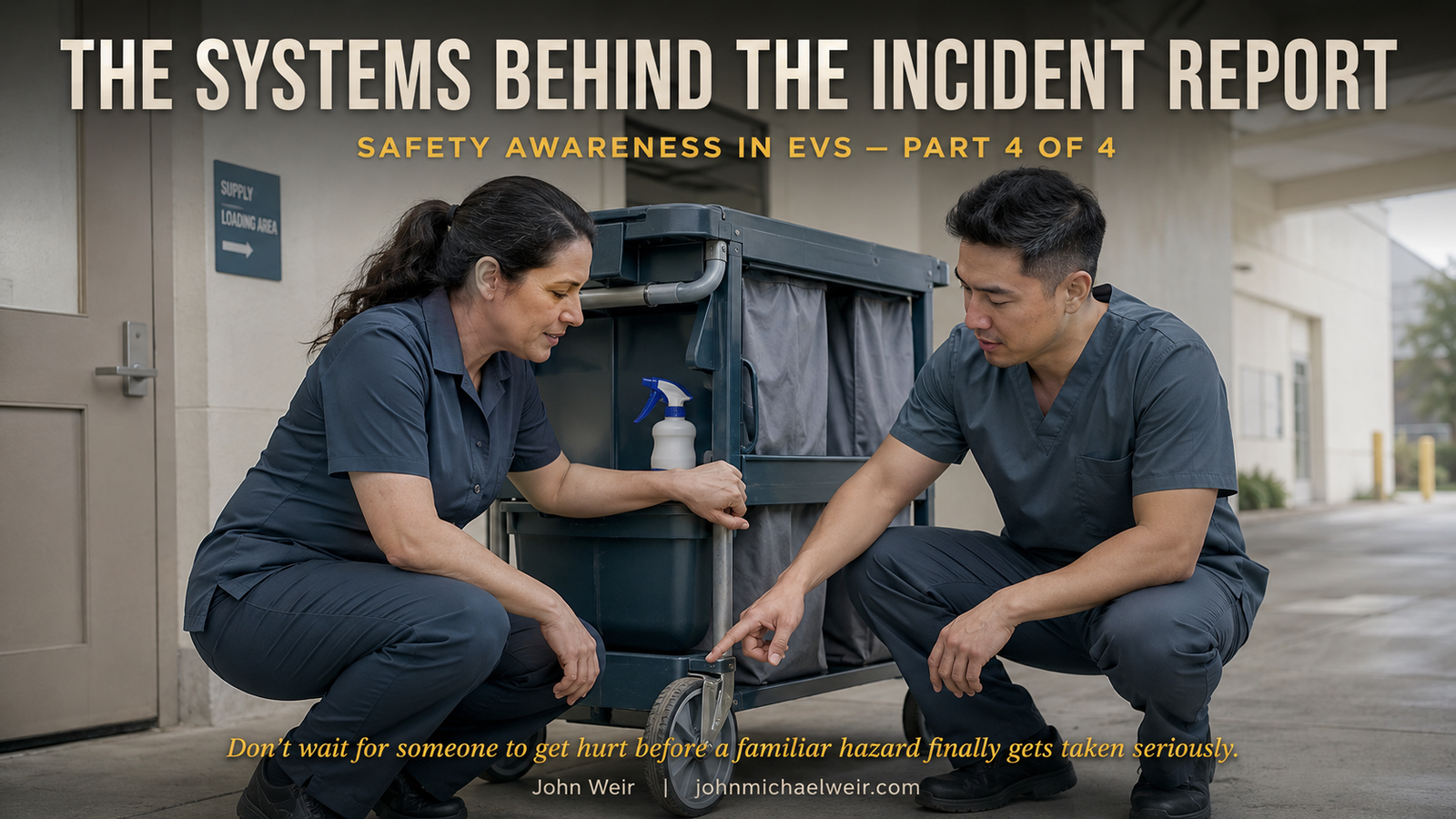
Safety Awareness in EVS, Part 4 of 4: The Systems Behind the Incident Report
I went deep into safety research for Environmental Services this year. What I found is that EVS doesn’t face one hazardous task. A shift moves through nearly every hazardous environment the hospital has, one after another, and most of those hazards go unnoticed simply because the team walks past them every day. I’m presenting what I found in four parts: the hazards you carry in your own hands, what gets on you or under you, the danger that comes from people instead of tasks, and the systems that catch it all before someone gets hurt. This is Part 4 of 4.
Parts 1 through 3 covered what the hazards actually are. This part covers what catches them before they turn into an incident report.
Rushing changes every hazard on this list. A heavy bag is more dangerous when you’re rushing. A wet floor is more dangerous when you’re rushing. A sharps hazard is more dangerous when you grab a bag without looking first. A chemical mistake is more likely when you’re rushing. An agitated patient is harder to notice when you walk into the room without stopping to understand what’s actually happening. That’s why safety and productivity can’t be treated as separate conversations. Rooms need to turn over. Waste has to move. Isolation rooms need proper cleaning. Those are real operational demands, and they’re not going away. But when every task becomes urgent, the pauses that keep you safe are the first thing to get cut. Look at the bag before you lift it. Check the room before you enter it. Inspect the equipment before you use it. Those seconds are part of the work, not a delay from it.
A near miss is one of the most useful pieces of safety information you’ll ever get, and it usually gets thrown away. A needle punctured the bag but missed the tech. A cart wheel locked on a ramp and the employee caught it. A secondary chemical container was mislabeled and almost got mixed with something incompatible. A patient raised a fist and Security got there before anyone was struck. None of those produced a workers’ comp claim, and possibly not reported, and that’s the mistake. They’re warnings. The hazard already showed itself once, for free. A near miss gives you the chance to fix the system while the cost is still zero.
Safety awareness isn’t about teaching your team that every room is dangerous. It’s about keeping routine work from going invisible. A tech who’s carried 10,000 trash bags can still hit the one with a needle in it. A cart that’s been hard to push for three months can still cause tomorrow’s back injury. Floor stripper mixed by hand in the same closet, the same easy way, for years can still be the one batch that splashes. Familiar doesn’t mean harmless. That’s the whole idea.
Here’s what leadership can do. Walk your own operation the way an employee experiences it, not as a cleanliness inspection, a hazard inspection. Watch how the trash gets lifted. Push the cart yourself. Walk the linen route. Look at the compactor. Inspect the chemical dispenser. Follow someone out to the parking garage at the end of a shift. Ask where someone could actually get hurt, then ask your team the same question, because they already know. Your job isn’t to have the answer walking in. It’s making sure the answer never becomes “we’ve always done it that way.”
EVS spends every shift preventing hazards for everyone else in this building. Contaminated waste removed, surfaces disinfected, spills cleaned, linen managed, every space kept usable and safe for someone else to walk into. That same attention is owed back. A real safety program isn’t a once-a-year reminder to lift with your legs. It’s built on noticing what’s become normal: the needle that never should have been in the trash, the bad cart wheel, a leaking dispenser, the patient interaction that didn’t feel right. Every one of those is a chance to step in before the incident report gets written. Don’t wait for someone to get hurt before a familiar hazard finally gets taken seriously.
#Safety #EnvironmentalServices @EVS #Leadership #HospitalOperations #InjuryReporting #OSHA #WAL&I #JointCommission
References:
U.S. Occupational Safety and Health Administration. Worker Safety in Hospitals: Understanding the Problem. osha.gov/hospitals/understanding-problem
Washington State Department of Labor & Industries. Janitorial and Housekeeping Safety. lni.wa.gov/safety-health/safety-topics/industry-topics/janitorial-housekeeping
The Joint Commission. National Performance Goal: Workplace Violence Prevention in Health Care. jointcommission.org/standards/national-performance-goals/preventing-workplace-violence
