
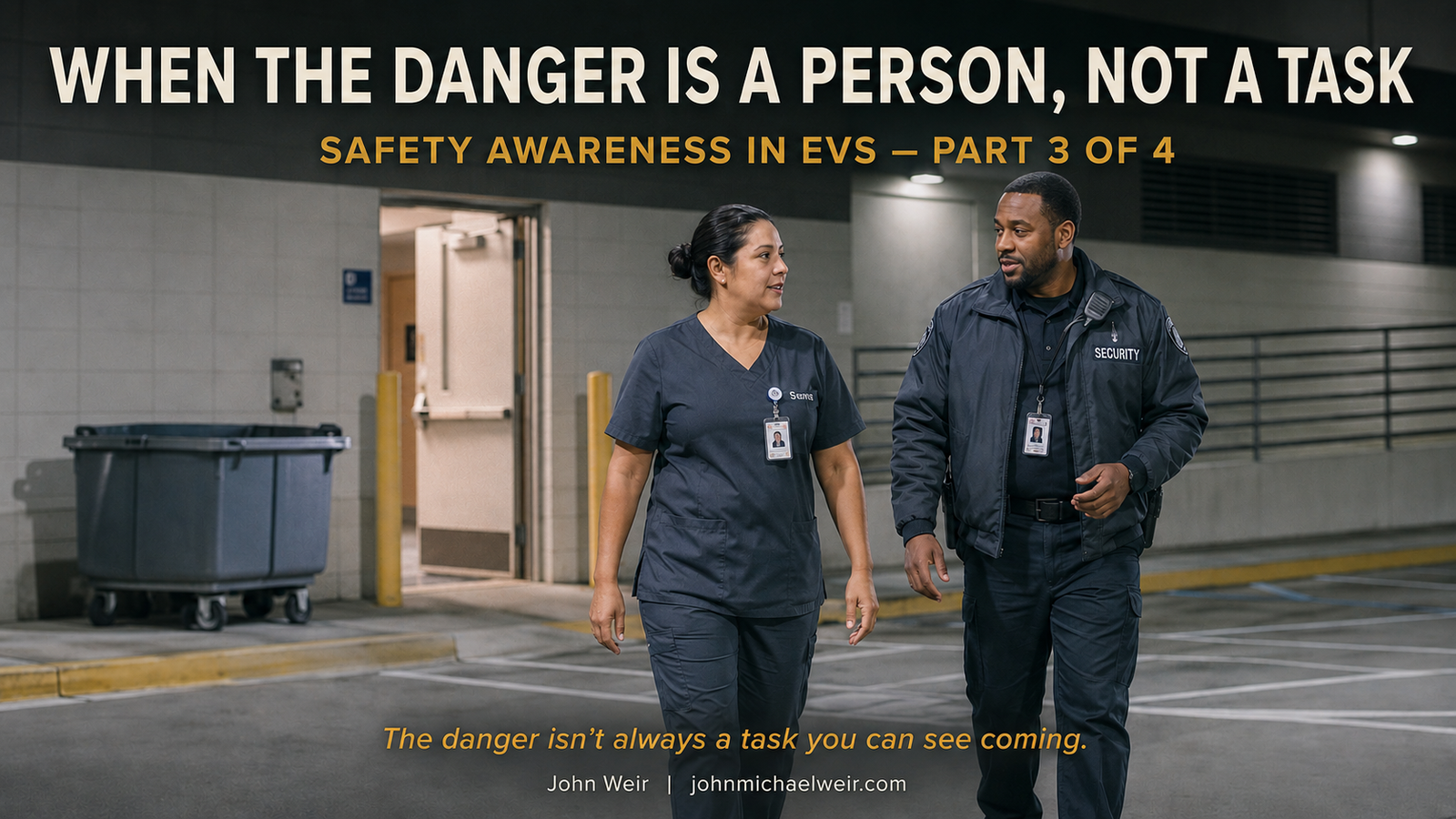
Safety Awareness in EVS, Part 3 of 4: When the Danger Is a Person, Not a Task
I went deep into safety research for Environmental Services this year. What I found is that EVS doesn’t face one hazardous task. A shift moves through nearly every hazardous environment the hospital has, one after another, and most of those hazards go unnoticed simply because the team walks past them every day. I’m presenting what I found in four parts: the hazards you carry in your own hands, what gets on you or under you, the danger that comes from people instead of tasks, and the systems that catch it all before someone gets hurt. This is Part 3 of 4.
Parts 1 and 2 covered hazards you can see and plan around. This part is different. Sometimes the hazard is a person.
Workplace violence gets talked about like it belongs to the ED and behavioral health. It doesn’t. You can work around a confused, frightened, cognitively impaired, or agitated patient on med-surg, in the ICU, or in almost any patient-care area, not just specialty units.
Joint Commission’s current workplace violence performance goal requires accredited hospitals to run a prevention program, provide education, keep a reporting and response process running, and conduct an annual worksite analysis that actually leads to action. That analysis should include EVS. We know things about our hospital other departments don’t. Locations can create uncomfortable encounters, where it’s hard to get help fast. Some situations can easily be a threat, where communication between clinical staff and EVS breaks down before something happens. If nobody’s asked you those questions, that’s a gap, not a compliment. Washington is also actively drafting healthcare-specific workplace violence rules under a new WAC chapter, and the draft language specifically calls out late-night and early-morning shifts and employee security in areas around the facility, including parking. It isn’t final yet. The risk it’s describing is already real.
Night shift doesn’t mean an empty building. Patient units stay staffed, the ED stays active, nursing doesn’t stop. But some of your work does take you outside the hospital. Taking trash to the compactor. Moving waste to an exterior accumulation area. Hauling soiled linen to an accumulation point. Walking between buildings. Crossing a parking garage at the end of a shift. Those are the moments worth thinking about security differently, not because something’s wrong, but because you’re briefly outside the environment that was built with eyes on it. If your facility offers a security escort to your car, use it. You don’t need to prove you were in danger to ask for one. At my facilities this is actively encouraged. A safety culture that makes you justify a precaution isn’t actually a safe culture.
Equipment is supposed to make our work safer and easier. When it doesn’t, it becomes part of the hazard instead. A damaged cord. A broken plug end. Brakes that don’t hold. A cart that no longer tracks straight. A vacuum that takes real force to push. A chemical dispenser that malfunctions. None of that is cosmetic. “Nobody has been hurt yet” isn’t a maintenance standard, it’s a countdown. Tag broken equipment, remove it from service, don’t ignore it because replacing is inconvenient this week.
No, you are not afraid at work. It’s about knowing that the danger in this job isn’t always a task you can see coming. Sometimes it’s a person, a parking garage at 11pm, or a cart nobody fixed. Those deserve the same attention as a bad chemical or a bad lift.
#Safety #EnvironmentalServices #TJC #JointCommission #HospitalSafety
References:
The Joint Commission. National Performance Goal: Workplace Violence Prevention in Health Care. jointcommission.org/standards/national-performance-goals/preventing-workplace-violence
Washington State Department of Labor & Industries. Workplace Violence Prevention in Health Care, Rulemaking. lni.wa.gov/safety-health/safety-rules/rulemaking-stakeholder-information/workplace-violence-prevention-in-health-care
U.S. Occupational Safety and Health Administration. eTool: Hospitals, Hospital-Wide Hazards, Workplace Violence. osha.gov/etools/hospitals/hospital-wide-hazards/workplace-violence
