
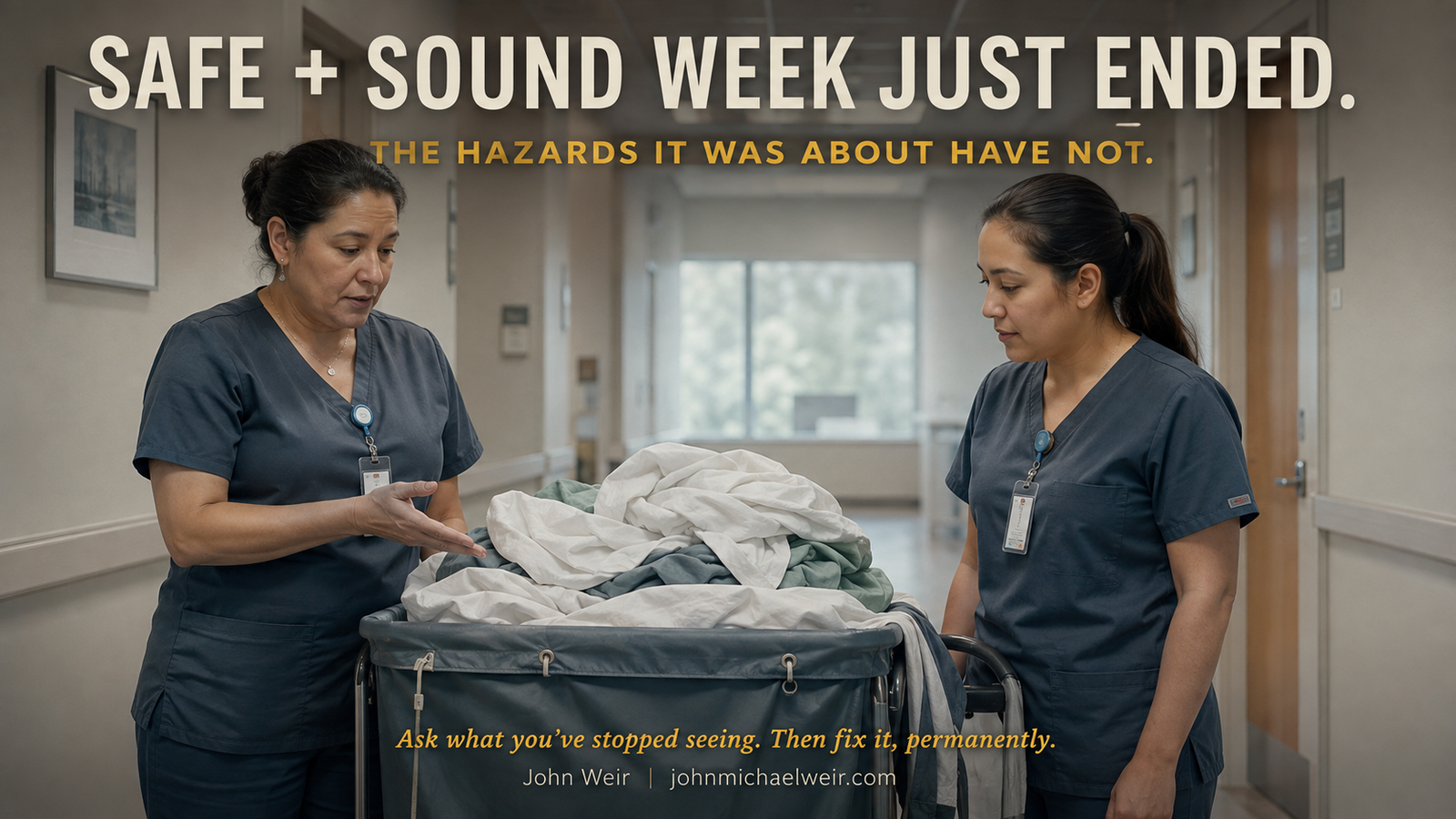
OSHA’s Safe & Sound Week ran August 10 to 16. It’s a voluntary campaign built on three things: management leadership, worker participation, and finding and fixing hazards before they find you. Participation is voluntary. The hazards it’s about are not.
Every EVS department has a version of the same list, and most of it has gone quiet. Overfilled trash and linen bags. Sharps disposed of improperly by clinical staff, not EVS. Cart wheels that have been bad for months. Chemical splash risk. Wet floors. Repetitive lifting. Workplace violence. None of these are secrets. They’re conditions a team sees so often that seeing them stops counting as noticing them.
A 2021 peer-reviewed study of 620 janitors here in Washington State puts a number on what that costs. Twenty percent reported a work-related injury or illness in the past year. Fifty-eight percent reported ongoing low-back trouble. And only forty-five percent of the people who got hurt actually filed a workers’ comp claim. That last number is the one that matters most. It’s not a gap in the safety program. It’s a gap in whether people believe reporting does anything.
Take the linen bags specifically, since they’re the easiest hazard to prove and the easiest to ignore. OSHA and CDC ergonomic research on hospital linen handling found that a bag filled more than halfway with dry compact linen, or filled with wet linen at all, exceeds safe lifting limits in most of the positions staff actually lift it from. Nobody weighs a linen bag before picking it up. The whole hazard survives on nobody stopping to check.
When I round, the question I ask isn’t just what looks clean today. It’s what have we stopped seeing. Every shift has an answer if you ask directly, and the answer is usually something nobody has mentioned in months because mentioning it stopped feeling useful.
Here’s the actual exercise, and it takes ten minutes, not a training day. Ask each shift one question: what unsafe condition have we gotten used to? Don’t collect five answers and build a committee. Pick one. Fix it. Permanently, not until the next supply shortage brings it back. That is closer to a real safety system than another annual presentation nobody remembers by lunch.
#Safety #Leadership #EnvironmentalServices
References:
Anderson NJ, Foley MP, et al. (2021). Work-related injury burden, workers’ compensation claim filing, and barriers: Results from a statewide survey of janitors. American Journal of Industrial Medicine. PMC9300089.
Centers for Disease Control and Prevention, National Institute for Occupational Safety and Health. An Ergonomic Assessment of Hospital Linen Bag Handling. stacks.cdc.gov.
Occupational Safety and Health Administration. Safe + Sound Week, August 10-16, 2026. osha.gov/safeandsoundweek.
Occupational Safety and Health Administration. Hospitals eTool: Housekeeping and Laundry, Work-Related Musculoskeletal Disorders. osha.gov/etools/hospitals.
