
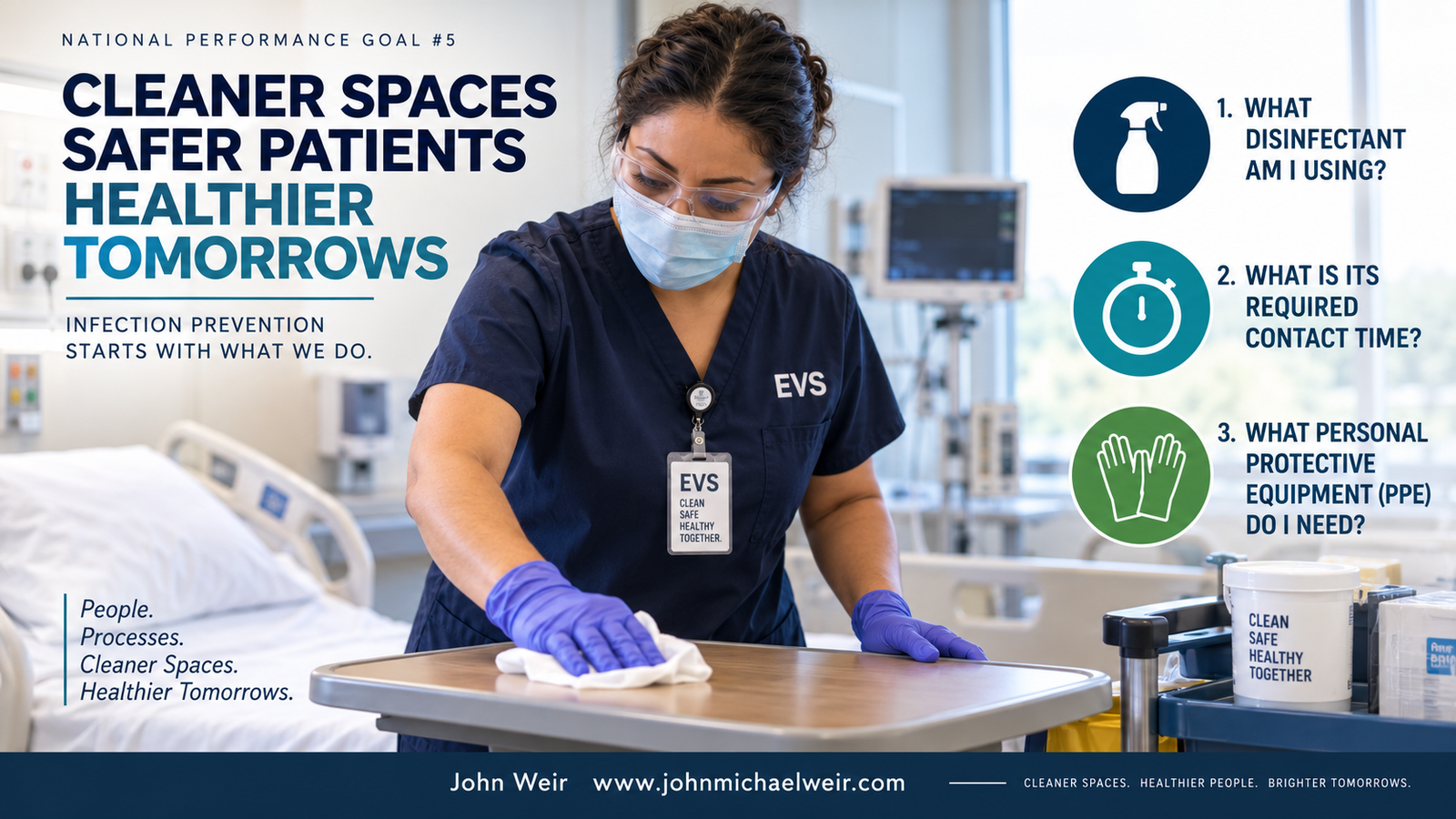
Three Questions Every EVS Technician Should Be Able to Answer
National Performance Goal #5: Preventing and Controlling Infection
A patient room can look clean and still contain risk.
The bedrail may shine. The overbed table may be free of clutter. The monitor may appear ready for the next patient. Yet visible residue can remain along seams, dried organic material can collect around equipment controls, and high-touch surfaces can be missed or disinfected incorrectly.
That is why infection prevention cannot be reduced to appearance alone.
Effective January 1, 2026, The Joint Commission’s National Performance Goal #5 states that hospitals must prioritize infection prevention and control. The goal emphasizes organized processes that protect patients and healthcare workers, reduce human error, and create accountability.
For Environmental Services, the expectation becomes practical at the point of cleaning. Every technician should be able to answer three questions:
- What disinfectant am I using?
- What is its required contact time?
- What personal protective equipment (PPE) do I need?
If a technician cannot answer those questions, we cannot be certain the product is being used safely or effectively.
Looking Clean Is Not the Same as Being Clean
Visible residue is an immediate warning sign. If soil, blood, bodily fluids, adhesive, dust, or other organic material remains on a surface, the cleaning process is incomplete.
Cleaning and disinfection are related, but they are not identical.
Cleaning physically removes soil and organic material. Disinfection uses an approved chemical product to inactivate microorganisms. A disinfectant cannot reliably perform its job when organic material remains between the chemical and the surface.
This creates a simple but essential sequence:
Inspect. Clean. Disinfect. Verify.
Applying a disinfectant wipe over visible soil and moving on is not enough. The technician must remove the soil and then disinfect the surface according to the product instructions.
The final inspection should include more than the center of a table or the obvious face of a device. Residue often remains in less-visible locations:
- Under bedrails and handles
- Around buttons, controls, and touchscreens
- Along mattress seams and bed-frame joints
- Around monitor bases and equipment wheels
- On cords, cables, and handheld controls
- Behind movable equipment
- Around toilet hinges, grab bars, and sink fixtures
These are not cosmetic details. They are potential points of transfer.
Question One: What Disinfectant Am I Using?
A disinfectant is not simply “the wipe in the room.” Each product has a specific formulation, approved uses, organism claims, safety requirements, and surface-compatibility limitations.
Technicians should know the name of the product they are using and why it was selected.
They should also understand that one disinfectant may not be appropriate for every situation. A hospital’s routine disinfectant may differ from the product required for Clostridioides difficile, another spore-forming organism, or a specific outbreak response.
Using the wrong product can leave the targeted organism unaffected. Using a product on an incompatible device can cloud screens, damage plastics, weaken protective coatings, or interfere with electronic controls.
The label and the organization’s approved procedures must guide the work, not memory, assumptions, container color, or what someone has always done.
The Centers for Disease Control and Prevention (CDC) guidance calls for healthcare surfaces and noncritical medical equipment to be disinfected with an Environmental Protection Agency (EPA)-registered hospital disinfectant, following the product’s safety precautions and use directions.
Question Two: What Is Its Contact Time?
Contact time, sometimes called wet time or dwell time, is the length of time a disinfectant must remain in contact with a surface to achieve its approved disinfection claim.
The key word is wet.
Wiping a surface and immediately drying it does not satisfy a three-minute contact time. Neither does lightly passing a nearly dry wipe across a large area. The surface must remain visibly wet for the full time stated on the product label or applicable instructions.
Common wipe failures include:
- Attempting to cover too large an area with one wipe
- Continuing to use a wipe after it has become dry
- Failing to keep the surface wet for the required time
- Immediately wiping the disinfectant away
- Missing undersides, handles, controls, seams, and edges
- Moving contamination from one surface to another
- Using a wipe that is not approved for the device or organism
- Allowing wipe containers to remain open so the wipes dry out
A wipe is a delivery system for a chemical disinfectant. It is not effective merely because it touched the surface.
CDC defines contact time as the period during which a disinfectant must remain in contact with a surface or device to achieve appropriate disinfection. For most products, the surface must remain wet throughout that period.
Technicians should never have to guess the time. Contact-time information should be included in training, posted on approved job aids, and reinforced during observations and competency checks.
Question Three: What PPE Do I Need?
Personal protective equipment is not optional when the task, chemical, isolation status, or exposure risk requires it. At the same time, more PPE is not automatically better. The correct PPE is the PPE identified by the disinfectant label, Safety Data Sheet, organizational policy, patient precautions, and the risk presented by the task.
Depending on the situation, this may include:
- Gloves
- Protective gown
- Eye protection
- Face protection
- Respiratory protection when specifically required
PPE failures occur in both directions. Employees may fail to wear required protection, or they may continue wearing contaminated gloves into hallways, touch carts and door handles with dirty gloves, or use the same PPE between incompatible tasks.
Gloves do not replace hand hygiene. They must be changed at the correct time, removed without contaminating the hands, and discarded before leaving the work area when required. Hand hygiene must follow glove removal.
Chemical PPE and isolation PPE should not be treated as interchangeable. A product may require eye protection because of splash risk even when the patient is not on precautions. Conversely, a patient’s isolation status may require additional PPE beyond what the disinfectant itself requires.
CDC advises facilities to manage environmental cleaning products according to their Safety Data Sheets and to use the PPE required for preparation and use.
Medical Equipment Requires Special Attention
Patient-care equipment presents a particular challenge because both the disinfectant instructions and the device manufacturer’s instructions must be followed.
A product may be an effective hospital disinfectant but still be incompatible with a particular monitor, pump, mattress, touchscreen, probe, cable, or other device. Excess liquid can also enter openings and damage electronic equipment.
Before cleaning unfamiliar equipment, the technician should know:
- Who is responsible for cleaning it
- When it must be cleaned
- Which product is approved
- Whether the device must be powered down
- Which components may be wiped
- Which areas must not be saturated
- Whether the product must be removed or rinsed afterward
- How the device will be identified as clean and ready for use
“EVS cleans the room” is not a sufficient assignment of responsibility. Hospitals need a clear cleaning-ownership matrix for shared and mobile equipment. If responsibility is uncertain, equipment can be missed because EVS believes clinical staff will clean it while clinical staff assumes EVS has already done so.
Competency Must Be Demonstrated
A signed training sheet confirms attendance. It does not prove competency.
Leaders should observe technicians performing the work and ask them to explain their decisions:
- Show me the disinfectant you are using.
- Where can you find its contact time?
- How do you know the surface stayed wet long enough?
- What PPE is required?
- What would you do if the wipe dried before you finished?
- Is this product approved for this device?
- What do you do when visible soil is present?
- Who is responsible for cleaning this piece of equipment?
These should not be trick questions reserved for survey week. They should be routine coaching questions asked during rounds, huddles, orientation, and annual competency validation.
The objective is not to catch employees making mistakes. It is to identify weaknesses in training and systems before those weaknesses reach a patient.
Build a System That Makes the Right Practice Easier
Individual accountability matters, but leaders must also create conditions that support success.
Technicians need:
- Standardized, approved disinfectants
- Clear and accessible manufacturer instructions
- Simple contact-time reminders
- Device-specific cleaning guidance
- Defined equipment-cleaning responsibilities
- Properly stocked PPE
- Wipes that are wet and within their expiration date
- Adequate time to complete the process correctly
- Direct observation, feedback, and retraining
- A safe way to stop and ask questions
If staff members regularly cannot answer the three essential questions, that is not only an employee problem. It is a system problem.
The Three-Question Standard
National Performance Goal #5 places infection prevention where it belongs: among the hospital’s highest patient-safety priorities.
For EVS, that priority becomes visible in thousands of small decisions made throughout every shift: choosing the correct product, removing soil before disinfection, keeping a surface wet for the required time, protecting medical equipment, using PPE correctly, and stopping when instructions are unclear.
Every technician should be able to say:
I know what disinfectant I am using.
I know how long the surface must remain wet.
I know what PPE the task requires.
Those three answers do not represent everything an EVS technician must know. But without them, cleaning becomes an assumption.
With them, and with the training, supplies, time, and leadership support needed to put them into practice, environmental cleaning becomes what it is intended to be: a reliable infection-prevention intervention and an essential part of patient care.
References:
The Joint Commission. National Performance Goal (NPG) #5: Preventing and Controlling Infection, effective January 1, 2026. jointcommission.org
Centers for Disease Control and Prevention. Recommendations for Disinfection and Sterilization in Healthcare Facilities. cdc.gov
Centers for Disease Control and Prevention. Considerations for Reducing Risk: Surfaces in Healthcare Facilities. cdc.gov
#HealthcareLeadership #EnvironmentalServices #HospitalOperations #PatientSafety #QualityImprovement #JointCommission #Compliance #InfectionPrevention
