
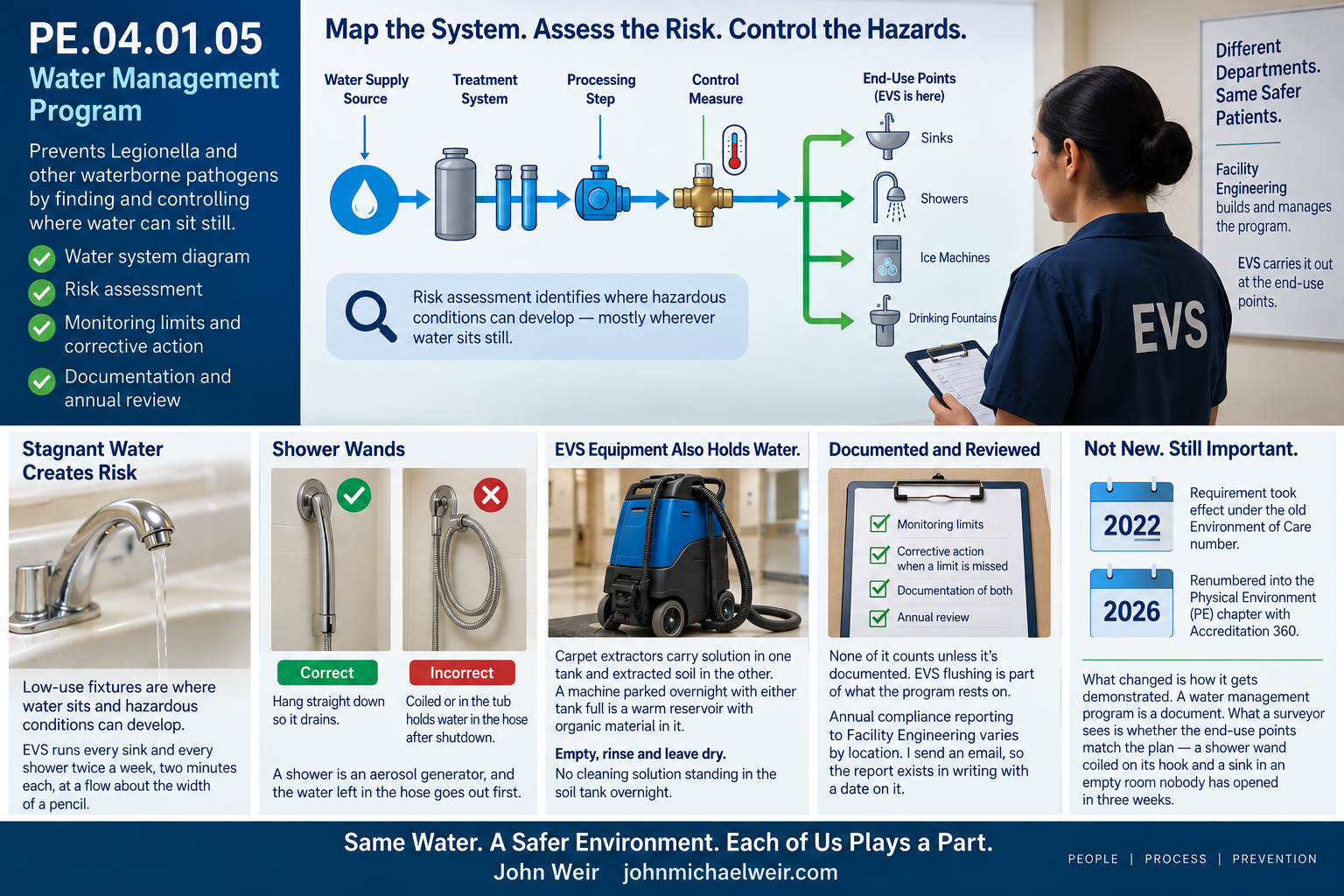
PE.04.01.05 requires organizations to have a water management program that addresses Legionella and other waterborne pathogens, and it carries four Elements of Performance. An individual or a multidisciplinary team has to be responsible for developing, managing and maintaining the program. A risk assessment is conducted, evaluating the condition of each step to find where hazardous conditions can develop, which is mostly wherever water sits still. The program then has to have monitoring limits, defined corrective action when a limit is missed, documentation of both, and a formal annual review.
Environmental Services (EVS) does not build the diagram and does not own the program. Most EVS departments have some responsibilities though.
Stagnant water is the problem the standard is written around, and the low-use fixture is what it’s about. My EVS teams runs water in every sink and every shower twice a week, two minutes each, at a flow about the width of a pencil. That is not a cleaning task and it does not look like one. No stagnate water is what the plan is written around, and they are the important ones to think about.
Handheld shower wands are left hanging straight down so they drain. A wand coiled on its hook, or resting in the bottom of the tub, holds water in the hose after the water is shut off. A shower is an aerosol generator, which is the exposure route this standard exists to control, and the water left sitting in that hose overnight goes out first. Straight down, hose hanging, every time the room is cleaned.
EVS also holds water in its own equipment. A carpet extractor carries solution in one tank and extracted soil in the other, and a machine parked overnight with either one full is a warm reservoir with organic material in it. Extractors get emptied, rinsed and left dry, with no cleaning solution standing in the tanks overnight. There is no carpet extractor on the water management diagram. The risk in that tank is the same risk the diagram was drawn to find.
None of it counts unless documented. The standard requires documented monitoring and documented corrective action, and the flushing EVS does is part of what the program rests on. Annual compliance reporting to Facility Engineering varies by location. I send an email, so the report exists in writing with a date on it and neither department has to reconstruct it from memory a year later.
This requirement is not new. It took effect in 2022 under its old Environment of Care number and was renumbered into the Physical Environment (PE) chapter when Accreditation 360 consolidated the old Environment of Care and Life Safety chapters in 2026. What a surveyor sees is a shower wand coiled on its hook and a sink in an empty room nobody has used in three weeks.
References:
The Joint Commission. R3 Report, Issue 32: New Standard for Water Management Program, Hospitals, Critical Access Hospitals, and Nursing Care Centers. October 27, 2021, updated November 18, 2025. jointcommission.org
The Joint Commission. Physical Environment (PE) chapter, PE.04.01.05, Elements of Performance 1 through 4. jointcommission.org (standards portal, login required)
Centers for Disease Control and Prevention. Developing a Water Management Program to Reduce Legionella Growth and Spread in Buildings. cdc.gov
ASHRAE Standard 188-2018, Legionellosis: Risk Management for Building Water Systems. ashrae.org
#HealthcareLeadership #EnvironmentalServices #HospitalOperations #PatientSafety #QualityImprovement #InfectionPrevention #JointCommission #Compliance #WaterManagement
