
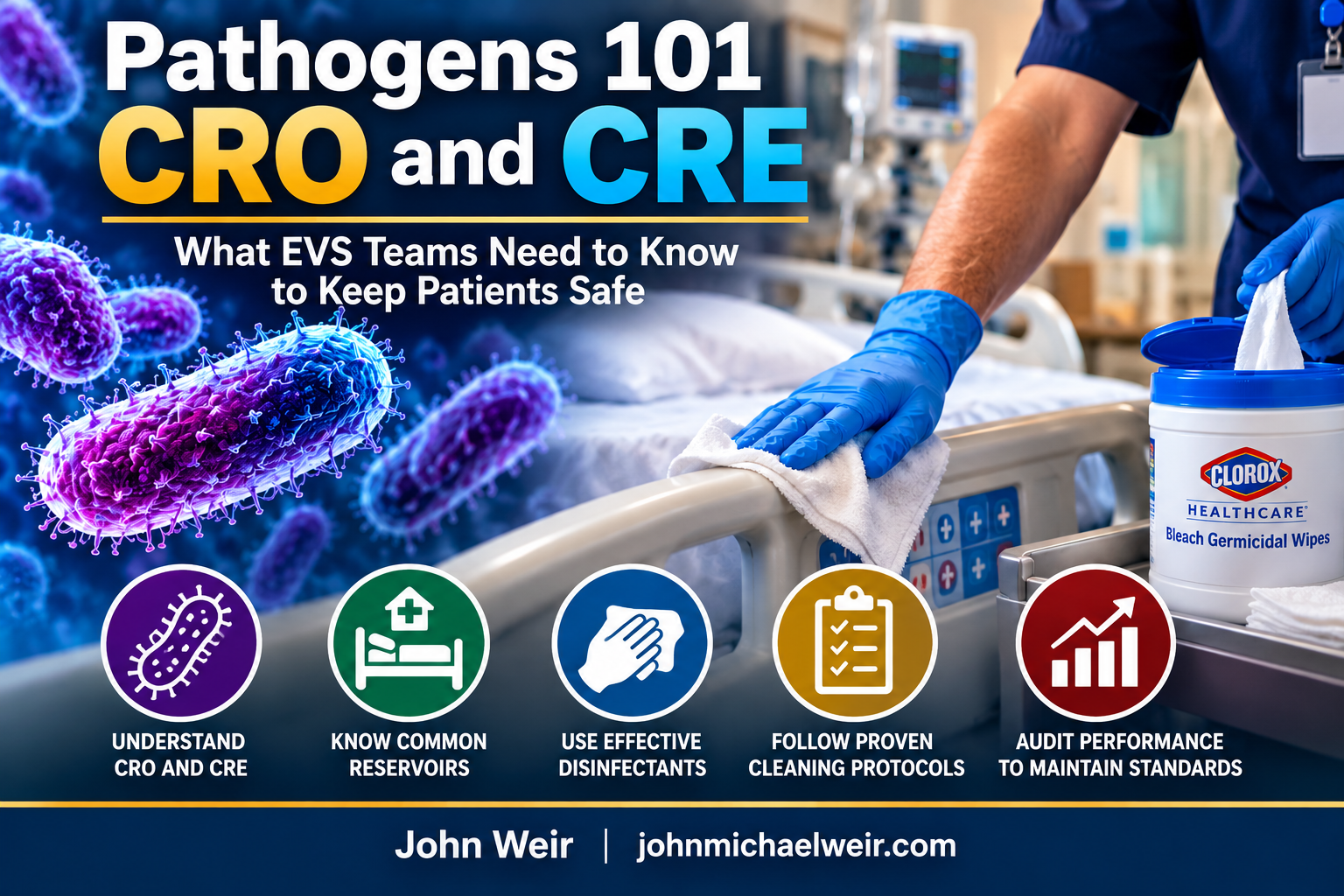
Carbapenem-resistant organisms (CRO) and Carbapenem-resistant Enterobacteriaceae (CRE) represent a significant challenge in modern hospital infection control because these bacteria survive on dry surfaces for weeks and resist the strongest antibiotics available. These pathogens spread primarily through contaminated hands and poorly cleaned equipment, making the role of Environmental Services (EVS) the first line of defense. Effective management of CRO and CRE pathogens depends on the consistent application of physical cleaning standards and the correct choice of disinfectants rather than relying on the hope that drugs will fix an outbreak after it starts.
Healthcare facilities face these threats daily. These organisms produce enzymes that break down carbapenems, which are often the last resort for treating severe infections. When these bacteria enter a patient room, they settle on high-touch surfaces like bed rails and call lights.
If the cleaning process is not methodical, the next patient in that room faces a direct risk of colonization. This article looks at how to identify these risks and the specific steps required to keep the environment safe.
The following areas are essential for maintaining a clean facility:
- The specific differences between CRO and CRE classifications.
- Common environmental reservoirs where these bacteria hide.
- Selecting disinfectants that actually kill resistant strains.
- Step-by-step cleaning protocols for high-risk patient areas.
- Methods for auditing staff performance to ensure standards remain high.
Understanding the biology of these pathogens is helpful, but the work happens at the bedside. A technician who understands why a specific contact time matters is more effective than one just following a list. Success in this area is found in the details of the daily shift.
A patient admitted for a routine surgery may enter the facility with a clear prognosis, yet the presence of CRO and CRE pathogens in the environment can lead to a life-threatening infection.
Carbapenem-resistant organisms (CRO) include any bacteria that have developed a defense against carbapenem antibiotics. These drugs are often the final option for physicians treating severe infections, and when they fail, the clinical options for the reader’s patients narrow significantly.
While CRO is a broad category, Carbapenem-resistant Enterobacteriaceae (CRE) is a specific subset of these organisms. They belong to a family of bacteria typically found in the human digestive tract, but they become dangerous when they migrate to other parts of the body or colonize environmental surfaces.
The Clinical Impact of Resistance
In a hospital setting, CRE commonly includes Klebsiella, E. coli, and Enterobacter species. These specific bacteria are often multidrug-resistant, meaning they do not just shrug off carbapenems; they frequently resist multiple classes of standard antibiotics simultaneously.
The risk is not uniform across the facility. Patients with prolonged hospital stays or those utilizing invasive devices, such as ventilators or urinary catheters, are at a much higher risk for colonization and subsequent infection.
This resistance is driven by specific mechanisms, such as the production of enzymes that neutralize the antibiotic before it can reach the bacteria. Because these organisms persist so effectively in the clinical environment, they represent a critical infection control challenge that goes beyond standard pharmacy interventions.
- Klebsiella species: Frequently associated with healthcare-acquired pneumonia and bloodstream infections.
- E. coli: A common cause of urinary tract infections that can become untreatable if carbapenem resistance is present.
- Enterobacter: Opportunistic pathogens that take advantage of weakened immune systems in intensive care units.
A single contaminated surface can change a patient’s outcome. If a surgical site becomes infected with a CRE strain, the recovery time doubles, and the complexity of care increases for every staff member involved.
The ability of these organisms to thrive in hospital environments makes them a constant threat to safety. When a patient is discharged, the biological footprint they leave behind remains a hazard for the next person placed in that bed.
Physical contact with contaminated objects serves as the primary engine for spreading CRO and CRE pathogens across a facility. These organisms do not require a complex vector to move; they simply wait on a surface for a hand or a piece of equipment to pick them up. Direct contact with colonized patients or their immediate environment remains the most frequent route of transmission.
Healthcare worker hands are a major factor in this process, often carrying the bacteria from one room to the next if sanitization steps are missed. These pathogens are remarkably hardy, surviving on dry surfaces for days or even weeks at a time. This persistence turns standard hospital items into long-term reservoirs.
- Bed rails and call buttons: Constant hand contact makes these high-risk touchpoints.
- Doorknobs and light switches: These serve as transition points for staff and visitors.
- Medical equipment: Portable monitors or IV pumps can carry bacteria between different patient bays.
- Remote controls: Often overlooked, these items frequently test positive for CRE even after a patient is discharged.
Pro tip: Treat every portable electronic device as a high-risk reservoir, as their textured surfaces and buttons often hide bioburden that standard quick wipes might miss.
I have seen cases where a room appears spotless, yet the bacteria remain tucked away in the small crevices of a TV remote or a bed rail. Studies consistently show these pathogens in patient rooms even after discharge, proving that standard cleaning often fails to hit every hidden reservoir. Relying on visual cleanliness is a mistake when dealing with microscopic threats that survive for weeks in the shadows.
Choosing Effective Disinfectants for Resistant Pathogens
Selecting a disinfectant for your facility requires verifying that the product carries an EPA-registered claim specifically targeting multidrug-resistant bacteria. You cannot assume a standard cleaner will work; instead, look for “Carbapenem-resistant Enterobacteriaceae” explicitly listed on the master label to ensure the chemistry is validated against these threats.
I have evaluated many products over the years, and I always start with the active ingredients. Common choices include quaternary ammonium compounds, hydrogen peroxide, and chlorine-based solutions, each offering different benefits for surface safety and kill speed. In my experience, hydrogen peroxide-based wipes are often the superior choice for high-turnover areas because they balance speed with low toxicity.
Contact time-the duration a surface must stay visibly wet-is the most frequent point of failure in a hospital. These times typically range from 1 to 10 minutes depending on the chemical and the specific CRO and CRE pathogens you are targeting. If a wipe dries in 60 seconds but the label requires two minutes, the disinfection process is incomplete and the bacteria may survive.
Take the hospital bed rail as a primary example. A technician should use a hydrogen peroxide-based wipe with a 1-minute contact time, ensuring the entire rail remains wet for the full duration. This is not just a suggestion; it is a clinical requirement for breaking the chain of infection. If staff “wipe and walk,” that is a habit that must be broken through better training on chemical mechanics.
Material compatibility is the final hurdle for any EVS lead. While bleach is highly effective, it may corrode expensive medical equipment or degrade plastics over time. Look for a buffered HealthCare Bleach Cleaner and Disinfectant. Clorox offers one many healthcare facilities use.
Always verify the dilution rates if your facility uses a dispensing system rather than pre-saturated wipes. An incorrect ratio renders the most expensive EPA-registered chemical useless against resistant organisms. Consistency in these technical details is what actually keeps a room safe for the next patient.
Standardized, methodical cleaning sequences in high-risk zones provide the most reliable defense against the transmission of CRO and CRE pathogens.
Daily cleaning of occupied rooms is necessary to reduce the overall bioburden that accumulates during a patient’s stay. I have seen that skipping even one day allows these organisms to establish a foothold on frequently touched items. Effective protocols require a top-to-bottom and cleanest-to-dirtiest workflow to ensure that gravity and physical friction work in favor of the technician.
Executing the Terminal Cleaning Sequence
Terminal cleaning after patient discharge is the most critical intervention for breaking the chain of infection. This process is more intensive than a daily touch-up because it involves every square inch of the patient environment. In my experience, the order of operations is what prevents re-contaminating a surface that was just sanitized.
Pro tip: Use dedicated cleaning equipment and microfiber cloths for isolation rooms to prevent cross-contamination between different areas of the facility.
The process follows a specific logic to ensure no area is missed and no bacteria are spread to clean zones. Technicians should use fresh cleaning cloths for each distinct zone within the room.
- Ceiling and High Surfaces – Dust and disinfect vents, light fixtures, and high wall sections first so any falling debris is captured by later steps.
- Walls and Mid-Level Fixtures – Work down the vertical surfaces, including television screens and wall-mounted equipment.
- Furniture and Equipment – Clean all sides of the bed frame, the mattress, and bedside tables using a methodical wipe-down pattern.
- Floor Cleaning or Disinfection – Finish the room by mopping from the far corner toward the exit to ensure the exit path remains the last area treated.
Consistency in these steps ensures that high-touch surfaces are disinfected at least daily, even when staffing levels are lean. When a technician follows a set path, they are less likely to overlook the undersides of chairs or the back of a bed crank where reservoirs often hide.
The physical removal of soil combined with the chemical action of the disinfectant creates a safe environment for the next admission. Maintaining these high standards requires more than just a checklist; it demands a culture of accountability and regular validation of the work performed.
A 25% annual turnover rate in Environmental Services (EVS) departments is not uncommon, making continuous training the only way to prevent safety gaps. Effective control of CRO and CRE pathogens depends on moving beyond one-time orientations to a system of ongoing competency validation. When a new hire starts or a protocol changes, the technician must demonstrate they can execute the task in a real-world setting, not just pass a written quiz.
- Weekly or bi-weekly audits in high-risk areas to identify drifting standards.
- Fluorescent marking gels applied to surfaces before cleaning to objectively verify physical removal.
- ATP meters to measure organic matter and bioluminescence on high-touch objects.
- Refresher training sessions triggered by new product introductions or specific audit failures.
I have seen facilities where the cleaning looks perfect to the naked eye, but fluorescent marking systems tell a different story. A supervisor might dab a small amount of gel on the underside of a bed rail or the back of a remote control. If that gel is still there after the room is turned over, the technician did not actually make physical contact with the surface.
This is not about catching people doing a bad job.
Objective data from these audits allows a lead to refine procedures based on what is actually happening during a shift. Feedback should be shared immediately so the team understands how their specific actions directly impact the facility’s bioburden. Regular validation ensures that the high standards required for multidrug-resistant organisms remain the baseline for every room, every day.
An EVS supervisor in a Seattle specialty center recently found that ATP meters provided the fastest way to show staff the difference between a quick wipe and a thorough disinfection. Data-driven cleaning turns a thankless task into a measurable science.
Conclusion
Consistent execution of cleaning protocols determines whether a healthcare facility successfully contains or spreads resistant organisms. Theoretical knowledge of microbiology does not stop transmission. The reader must ensure that staff members understand how to apply disinfectants correctly every time they enter a patient room.
Key Takeaways for Managing Resistance
- CRE and CRO strains survive on hard surfaces for weeks, making environmental reservoirs a primary source for healthcare-associated infections.
- Disinfectant selection must prioritize products with specific claims against carbapenem-resistant organisms to ensure the chemical actually breaks down the pathogen.
- High-touch surfaces like bed rails and call lights require standardized friction cleaning rather than simple spraying or misting.
- Regular audits of Environmental Services (EVS) workflows provide the only reliable data on whether staff members follow the established dwell times for chemicals.
Immediate Next Steps
You should review the current disinfectant Master Task List to verify that the chemicals in use have EPA-registered labels for CRO and CRE pathogens. After verification, managers can perform a floor walkthrough to observe if staff members allow surfaces to remain wet for the full required contact time. Real-world results come from these small, repeatable actions.
#InfectionPrevention #EnvironmentalServices #HealthcareCleaning #AntibioticResistance #PatientSafety #HospitalCleaning #CRE #InfectionControl #TerminalCleaning #HealthcareLeadership
