
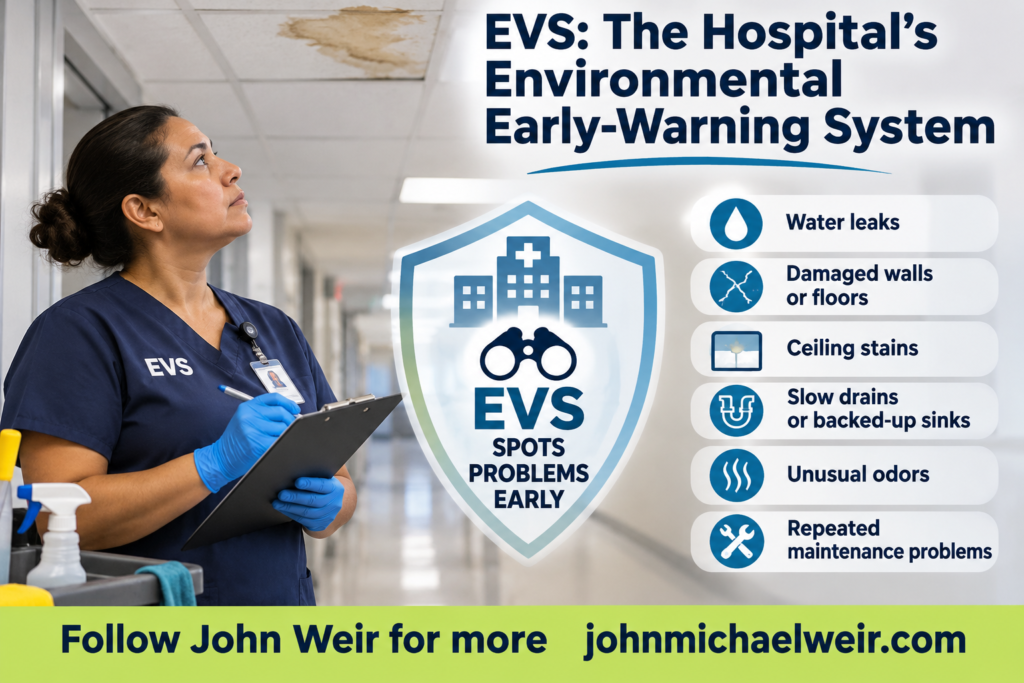
Environmental Services employees have one of the broadest views of the hospital environment. They move through the entire building, places other departments only see occasionally. That gives EVS a role beyond cleaning, because EVS staff are often the first to notice something is wrong.
A leaking pipe, a damaged ceiling tile, a strange odor, a backed-up sink, a blocked exit, sharps in ordinary waste, any of these can be spotted first by an EVS technician. These problems don’t belong to EVS to repair, but we are frequently the first to identify them.
Hospitals are complex environments. Airflow, water systems, building surfaces, equipment condition, waste handling, fire safety, and infection prevention all interact. A room can be cleaned correctly and still have an environmental problem. A damaged wall is no longer cleanable. A malfunctioning sink creates splash and drainage concerns. A door that won’t close affects security or room pressure. EVS staff need to recognize when something doesn’t look right and know what to do next.
Training should include recognition of conditions that deserve escalation: water leaks, damaged walls or floors, ceiling stains, slow drains, unusual odors, and repeated maintenance problems. The reporting path matters as much as the training itself. A technician should know whether a concern goes to a supervisor, into the work-order system, directly to Facilities, or gets treated as an immediate safety issue. Supervisors need to know when a routine work order isn’t enough.
EVS leadership rounding should go beyond clean floors and empty trash. Leaders should watch for damaged surfaces, moisture, unsafe storage, blocked pathways, and recurring maintenance issues. Frontline employees often know about these problems before leadership does. They know which sink backs up, which door won’t close, which cart keeps failing. EVS staff move through every area daily. They know what normal looks like, and they notice fast when something changes.
Environmental Services is part of the hospital’s environmental surveillance system. The goal is to teach employees what deserves escalation and give them a clear way to report what they see. A strong EVS department does more than clean the hospital. It catches environmental problems before they become safety events, infection control failures, regulatory findings, or operational crises.
#EnvironmentalServices #HospitalEnvironment #Leadership
Discover more from John Michael Weir CHESP CMIP T-CNACC
Subscribe to get the latest posts sent to your email.
