
PE.03.01.01: Life Safety Code
PE.03.01.01, one of the standards inside the Physical Environment (PE) chapter Accreditation 360 created in 2026, carries the requirements that used to live in the Life Safety (LS) chapter. Environmental Services does not own the Life Safety Code program and cannot repair much of what falls under it. EVS can still create a finding under it. EVS is also in every corridor, every storeroom, and every patient room daily, which makes it the department most likely to see a problem first.
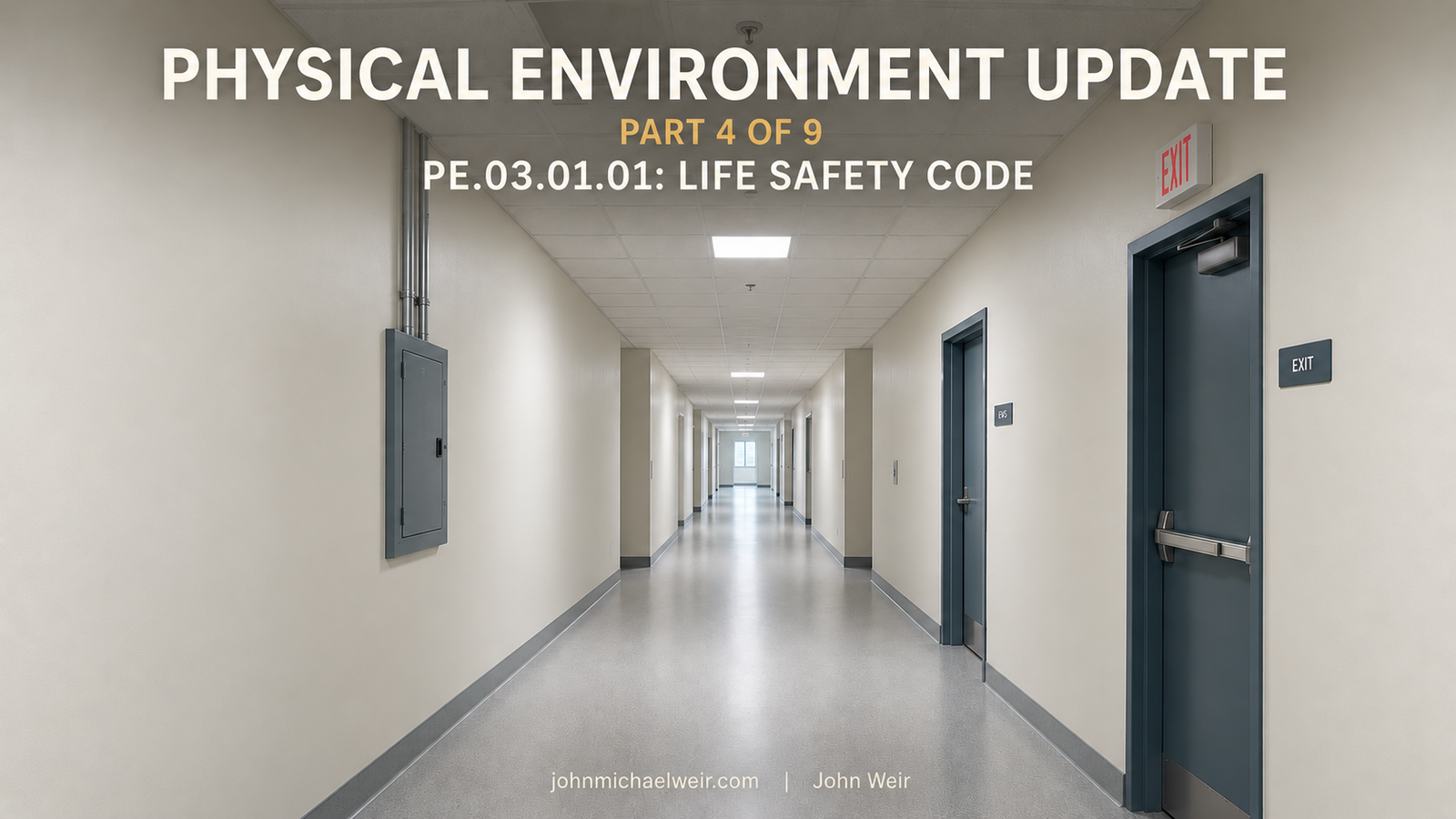
Corridors are where this gets tested every day. A hospital corridor has to hold eight feet of clear, unobstructed width. EVS could easily end up with carts on both sides, and what is left between them is not eight feet. That by itself is a finding. There is a second version of the same problem that is easier to miss. A technician cleaning a patient room parks the cart on the correct side, but not close to the door, so it sits farther out into the corridor than it needs to. That extra distance comes out of the clear width. A cart in use can project into the corridor as long as five feet remains clear. The same cart parked and unattended is storage. Storage gets no allowance. Floor care is the hardest case, because doing floor work in a patient room means a lot of things come into the hallway at once. All of it counts against the same eight feet.
Storerooms are the second place to watch. Supplies stacked too close to a sprinkler head keep it from working the way it was designed to. Many areas already carry the marking for this: a red line on the wall showing that nothing can be stored above that height, or a sign saying nothing on the top shelf. Those markings are not decoration. They apply in rooms EVS does not stock, patient supply rooms included, and supplies above the line are worth reporting even when they belong to another department.
Then there is the ceiling. Water stains on ceiling tiles turn up regularly, and they only get addressed when someone notices them and reports them. Many people do not look up. EVS is trained to. Dust on a ceiling vent, a ceiling tile out of place, a stain that was not there last week: those get caught because looking up is part of how the work is done.
The same habit picks up the rest of what a surveyor looks for. Fire doors propped open. Storage stacked against a fire door. An unsealed penetration in a wall. Storage in an electrical room. A fire extinguisher or an alarm pull station with something parked in front of it. Some of that belongs to Facilities to repair. EVS does not have to own the repair to own the observation.
A corridor cannot be prepared for a survey. It is clear on a random Tuesday afternoon or it is not, and a surveyor walking the unit sees the version that exists when nobody is expecting them. That is what Accreditation 360’s shift toward observation is built to find: not the policy describing corridor storage, but the corridor itself. The department standing in that corridor all day decides what a surveyor finds there.
References:
The Joint Commission. Physical Environment (PE) chapter, PE.03.01.01, effective January 1, 2026. jointcommission.org
The Joint Commission. Commonly identified life safety problems, physical environment. jointcommission.org
#HealthcareLeadership #EnvironmentalServices #HospitalOperations #PatientSafety #QualityImprovement #JointCommission #Compliance #LifeSafety
