
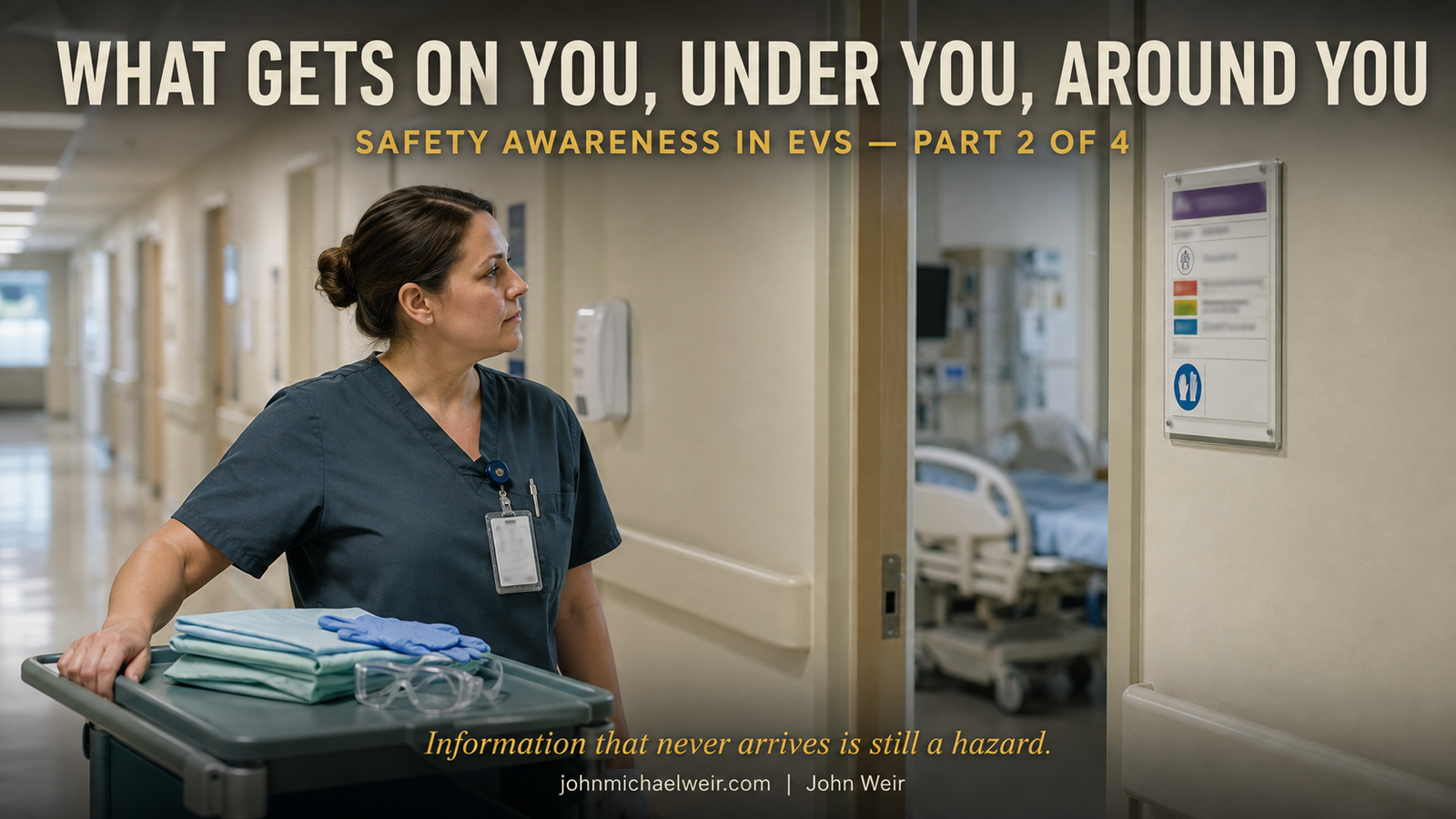
Safety Awareness in EVS, Part 2 of 4: What Gets On You, Under You, Around You
I went deep into safety research for Environmental Services this year. What I found is that EVS doesn’t face one hazardous task. A shift moves through nearly every hazardous environment the hospital has, one after another, and most of those hazards go unnoticed simply because the team walks past them every day. I’m presenting what I found in four parts: the hazards you carry in your own hands, what gets on you or under you, the danger that comes from people instead of tasks, and the systems that catch it all before someone gets hurt. This is Part 2 of 4.
Part 1 covered what you carry and lift. This part covers what you’re exposed to, and how often the exposure isn’t the obvious kind.
Blood and body fluid exposure is sometimes dramatic, a spill in the ED, and sometimes it isn’t. Contaminated linen. Leaking waste. Splash during bathroom cleaning that reaches your face without you noticing it happened. Washington L&I counts both contaminated sharps and splash into the eyes, nose, mouth, or broken skin as bloodborne pathogen exposure. That’s why PPE decisions have to follow the task. Standard Precautions apply based on anticipated exposure, whether or not anyone’s actually confirmed an infection. One task in a room might need gloves. Another task in the same room might need eye protection or a gown. The room doesn’t tell you which. The task does.
Overhead work is its own blind spot. An eye injury doesn’t have to come from a dramatic chemical splash. Reach up to clean a vent, a ledge, a light fixture, a high horizontal surface, and dust and debris fall straight toward your face. You’re already wearing gloves because gloves are part of every shift. Safety glasses probably haven’t crossed anyone’s mind, because the room looks the same as it always does. It isn’t. If debris can fall toward your eyes, that’s a reach for eye protection, not a maybe.
Chemical dilution systems have taken a lot of the guesswork out of mixing solutions, and that’s progress. It hasn’t made the exposure disappear. A hose fails, or a connection loosens. Concentrate splashes while you’re changing a container. OSHA is specific that disinfectants, detergents, and concentrated soaps can cause skin reactions. Mixing incompatible products creates a hazard too. This is why the Hazard Communication Standard requires you to know what you’re working with. You should be able to answer, without pausing, what PPE this product needs. You need to know what to do after skin or eye exposure, where the eyewash is, where the SDS lives, and that you never mix chemicals outside an approved process.
Slips, trips, and falls might not be the injury you see most, but the setup for one is always there. Wet floors are the job. Add a cord, a piece of equipment, damaged flooring, a spill nobody flagged yet, a load blocking your sightline, and the odds go up. OSHA calls out wet floors and clutter specifically as hospital housekeeping hazards. There’s an irony in it: you’re often the one responsible for fixing the exact hazard that could put you on the floor. That’s one more reason speed can’t be the only thing anyone measures.
Last is the exposure you can’t see coming because nobody told you it was there. In EVS we walk into the same patient environments as nurses, therapists, and physicians. Pathogens don’t check job titles. The risk can be contact, droplet, airborne, bloodborne, or just environmental, depending on what’s actually in that room. The real safety issue isn’t the pathogen. It’s communication. You should never find out a room needed special precautions after you’ve already cleaned it. The system has to tell you the precautions, the PPE, and whether respiratory protection applies. It has to tell you whether the room’s actually cleared for release, before you walk in, not after. Every failure here traces back to the same thing: information that sat in one department and never made it to the person doing the work.
#Safety #EnvironmentalServices #PPE
References:
Washington State Department of Labor & Industries. Bloodborne Pathogens. lni.wa.gov/safety-health/safety-topics/topics/bloodborne-pathogens
Washington State Department of Labor & Industries. Standard Precautions in Healthcare Settings. lni.wa.gov/safety-health/safety-topics/topics/standard-precautions-in-healthcare-settings
U.S. Occupational Safety and Health Administration. eTool: Hospitals, Housekeeping, Hazardous Chemicals. osha.gov/etools/hospitals/housekeeping/hazardous-chemicals
U.S. Occupational Safety and Health Administration. eTool: Hospitals, Housekeeping, Slips/Trips/Falls. osha.gov/etools/hospitals/housekeeping/slips-trips-falls
