
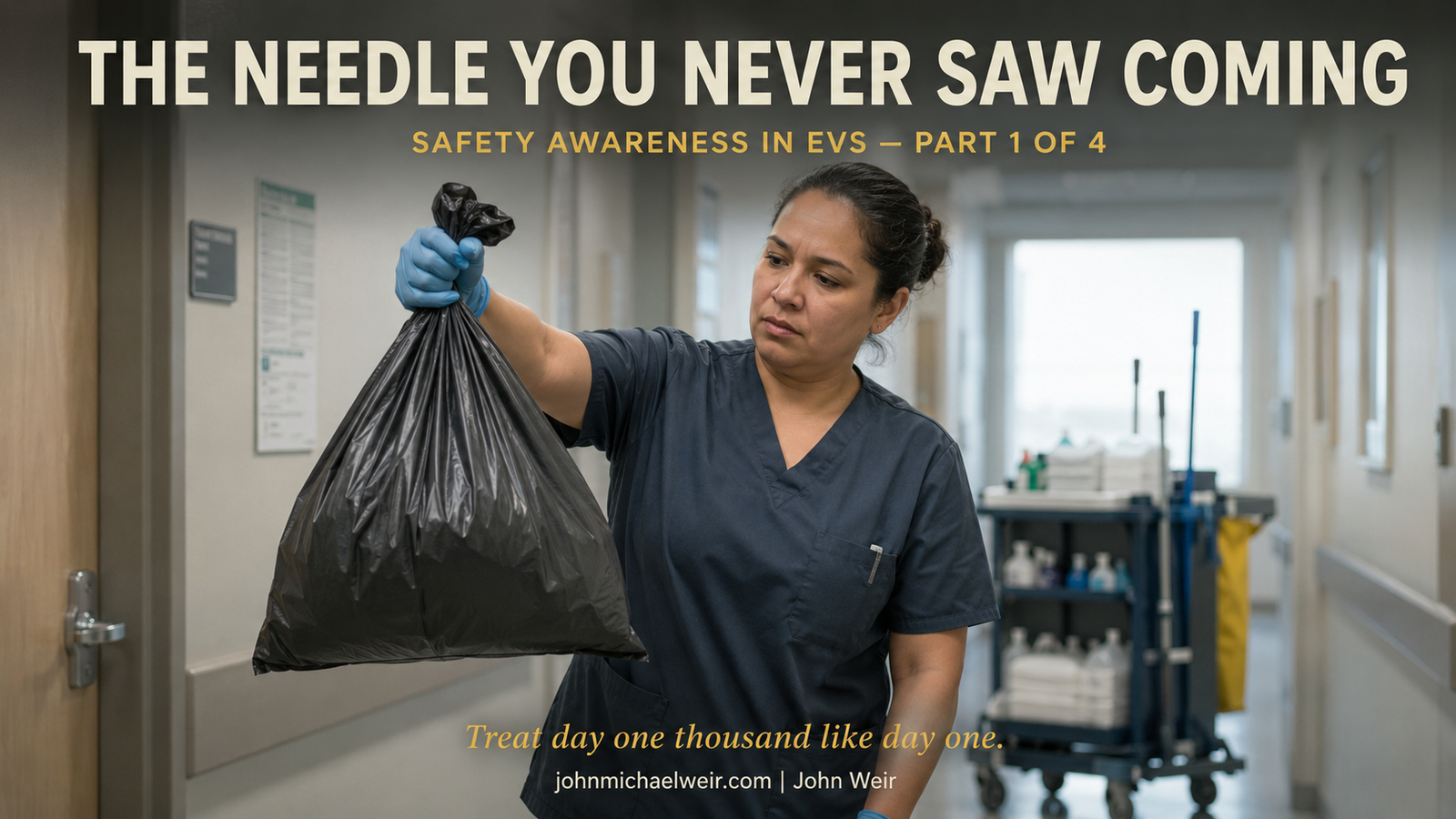
Safety Awareness in EVS, Part 1 of 4: The Needle You Never Saw Coming
I went deep into safety research for Environmental Services this year. What I found is that EVS doesn’t face one hazardous task. A shift moves through nearly every hazardous environment the hospital has, one after another, and most of those hazards go unnoticed simply because the team walks past them every day. I’m presenting what I found in four parts: the hazards you carry in your own hands, what gets on you or under you, the danger that comes from people instead of tasks, and the systems that catch it all before someone gets hurt. This is Part 1 of 4.
I went deep into safety research for Environmental Services this year. What I found is that EVS doesn’t face one hazardous task. A shift moves through nearly every hazardous environment the hospital has, one after another, and most of those hazards go unnoticed simply because the team walks past them every day. I’m presenting what I found in four parts: the hazards you carry in your own hands, what gets on you or under you, the danger that comes from people instead of tasks, and the systems that catch it all before someone gets hurt. This is Part 1 of 4.
An EVS shift moves through every part of the hospital. Patient rooms, the ED, behavioral health, procedural areas, loading docks, linen and waste rooms. That range is what makes the work matter. It’s also why one safety checklist can’t cover it. In a single shift a tech can handle contaminated waste, push an overloaded cart, lift wet linen, reach overhead, and clean up blood or body fluids, all before lunch. OSHA and Washington L&I name the same categories for this work every time: infectious exposure, chemicals, slips and falls, and musculoskeletal injury from lifting and awkward posture. None of that is a knowledge gap. It’s a familiarity problem. A hazard you walk past every day stops registering as a hazard.
A needle gets dropped in regular trash instead of a sharp’s container. The tech lifts the bag, bumps it against the body, and the needle pushes through the plastic. Or a sharp gets wrapped inside linen instead of pulled and reported. Washington L&I specifically names taking out trash that may contain needles and handling laundry that may contain sharps as bloodborne pathogen exposure risks. A needlestick isn’t just a puncture. It’s a possible hepatitis B, hepatitis C, or HIV exposure. The rule that actually protects you: never assume a bag holds only what belongs in it. Don’t squeeze it smaller. Don’t bump soiled linen against your body. Don’t reach into a container blind. And if clinical staff keep discarding sharps wrong, that’s a hospital safety problem to escalate, not something EVS is supposed to quietly absorb.
The next one builds slower. A cart wheel goes bad. It still rolls, so it stays in service. Then it gets loaded with linen, supplies, chemicals, waste, and what used to take moderate effort now takes leaning, twisting, and bracing the shoulders on every corner, dozens of times a shift. OSHA names pushing and pulling heavy carts, moving beds, lifting mattresses, and working in awkward positions as real ergonomic hazards in hospital housekeeping, not soft complaints. The injury shows up slowly too. Shoulder first, then the lower back, then somebody says that’s just housekeeping. It isn’t. Most of the time the fix costs less than one missed workday. Replace the caster.
Weight catches people the same way. A trash or linen bag looks like an ordinary load. It isn’t always. Wet linen, more than one bag’s worth, crammed into one, and the tech only finds out how heavy it is after already committing to the lift. That’s exactly the kind of sudden, unpredictable load that strains a back or shoulder. You’re allowed to put it down. Get help, split the load, use the cart, and escalate it if the same area keeps overloading bags. Telling a team to lift safely while handing them unpredictable 50- and 60-pound bags isn’t a safety program.
Needles aren’t the only sharp thing hiding in a room. Broken glass ends up in ordinary trash. Damaged equipment exposes metal edges. Blades and lancets turn up where they shouldn’t. The risk climbs the moment you reach somewhere you can’t see it: under a bed, behind a toilet, inside a receptacle, between furniture. Look before you reach. Gloves cut down exposure. They don’t protect you from cuts.
None of this calls for new training material. It calls for treating a bag, a cart, and a blind reach the same way on day one thousand as you did on day one.
References:
Washington State Department of Labor & Industries. Bloodborne Pathogens. lni.wa.gov/safety-health/safety-topics/topics/bloodborne-pathogens
U.S. Occupational Safety and Health Administration. eTool: Hospitals, Housekeeping. osha.gov/etools/hospitals/housekeeping
U.S. Occupational Safety and Health Administration. eTool: Hospitals, Housekeeping, Work-Related Musculoskeletal Disorders. osha.gov/etools/hospitals/housekeeping/work-related-musculoskeletal-disorders
Centers for Disease Control and Prevention, National Institute for Occupational Safety and Health. Sharps Disposal and Needlestick Injury Prevention. cdc.gov/niosh
